
TT-Could you please introduce yourself and the organization that you work for?
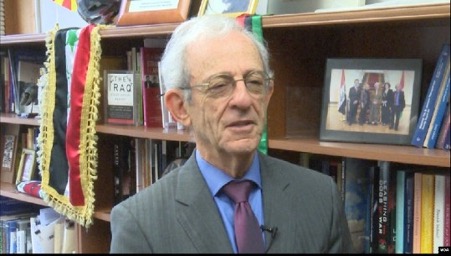
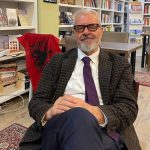
AA-my name is Alex Anderson, director of the Kosovo project of the ICC. The ICC is an international non-profit organization composed mainly of former statesmen and state women. We work through field based analysis on conflict situations, produce reports that reflect what is going on in the various fields of conflict. For instance we have an office here in the Balkans, a full office in Kosovo, Prishtina and I have a colleague who works in Belgrade, we have thankfully phased out a number of other offices which I think its good news for the Balkans. We work in a variety of other conflict areas.
TT- So when you move out, that is good news for the country?
AA-Yes, definitely. (laughs) Also, it is an organization with finite resources. If we want to open up an office in an area where either a crisis has just blown up or where its expected. Somewhere like East Asia where we have potential for a crisis. For example some years ago we opened up in Seoul, South Korea. From that office we cover the Korean issue, but also the wider region, the relationships between Japan, Korea and Taiwan. And this is just an example of what we do. And of course when we do open up we have to realize that we are a $12 million, we are not certainly going to sprout another few million dollars , its always a job maintaining that, so we have to close up where we need to close up. For example we are asking ourselves now, will we need to produce another report on Macedonia, maybe we won’t but we’ll see.
TT- Coming back to your discussion today, I think it was one of the most pragmatic ones. You took a realistic approach upon the violence might erupt and that Kosovo is still very fragile and brittle and there are reasons to expect unrest in Mitrovica. Does the ICC have a reasonable prediction that there will be a crisis in Kosovo if the status is proclaimed whether its independence, conditional independence or what have you?
AA- Well, we don’t want to be a Cassandra just for the sake of it. And also I think its important to reflect that as an organization with an established field presence in Kosovo and a voice that is very listened to, for a small place like Kosovo which is concentrating day by day so feverishly on the issue of status that some sort of prediction form us can actually tip the balance.
TT-Like a self fulfilling prophecy?
AA- Yes that sort of thing can very easily happen. Looking back lets say over the last couple of years there have been situations when we thought the risk of violence was very high. For example the tension in the lead up to the indictment of former Prime Minister Ramush Haradinaj was very real. There was a very real risk that some of the armed groups that were basically the KLA back in 1999, to which younger generations attached themselves and the younger generation is more militant than the KLA generation which is already 8 years older. That situation could have gotten completely out of control especially in West Kosovo. It didn’t thankfully. So we have had times when there was a very high risk of something going very wrong and we came through with Kosovo Albanian society learning some very important lessons abut itself in the process. However if you look back a bit further into the March riots of 2004 it was such a shock to everybody including some of the people who were charged for inciting the groups. For instance we talked to veteran leaders who told us “We have tried to incite people to come demonstrate all the time but they don’t and then there I suddenly 5000 of them behind me and 5000 in the front and they are out of control and they start to burn churches.” So I have heard recently one Kosovo politician wrap it up very nicely: “In this country to be there is no number between 0 and 100. Albanians are either loyal, orderly patient or not and it’s very difficult to gage between these two polarities so therefore the political class in Kosovo is very nervous about its own population. It does not quite understand the population. It feels it has to keep making promises about Kosovo status. As I was saying today Kosovo’s top leaders have got into addressing their own population what is going to come, what sort of independence and when it is going to come and maybe in a too-heightened and artificial way they have taken a statement of aspiration from the contact group and converted into a promise and that is dangerous, raised expectations too high. They have done it also to try and head off but in the process, I think, they have shown up some of their lacks. I think this is a political generation that is much focused on the wrapping up of the businesses of the war, on proclaiming things then actually doing the job of managing and this is one of the problems that Kosovo has got. I think it has got a political generation that does not really have a managerial essence. One looks rather hopefully for a younger more technocratic generation though I do not see presently room for them. Now the atmosphere in which politics is done may undergo quite a drastic change come status, Kosovo’s political system is going through some change especially the LDK. Once the independence issue is going to be removed, settled, done by hopefully some time not too far next year. This will get into the context of politics. It will become much more about the everyday bread-and -butter. Long term, there needs to be an injection of vision in Kosovo’s politics. Kosovo Albanians’ imagination tends to run out at the moment of independence, beyond that there is just a blinding white light, no pragmatic plan on what do we do in 2008 and moving forward in 2009.
TT- Well taking a lead from one of the things mentioned in the conclusion as “economics above politics”, there was mention of economic strategies and issues. How do you see this development? From being a pure 100% political sensitive issue into a more economic problem?
AA- I hope we can get to that soon. But we have to deal with status first. For example one of the panelists was regretting the way that UNISEK and Ahtisaari handled the economic negotiations about the mines of lignite. Now that is very difficult without status. Another example is in Mitrovica, where we have a fellow NGO, the European Stability Initiative that claim that we have to sort out the economy first and that this in itself will unite the two halves of the city. I don’t think either of those two views are fully realistic. You have to sort out basic political questions first. In the forming of new countries it is always the national issue first, the economic issue, the figures and numbers later.
TT- One of the very interesting scenarios that you pointed out for discussion was a situation in which the Security Council does not completely endorse the Ahtisaari plan. What if we have a situation similar to Iraq, the US going forward without a UN mandate? Do you think that could happen?
AA- These are very last resort solutions. Let’s hope that we don’t have to face them. Lets work towards having a situation in which the Security Council can speak with 1 voice, can provide an authoritative foundation for the creation of the new Kosovo state. As it looks now, it is unlikely that the Security Council will say the word “independence” in its resolution. What the resolution should do in the minimum is to wind up UNMIK, endorse both Ahtisaari package of whatever has been agreed on minority rights, decentralization, protection of Serbian Orthodox sites, etc and of course endorse the new international presence, the purpose of which should be ultimately to try to monitor and guide Kosovo towards normal statehood within the EU. You have to have a goal for an international presence and I think the EU goal is the only feasible and credible one to get Kosovo going. But as far as possible plan B-s and C-s are concerned, these are very second best solutions. It will be much more difficult and it will be difficult in any case to secure the semidetached Serb north of Kosovo in any case even with consensus and authority of the UN Security Council to define and independent Kosovo within its present borders. And of course that will be much more difficult if you don’t have a full consensus about the Kosovo solution. The US of course is looking very much to Europe and the European Union for taking the responsibility of Kosovo post-status. It would serve no purpose for the US to simply unilaterally step in, the European is going to spatter all apart unable to have consensus within itself to provide the EU mechanisms with which to secure Kosovo post-status.
Kosovo towards normal statehood within the EU

Change font size:
Recommended Articles
Latest from Op-Ed
It’s not just the verdict that is unjust
Change font size: - + Reset By Daniel Serwer Tirana Times, September 17, 2026 – The Kosovo Specialist Chambers’ has convicted former President Hashim Thaci and three other Kosovo Liberation Army leaders of war

September 16: Justice, History and Kosovo’s Statehood
Change font size: - + Reset By Sylë Ukshini Tirana Times, Sept. 15, 2026 – The September 16 judgment at the Kosovo Specialist Chambers in the trial of former Kosovo President Hashim

A Government Memorandum and Some Unanswered Economic Questions
Change font size: - + Reset By Zef Preçi Tirana Times, September 14, 2026 – According to media reports in recent days, Albania and the U.S. company Argent LNG have signed a
The Re-emergence of Terrorism and the Threat to the Global Economy
Change font size: - + Reset by Albert Rakipi, PhD Tirana Times, September 11, 2026 – The increasingly visible re-emergence of international terrorism against the backdrop of the major conflict unfolding in
A Quarter Century Since Ohrid: The Agreement That Gave North Macedonia Its Future
Change font size: - + Reset by Ferit Hoxha, Minister for Europe and Foreign Affairs of Albania Tirana Times, August 12, 2026 – There are moments in history when a country’s future is