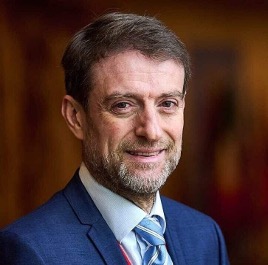
“Once again, it is clear that corruption, crime rate and lack of legal security are considered the most emergency issues for enterprises. Last but not least, is that the investment opportunities in Albania continue remaining little known to the German economy,” says German ambassador to Albania Hellmut Hoffmann.
TIRANA, April 29 – Legal security, fight against corruption and crime, transparency of public procurement, predictability of economic policies and adequacy of vocational training are considered the most problematic factors for doing business in Albania by German-Albanian enterprises operating in Albania, according to a survey conducted by the German Association of Industry and Trade (DIHA) in Albania.
Speaking at the launch of the survey this week, German ambassador to Albania Hellmut Hoffmann said German-Albanian enterprises operating in Albania estimate the situation of the Albanian economy somehow better compared to 2013 and are rather more optimistic about future prospects.
“Once again, it is clear that corruption, crime rate and lack of legal security are considered the most emergency issues for enterprises. Last but not least, is that the investment opportunities in Albania continue remaining little known to the German economy,” he added.
Speaking about DIHA’s proposals to improve the business climate in Albania, the German ambassador said the Albanian government had in the past few weeks undertaken initiatives and made steps forward by putting on track the legal changes.
Last January, representatives of German companies operating in Albania said the Albanian government should focus on public relations, the legal framework, market entry, taxation and customs, financial relations with companies and education to further improve the business climate and the country’s attractiveness to foreign investors.
The results of the fifth business survey by DIHA shows that Albania continues remaining one of the least attractive destinations in central and eastern Europe along with Ukraine, Kosovo and Belarus.
However, an overwhelming majority of 86 percent of German enterprises say they would still invest in Albania if they were given the opportunity once again.
Some 62 percent of businesses consider the current economic situation bad, down from 64 percent in 2013 and 36 percent in 2012.
Expectations for 2014 appear slightly more optimistic with 23 percent expecting better economic prospects and 56 percent expecting the situation to remain unchanged.
Some 36 percent of surveyed businesses describe their own business situation in 2014 as good, 51 percent as satisfying and 13 percent as worse.
Some 41 percent of businesses expect their income to increase in 2014 but only around a quarter expect investments to increase.
Only around 28 percent of companies say they will increase staff in 2014, while 8 percent plan to cut staff.
The adoption of a progressive taxation system on personal income and corporate income has made the fiscal burden one of the top seven concerns for the German-Albanian business community. Since January 2014, the corporate income tax on medium-sized and big enterprises has increased to 15 percent, up from 10 percent under the previous flat tax regime.
Labour costs, productivity, motivation and qualification of employees, adequacy of higher education, legal flexibility of employment, quality and availability of local suppliers, availability of skilled staff, payment behaviour, political and social stability and infrastructure are perceived the top ten factors for doing business in Albania.
The survey on the business environment included 1,435 companies from 16 central and eastern European countries.
The existence of a reliable structural and legal framework and positive experience by foreign companies operating in Albania would further increase foreign direct investment in Albania, said DIHA last January in a letter to the Albanian government proposing 20 steps to improve the business climate in Albania.
German Ambassador to Tirana Hellmut Hoffmann has earlier noted the Albanian authorities should send the right signals for an increase in reliability among foreign companies already operating in Albania to have more German companies interested in doing business in Albania.
German companies are already present in Albania operating in several key sectors.
The biggest German investments in Albania can be found in the Tirana International Airport, the Durres Port, the Tirana Business Park, and the expected TAP pipeline.
German-owned ProCredit bank also plays an important role, offering loans to SMEs and most recently to renewable energy projects.
German companies in Albania are also actively engaged in other important sectors such as construction, production, retail sales and logistics. Tirana Business Park, a Euro 100 million investment led by Germany’s Lindner Group, is being built outside Tirana.
Rofix, which produces construction materials and Profarma pharmaceutical company which has been acquired by a German consortium, are some other successful German-run companies in Albania.
Germany’s was the sixth top destination of Albanian exports in 2012 and the fourth main partner for imports. Bank of Albania data show Albania imported Euro 228 million of goods of from Germany in 2012 and exported Euro 48 million, mainly garment and medicinal plants.
German foreign direct investment in Albania climbed to 84 million euros in 2012, ranking Germany among one of the top ten investors in Albania, according to Bank of Albania data.
The German development cooperation with Albania was launched in 1988, just before the collapse of the communist regime. Since then, the German federal government has made available around 1 billion euros for financial cooperation projects throughout the country. The focus is on improving municipal infrastructure and energy supply and strengthening the financial sector.