TIRANA, March 14 – Albania has made dealing with construction permits much easier in the past one and half years after it launched an electronic platform, but local government units issuing them fail to meet review and approval deadlines, says the Albania Investment Council, a government advisory body.
“Since its launch on September 1, 2016 as a single tool for the application, review and approval of construction permits, the e-Permits platform has disciplined the review of applications from the point of view of deadlines for the applicants and institutions, also reducing operational costs. Meanwhile, completion of the review procedures within 60 calendar days remains a challenge for the municipalities’ administrations,” says the Albania Investment Council.
The advisory body serving as a linking bridge between the business community and the government, blames the situation on the poor capacities of the new larger municipalities following a 2015 administrative and territorial reform that cut the number of local government units to 61 municipalities, down from a previous 373 communes and municipalities.
“Application of such novelty has not been easy taking into consideration the limited capacities of some municipalities or special institutions, the difficulties of their administrations to abandon the paperwork tradition and documentation or to get informed in time on the new concepts of the legislation such as the principle of silence as approval which is not respected in all the cases, in particular when municipalities do not receive a response from the Immovable Property Registration Offices on the situation of properties,” says the Investment Council.
Dealing with construction permits was one of Albania’s worst indicators in doing business until 2016 and ranked the country 106th out of 190 economies in the 2018 Doing Business report. The flagship World Bank report shows it takes 17 procedures, 220 days and an estimated cost of 3.5 percent of the warehouse value to get a construction permit in Albania.
The number of construction permits issued by local government units hit a six-year high of 819 in 2017, almost double compared to 2016, hinting a recovery in the long-ailing sector following a standstill from 2012 to 2015 when a combined total of only about 950 permits were issued following a construction boom ending in 2011 in the aftermath of the global financial crisis.
The value of construction permits issued in 2017, most of which destined for residential buildings, is estimated at about 49 billion lek (€370 million), according to state statistical institute, INSTAT. Among the permits, there were also 53 hotels with an investment value of about 2.9 billion lek (€22 million).
The increase in construction permits also comes amid tighter measures against illegal constructions and at a time when Albania is concluding a legalization process on dozens of thousands of illegal buildings in the pre-2014 period.
The number of construction permits saw a sharp decline from 2012 to 2016 dropping to a few hundred down from more than 1,000 annually before 2011.
INSTAT data shows the number of construction permits rose to 455 in 2016, up from a mere 170 in 2015, 360 in 2013, 1,604 in 2011 and 1,492 in 2008 just before the onset of the global financial crisis when the construction industry was at its peak level.
As elsewhere in the region, construction was the hardest-hit sector in Albania’s economy during the post-crisis period, losing its position as one of the key drivers in the pre-crisis years and cutting thousands of jobs.
However, the construction industry has gained momentum in the past few years mainly thanks to some ongoing major energy-related projects that are set to complete their investment stage this year and a new boom in construction especially in Tirana.
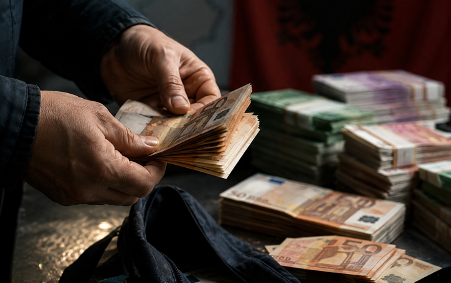
The main opposition Democratic Party claims the construction boom is a result of drug proceeds being laundered into high-rises and apartments blocks from the peak 2016 cannabis cultivation and ongoing heroin and cocaine trafficking. The allegations have been rejected by the ruling Socialists who say the rising construction industry is a result of a recovery in credit.
While demand for new apartments in Tirana remains satisfactory, tight lending standards and poor demand remain a key barrier in other Albanian regions where thousands of apartments remain unsold especially in Durres and Vlora.
Developers have recently shifted to building tourist resorts and villages in coastal areas as tourism rapidly grows and the government is offering tax incentives for luxury four-and-five star accommodation units.