 TIRANA, April 24 – Only few of the 27 principles of the Council of Europe’s Indicators for media in a democracy have been consistently implemented in Albania, a report published by the Albanian Media Institute showed this week.
While Albanian legislation has been mostly harmonized to European regulation, the enforcement of the principles does not always measure up to their standards due to incomplete or inconsistent legal regulation, weakness of institutions that enforce them, as well as the influence of other economic or political actors, along with the economic and social status of journalists, says the report.
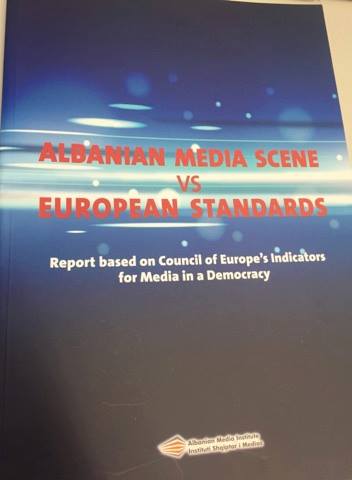
Financially supported by the Embassy of the Netherlands in Tirana, the “Albanian media scene vs. European Standards” report is an assessment of the media situation in the country based on the Council of Europe’s Indicators for media in a democracy.
Dewi van de Weerd, the Ambassador of the Kingdom of the Netherlands to Albania, stressed the importance of free media in a democracy and the support that the Netherlands provides to civil society and free media.
“Journalists should be able to speak their minds freely and have time and space to investigate into stories that are important to the public,” she states in the foreword to the study. Addressing journalists during the launch ceremony, she said that such studies could be periodical, highlighting the importance of regular assessment of media freedom in the country.
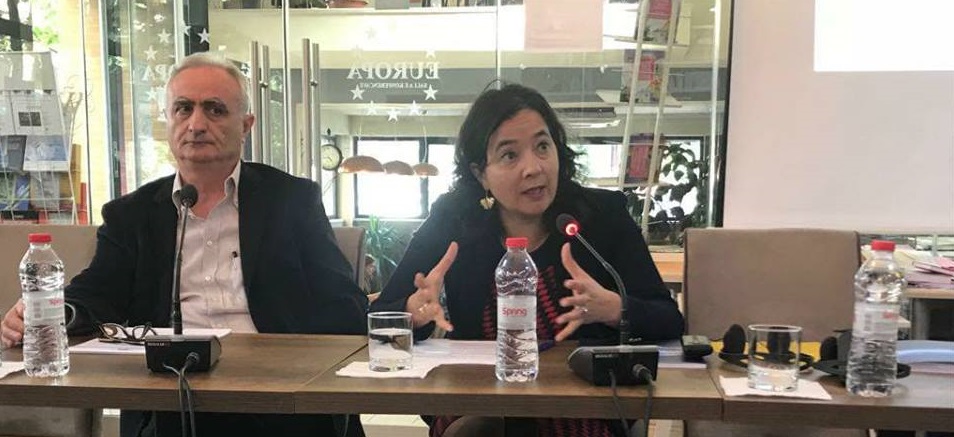
Remzi Lani, the director of the Albanian Media Institute, said that Albania lacks a cohesive media strategy or policy and such reports could be useful in adopting a more research-based policy approach for overall approach to media.
The report’s main findings were introduced by Ilda Londo, a researcher at the Albanian Media Institute. The contributors to the study, including Dorian Matlija of Respublica, Aleksander à‡ipa of the Union of Albanian Journalists, Aleksandra Bogdani of BIRN Albania, Rrapo Zguri of the Department of Journalism at the University of Tirana and Blendi Salaj of the Albanian Media Council, also elaborated on the report.
The report finds that almost all standards of the principles of the Council of Europe are relatively guaranteed by legislation, but the practice is not always true to these legal guarantees. The explanations for this deviation are complex and are related to the dynamics of the media system, as well as to the broader social and political context in the country. For some of the indicators analysed, the main problem is incomplete legislation that has not been fully harmonised with European law, as in the case of the balancing act between the protection of state secret and freedom of information, in protecting confidentiality of sources of information, and in the enforcement of equal access for the media to distribution channels. Sometimes the regulations lack the mechanisms necessary to guarantee their implementation, such as sanctions, as in the case of the openness of authorities to all media. Despite the good work done by independent public authorities in this field, such as Commissioner on Information and Data Protection, the practice still is not in line with the high standards set by the law.
In other media areas, the main problem according to the study is that regulation is not fully implemented, or has been implemented in a selective manner and sometimes also contrary to the original intent of the law. The main reason seems to be the priority of vested interests of particular actors, such as politics or business, over the spirit of implementing legislation to the letter. Part of the problem for this lies with the judiciary, currently enjoying the lowest trust in public, which shows it is not always consistent and not necessarily guided by ECHR standards with regard to the principles of legal protection of the right to freedom of expression and freedom to criticise state officials. The mix of legal shortcomings, weak institutions, lack of tradition, and also external economic and political influences mainly explain the problems in fulfilling European standards with regard the independence and efficiency of the regulator as well as public broadcaster’s independence and editorial autonomy.
Finally, the report highlights that the media system in Albania is particularly lagging behind compared to European standards when it comes to its economic model and trends, the lack of guarantees for protection of editorial independence in the face of economic pressure, and the poor organization capabilities of journalists to protect their rights. The reasons for this are to be found partly in inadequate legislation, as in the case of transparency of ownership and prevention of monopolies, neutrality of state’s financial assistance, as well as in the failure to offer a legal solution and favour market conditions that would contribute to achieving independence of editorial policy.