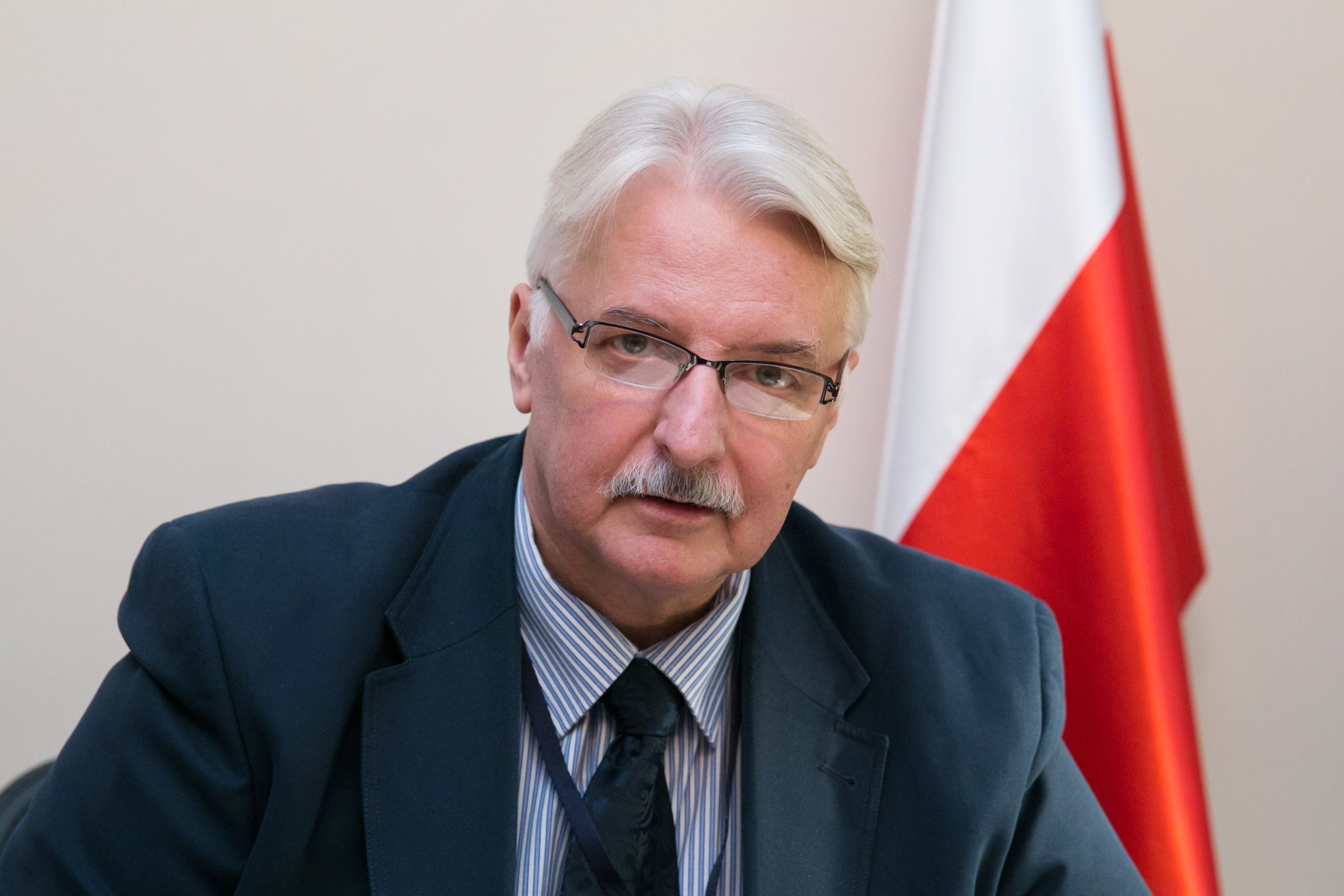
In an interview with Alba à‡ela, the deputy director at the Albanian Institute for International Studies (AIIS), Polish Foreign Minister Witold Waszczykowski talks about Albania’s integration process as well as common challanges facing both countries as NATO allies
Minister Waszczykowski welcome to Albania. We would like to start by asking which is the purpose of this visit that you are holding in Albania right now?
First of all let me express once again our support for the European integration process of Albania and our willingness to continue sharing the Polish EU accession experience with Albanian partners. Undoubtedly the bonds between Albania and Poland have been reinforced in previous years and I am very glad to see the excellent political relations between our countries. My visit to Tirana is also a good opportunity to discuss issues related to security in Europe, especially in the context of the upcoming NATO Summit in Warsaw.
Albania and Poland share a long history of relations and communications not just between two countries but between two nations. Considering the ongoing history of these bilateral relations, what would you say is the future perspective of these relations?
While talking about the future of Polish-Albanian relations I would like to mention several aspects. First of all – NATO membership of Poland and Albania that creates a very solid basis for our relations in future. Our allied cooperation is based on the very similar perception of threats coming from the East and South and in this field our cooperation could be extended. Secondly – future cooperation within the European family of states and nations. In order to prepare Albania for the future accession negotiations we continuously support our Albanian partners through numerous multilateral and bilateral initiatives as well as the involvement of our experts. Thirdly – we would like to use the development of tourism and various cultural, scientific and social projects to improve people-to-people contacts and relations between our nations. Last but not least, we can perceive the need to deepen our economic relations, in such fields as tourism infrastructure, agriculture and food industry, mining industry and energy, transport. The potential is there. In my opinion what we need is to make use of it.
Poland is a largely bigger and more powerful economy than Albania. Our countries are also separated by quite some geographical distance. What is the level of economic interaction between our two countries? We hear that more and more Polish tourists are getting to discover Albania for example. Would you say tourism is one economic field with potential to explore on both sides?
Over the last years, Poland has become the largest economy in Central Europe. Unlike other European countries we have gone through the global economic crisis largely unscathed and have steered clear off the recession. Nevertheless, our economy continues to face the ongoing challenges posed by globalization, such as the need to increase its stake in international trade and investment. Over the last two decades, we have witnessed dynamic growth of SMEs. Today, these companies are looking for expansion opportunities by acquiring new capital, technologies and developing partnerships on foreign markets. Polish entrepreneurs have a lot to offer in automotive, white-goods manufacturing, aviation, business services, energy (especially green solutions), retail and pharmaceuticals sectors. If you want to set up business, Poland is a good choice. Polish professionals are highly skilled. This refers not only to the manufacturing sector, but also, for instance, to software companies employing highly-trained Polish IT specialists. Poland is perceived as a very attractive FDI destination in our region and in Europe, according to international reports, as well. We have enjoyed this status for many years and consequently we are becoming a country of choice for investors from all over the world.
I am convinced that Polish and Albanian business can complement and support one another, for instance in tourism. Why should we not arrange some study visits for journalists to get more knowledge what cooperation opportunities exist in this sector – or others – in both our countries.
The Polish Embassy in Tirana has been quite successful not only to maintain an excellent political relationship but most importantly to establish a decisive community with interest in Polish culture, letters and developments. How can cultural interaction and knowledge between our two countries expand?
I am glad to see that we share the opinion about excellent political relations between our two countries, allies within NATO, but also increased contacts between our societies. We also highly appreciate the activity in the Albanian-Polish Friendship Society and the Albanian Chopin Society. We also observe an increased interest of Albanians in Polish literature and history. As far as I know our cooperation with the Albanian Film Academy Marubi is very fruitful and we find very inspiring the great success of the screenings of Polish films like “Warsaw 44” and “Jack Strong” .
I am equally happy for the closer contacts between Polish and Albanian young people, of which the cooperation and exchanges between Nicolas Copernicus secondary schools in Warsaw and Elbasan are a perfect example. Very soon, this month already, an exhibition documenting cooperation of Polish and Albanian archeologists, will be opened in Tirana. I also hope that the cooperation between the two ministries of culture will continue to expand.
Let me remind you that in 2017 we will celebrate the 80th anniversary of establishing diplomatic relations between Poland and Albania. I have no doubt that our diplomatic missions in Tirana and Warsaw will use this important anniversary to implement various projects aimed at expanding knowledge of our countries in respective societies. Next, in 2018, Poland will celebrate the 100th anniversary of regaining its independence, which seems a great opportunity to present Polish history and today’s developments to the Albanian public through concerts, seminars, exhibitions and film screenings.
Albania and Poland collaborate in the context of the NATO for security issues as two countries with a clear pro-western orientation often faced with difficult events. How do you evaluate the collaboration of our two countries within the Alliance?
It is obvious that due to geographic factor and varying challenges in our respective regions, our security interests slightly differ. However the truth is that we are members of the same “club” and we share the same general principles and values such as freedom, democracy, individual liberty and rule of law. The principles of solidarity and indivisibility of security oblige us to take care of security of each and every Ally, regardless of its geographic location. That is why Poland is sensitive to security concerns of southern Allies. Our armed forces will participate for example in NATO mission on the Aegean Sea. We have continuously supported decisions on reinforcing and stabilizing NATO southern flank. We have been doing so for the sake of solidarity and unity of the Alliance. We expect similar constructive sensitivity with respect to security concerns of our region. I know that we can count on Albania in this respect.
The next NATO Summit will be held in a few days in Warsaw and the agenda is quite loaded with challenges of the new security environment. In your perspective what will this Summit bring for the Alliance?
Poland recognizes threats and challenges faced by the entire Euro-Atlantic community. Our intention is to assure that the results of the Warsaw Summit will improve security of all Allies.
In my opinion, the Summit in Warsaw should achieve three key objectives. It must be universal to respond to the challenges in the area of security of the entire Alliance. It must be up-to-date so that decisions which will be taken are based on the latest data and analyses and take into account the most likely scenarios. It must be decisive so that measures adopted in its course precisely define the way to strengthen our capacity to defend and to deter. If these three objectives are met, any potential aggressor will find the attack on any member of the Alliance unprofitable.
Among other important issues that will be discussed during the Summit there are open door policy, partnership cooperation, mission in Afghanistan, NATO policy towards Russia or the Allied assistance for Ukraine – to name just a few of them. However, I truly believe that given the present security environment, what is the most important for the future of the Euro-Atlantic community, is the defence dimension of the Warsaw Summit and decisions referring to Alliance’s defence and deterrence posture in a long term perspective. We want to assure a long-term military adaptation of the Alliance to the deteriorating security environment of today and surely of tomorrow.
Will this summit address the fraught relationship of Europe with Russia as it has been an issue of particular concern to the Polish foreign policy during the last years?
Since 2014 security environment of the Euro-Atlantic area has deteriorated as a result of Russia’s actions and NATO has to adapt to the new circumstances. ‘Business as usual’ relations are not possible until Russia returns to the path of observing the international law. The Alliance is united on that issue. And even more can be done within the OSCE that provides a good framework and has unique advantages: experience and inclusiveness. We are ready to work with Russia to make OSCE’s confidence and security building mechanisms functional and effective, namely Treaty on Conventional Armed Forces in Europe, Open Skies Treaty, and Vienna Document.
Let’s turn to the situation in the EU. Poland has been described as a story of success when it comes to European integration as well as after accession. Considering this successful practice, what would you say Poland could teach Albania for its own integration efforts?
The membership in the EU has been a beneficial development for Poland. The fundamental merits of the European integration lie in the realm of economy. One of the most important proofs is success of our entrepreneurs on the single market: Poland’s exports to the EU have soared quite significantly in the first 12 years of our membership. We have also proved to be quite efficient when it comes to the use of cohesion funds. Investing in administrative capacity building is one of the important factors that allows to use all potential benefits of membership.
What are your thoughts on the European perspective of the Western Balkans? The region has remained like an isolated island in the midst of a united Europe. Do you think the region countries shall succeed to join the Union?
There is no doubt that Western Balkans are a part of Europe. Poland is a long-standing supporter of the EU enlargement process, especially in relation with Western Balkans. We see the European perspective also as the best guarantee for stability in this region. Full integration of the Western Balkans countries with the EU plays a crucial role in political, social and economic stability of the region.
Poland has always been a factor of strength in the European Union, backing both the enlargement and the deepening of the Union. What is the vision of the new administration in Poland regarding these two parallel developments for the EU? Is there any change in their approach to the Union?
As I said earlier, Polish government is a supporter of further EU enlargement, provided that candidate countries fulfil the necessary conditions and requirements. As for the deepening of the Union we believe that constructing a European superstate is not a solution. In certain areas there are of course merits of acting jointly (like in the completion of the single market or in the energy sphere) but that should not mean “more integration” logic as a default policy stance. On the contrary, the bulk of actions should be carried out on the national or even regional level. I believe that only when the possible benefits justify it we should move to the European level of decision-making. That is the logic of subsidiarity which is dear to our hearts.
What is the Polish understanding of the current situation in Europe, of the particular developments such as the migrant crisis or even Brexit, which seem to be pulling apart the fabric of unity? What do you think the future of the European Union will be?
We perceive current situation in Europe as extremely demanding for the integrity of the EU. The scale of the migration crisis has surpassed our imagination and capacity. It concerns, with different intensity, all EU Member States have to find the universal solution to overcome it. The crisis dynamics vary according to number of migrants and potential risk of the redirecting the migratory pressure from Balkan route towards Adriatic Sea and Italy. It is not easy to find horizontal solution to such a complex and long-lasting issue. Poland stands on the position that the migration crisis can be solved by effectively dealing with the real causes of migration. The EU should focus on tightening external border controls, maintenance of the integrity of Schengen zone and closer cooperation with third countries. I believe that the integrity of the EU strictly depends on the integrity of Schengen zone. The engagement of Polish Border Guard is one of the most substantial in the whole EU, not only because of daily tasks linked to surveillance of Polish borders but also other external borders too. Since the beginning of this year we have sent almost 200 Border Guard officers to Greece, Slovenia and Macedonia. Polish Border Guard Officers enhance border controls, efficiency of hot-spots and build up capacities where they are most needed. We stand ready to assist these and other countries too in order to maintain proper border controls.
As to potential Brexit, we keep our fingers crossed for the “remain” option, although we are aware that this will be a sovereign decision of the British people. I am convinced that even in case Brexit comes true, we will continue our excellent bilateral relationship. While renegotiating the terms of EU membership, the British government has raised a number of important issues concerning democratic legitimacy, greater flexibility, protection of the non-Eurozone members and greater economic competitiveness. We want to continue to work with our British partners along those lines after the referendum. As for the more general question on the prospects of the European integration, Polish government believes that the EU should focus on completing the single market, developing more robust neighbourhood policy and acting in a close strategic alliance with our Transatlantic partners – without illusions of building a political structure above the heads of sovereign nations.