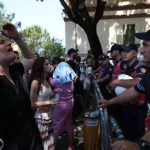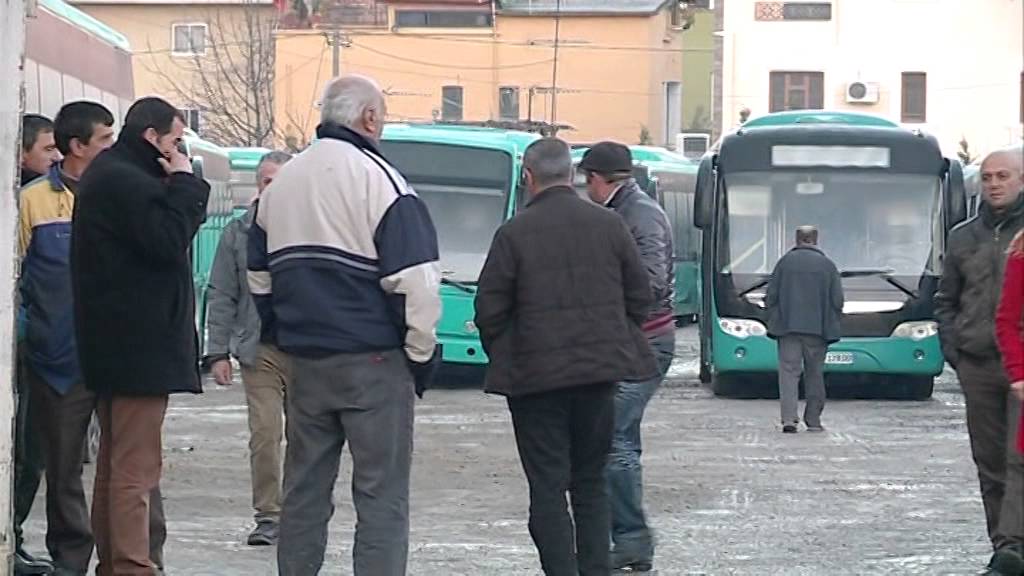
TIRANA, Feb. 12 – Tirana was paralyzed on Thursday by a 24-hour strike staged by city public transport operators, demanding an increase in bus fares. The full-day strike, causing massive traffic jams, came after a three-hour strike earlier on Wednesday, staged by public transport employees who claim they have not received wages for the past three months due to current low fares not meeting the bus operators’ expenses.
The strike has been called by the association of public transport employees, while the association of public transport operators, which has continuously demanded an increase in bus fares, claims it is negotiating to give an end to the strike.
“We are staging the 24-hour strike not only to demand the unpaid wages of some 400 Tirana public transport employees, but also to demand an increase in the bus fares. The price cannot stay at 30 lek (Euro 0.21), a new tariff has to be approved. If our requests are not taken into consideration, we will escalate our protests,” warned Zija Hasani, the head of the Union of Public Transport Employees in Tirana.
The strike also brought chaos in Tirana with traffic jams all over the capital and the streets packed with pedestrians.
Public transport users say they cannot afford even a 10 lek (Euro 0.07) increase and are dissatisfied with the service offered by the private operators.
“There are four of us in our family who use the public transport every day. We cannot even afford 10 lek increase, not to mention 20 or 40 lek (Euro 0.14 to 0.28) the association is demanding. We are irritated with the service offered by these operators, they drive too slowly, are often overcrowded which causes delays at work and often forces us step down and walk on foot for the one or two bus stops,” a public transport user was quoted as saying.
“In case the bus fare increases, we will also stage protests too,” said another regular passenger.
“I find it absurd that the employees are demanding an increase in bus fares instead of their wages,” said another public transport user, accusing employees of theft because of not handing out fares to passengers despite collecting the money.
In addition, passengers are also surprised the strike is being held at a time when fuel prices have dropped by 20 percent due to the sharp cut in international oil prices.
The Urban Transport Association requests that transport operators must be allowed to increase their bus fares or government should lift the excise duty and circulation taxes on fuel.
The Municipality of Tirana, which is the decision-making body over city bus fares, has earlier warned public transport companies that any unilateral increase in bus fares would automatically strip them of their licences.
Claiming a difficult financial situation, the Association of Urban Transport in Tirana had called for an increase of the bus fares to 70 lek (Euro 0.5), up from lek 30 currently.
Government has approved a decision which shifts the decision-making on bus fares to local government units which in the case of Tirana, makes it a responsibility of the municipality.
Back in 2013, Albania’s Competition Authority fined five public transport bus operators in Tirana for violating competition rules with students’ season tickets. The Authority said the five operators were fined a total of 6 million lek (Euro 42,000) because of refusing to recognize seasonal tickets without the logo of the Association and limiting the trade of season tickets for the 2007-2012 period.
While bus fares may be low compared to other regional countries, it must be noted that Albania has one of Europe’s lowest GDP per capita.
Albania’s GDP per capita, an indicator of the standard of living, dropped to 2,904 Euros in 2013, the lowest level in the past seven years and the poorest among enlargement countries, according to data published by Eurostat, the statistical office of the European Union.
At 2,904 euros in 2013, Albania’s GDP per capita was lower even compared to potential candidates Kosovo and Bosnia and Herzegovina and at only 11 percent of the EU 27.
Fuel prices have dropped by 20 percent to an average of 160 lek/litre (Euro 1.12) in the past few months at a time when international oil prices have almost halved compared to their peak level in mid-2014. The poor reflection of domestic oil prices is a result of the huge tax burden levied on fuel, estimated at around 100 lek/litre (Euro 0.7)
Data published by GlobalPetrolPrices.com this week show Albania’s diesel prices stood at Euro 1.21/litre, higher than Macedonia’s Euro 0.88/litre, Montenegro’s Euro 1.03/litre and Serbia’s 1.17 euros.
Starting January 2015, the circulation tax, currently at 17 lek/ litre, has increased by another 10 lek (12 lek VAT included) taking it to 27 lek litre (Euro 0.19), not to mention the excise tax at 37 lek/litre, the carbon tax at 1.5 lek/litre on petrol and at 3 lek/litre on diesel, VAT at 20 percent, and other customs duties which make fuel prices in Albania among the highest in the region and Europe despite the country having one of Europe’s lowest GDP per capita.