By Ad魥 Consigny
TIRANA, Oct. 11 – Between 1967 and 1986 the Albanian population got busy: in every town and village, residents were mobilized into building bunkers. Enver Hoxha was behind the whole process. The leaderis remembered for the authoritarian regime he imposed on Albanians from 1944 until his death in 1985; and it is a common tool of authoritarian powers to make the too-openly-reluctant work on all kind of absurd tasks. Think digging holes to fill the one you dug the day before, for instance. In his building bunker mania, Hoxha was faithful to such a tradition. But he didn’t know.
Back then, the task was all but absurd. Enemies surrounded Albania, getting ready to attack the isolated country. Eastern Block,Western Block, everyone was against the great Albania. Something had to be done. Here is what Hoxha knew. If Hoxha had been diagnosed, he would have been called a paranoid. And paranoids can be very persuasive. Especially at the head of a country so isolated that the one and only source of information comes from government-controlled media. Here is how a population can catch the bug of its leader and howwith no threat of any kind some 700,000 bunkers popped out of the Albanian ground.
Hoxha’s death in 1985 before the opening of the country spared him the sad discovery of reality. Albanians were here to receive the shock. No one in the world actually really cared for this little poor country. What was the promise of a safe future suddenly became a huge and useless spending impairing Albania’s development. While the population lacked everything, a fortune had been devoted to steel and concrete. Bunkers were no more but the relish of a madness gone to far. A relish become burden: meant to resist bombing, they are not easily took away. They remained all around Albania, on its beaches, its most inaccessible mountains, its lands, its towns.
Until the end of the 90s they could still inspire respect thanks to their protective properties. TheNATO bombing of neighboring Kosovo ended that second illusion: a few of them were touched, none barely resisted.Kujtim Ka詫u directed his movieKaptain Bunkerwith in mind the fascinating observation that time can change our perceptions: the very same thing that was once respected and meaningful had become ridiculous. “They flew in the air almost as if they were toys for children” says K. Ka詫u, interviewed inConcrete Mushroom. This short documentary was made in 2010 by two architecture students, Elian Stefa and Gyler Mydyti, as part of an eponymous broader project advocating a deliberate reclaim of their bunker by Albanians.They state that more than a simple stain of concrete on the landscape, bunkers are testimonies of Albania’s past.
As such, they deserve a realdiscussion. Since the 90s,bunkers have been out of public life. So, in an unplanned manner, everyone did what he wanted with the nearby mushrooms. Technically, any bunker located on a private land is still state-owned and shouldn’t be used. But still, some are utilized as trash repositories, latrines, chicken coops, barns, etc. Few found new use thanks to rare initiatives and became kiosks, bars, restaurants and even tattoo parlor. But most are forgotten in hidden areas difficult to reach and probably never saw a soul since the last couple lost its virginity there – such stories are often heard, easily explained by the seclusion of the spots.
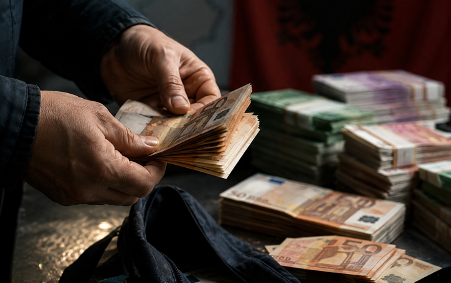
Nowadays,their existence is challenged by the needs of the construction industry in Albania. Bunkers lost their pride an ultimate time since home-made bombs have been proved efficient in destroying them. Once put down and sold, a bunker can pay up to 200 euros and even if only around 30 euros ends up in the pocket of the destroyer, it is still a good deal in a country were the minimum salary is around 140 euros. Slowly but surely, bunkers are disappearing out of Albania’s landscape.
Some celebrate. Other worry נand act. Led by the idea that a society needs traces of its past, whatever it might be, the two Architects behind theConcrete Mushroom project state that Albania has everything to lose in forgetting or destroying those traces. The past should be given a new life – they say – a life that would reveal new dynamism at play in the Albanian society. It means not destroying – as it is planned by prime minister Berisha – the huge and now unoccupied Pyramid, once built in Tirana Centerto the gloryof Hoxha. It also means ceasing to see bunkers as burden and to instead consider them as an opportunity to unleash creativity. For their part, the two are not lacking any. In a book to be finally released in a week (precedent versions were freely accessible to anyone on the Internet) they propose possible uses for the bunkers and even provide construction plans for those willing to put their ideas into action.
You think bunkers are gloomy cold spaces? And what about spending a night in one ? And paying for it? Yes, this is the definition of a hotel and as crazy as it looks, it is the main proposal ofConcrete Mushroom.Sure, it involves some fixes but the idea isn’t as far-fetched as it may first sound. Tourism is growing in Albania, if not booming: the first half of 2011 saw 40% more tourists than the same period one year before. That same year, the country was even picked number one destination to be visited by the Lonely Planet. Pictures of tourists on top of bunkers, on their side or even in it, easily accessible through a quick Google Image search, reveal that they do are interested in bunkers. Any guide in Albania would agree: they all want to stop and visit at least one. On top of that, one of Albania’s main attract lays in its baffling landscapes, beaches and mountains. There is room for an eco, nature-oriented tourism. And bunkers are an especially good fit here. They are everywhere, meaning that the whole trip of a nature-explorer could be punctuated by nights in various bunkers on his way. The strategic thinking behind the choice of their location also often provide them with great viewpoints. Plus, they are simply already here. No need for new constructions and material, just a few adaptations. This, is “sustainable-tourism”
Theideahad to come true, at least for a try. And it did this summer: some 20 students from FH Mainz (Germany) and POLIS University (Tirana) started to work together in the northern city of Tale on the development of the first hostel-bunker for backpackers. So that the very symbol of Albania’s self-isolation would become a welcoming shelter for foreigners. The bunker they transformed can host up to 8 people. Opened on the 24th of September, their prototype is the final step of a process that started with Iva Shtrepi ‘s diploma thesis. Some professors liked so much the idea of that FM Mainz former interior architect student that they decided it was worth a serious try. The prototype is not an end in itself they all state, it is meant as a way to advert such bunkers conversions: behind the project lays the belief that they can have positive social fallouts, in addition to their participation to tourism growth. The next step – their spreading around the country, depends on the solving of properties issues in Albania. Currently, the bunkers are state owned. So their use depends on the good willing of the government. And for the moment, officials told the team that it could “do whatever [it] wanted in the bunker, but not change its function”. A rather confusing statement. So technically the transformed bunker is an academic project, not a hostel. Still, the team hopes that its initiative will participate in the evolution of mentalities.
The question is to know whether Albanians are interested in the bunkers or if they witness their disappearance with indifference -if not approval. But those initiatives and their concomitant timing reveal that there are for sure among the young Albanian reaching adulthood people reclaiming their history. Meaning a past they never lived in but whose consequences are still felt. Rather than pretending to symbolically erase it through destruction, they wish to acknowledge its existence and go forth. Bunkers could become symbols of a generation of young people too far from communism to regret it, who face its traces and decide to make them theirs.
Ad魥 Consigny is currently living in Tirana and interning at the Albanian Institute for International Studies. She is a 21 years old Parisian born to a Tunisian mother and a French father, she grew up with the Internet and studied Humanities, she eagerly discovers the world and believes in journalism.