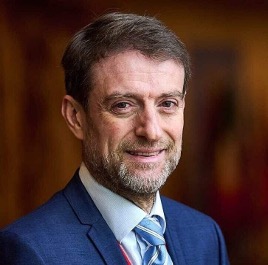
Social Welfare Minister Erion Veliaj says the government is trying to find a new formula which will provide pensions for real contributors to the scheme, the poor and those who pay contributions in private schemes.
TIRANA, Jan. 14 – The Albanian government has initiated a reform in the pension system which targets curbing the escalating deficit in the scheme and preventing a possible social crisis considering that half of working wage population does not pay social insurance contributions and could remain without a pension at retirement age.
Currently, an estimated 56 percent of people of working wage are out of the social insurance scheme, which has a deficit of 45 percent and is financed by other tax revenue.
Government says the new system will establish social pensions at a subsistence level for those who have not been able to pay social security contributions because of informality or joblessness. The social pensions will probably be awarded to people aged 70 and over.
Social Welfare Minister Erion Veliaj says the government is trying to find a new formula which will provide pensions for real contributors to the scheme, the poor and those who pay contributions in private schemes. “One pillar is that there should be a social pension that ensures subsistence level for everybody despite the amount of contributions paid, the second pillar foresees the lift of the ceiling for payment of social security contribution which will allow people who pay more to benefit more while the third pillar involves private pensions,” Minister Veliaj told reporters.
The changes are based on recommendations by the World Bank but the official version has not been introduced yet.
While no official version has been made public yet, experts say the shift to social pensions could further increase informality in the scheme.
The deficit in the pension scheme for the first eleven months of 2013 rose to around 39.6 billion lek (Euro 277 million), up from around 36 billion lek during the same period in the previous year, unveiling the need for an emergency reform in the pension system which suffers poor collection rates due to widespread informality, according to Finance Ministry data.
Albania’s High State Audit has requested the initiation of a complete legal reform in the social security system whose deficit in the past three years has considerably increased. In a report on the performance of the Social Insurance Institute for 2012, the High State Audit says the pension deficit increased to 1.49 percent of the GDP or 143 million euros in 2012, up from 0.9 percent of the GDP back in 2009.
The High State Audit says the reform should target the rate of covered people because only 65 percent of the current workforce participates in the social security scheme. The reform should also target a change to the current formula which acts as a disincentive because the maximum pension is limited to twice as much as the minimum pension while the maximum wage is five times higher than the minimum wage.
The new system should also target tax evasion which is very high because of informality and the declaration of lower than real income to pay less in the compulsory social security and health insurance contributions.
“The pension scheme is in deficit which has jumped over 1 percent of the GDP even though 55 percent of rural areas social security contributions are financed by the state budget,” says the report.
Around 112,000 people self-employed in the agriculture sector did not pay social security contributions in 2012, causing around Euro 17 million in tax evasion.
The pension system is currently in deficit, and with the projected dramatic aging of the population over the coming decades, it will be unable to cope with increasing demands for pensions, says the IMF. The IMF mission encourages the authorities to develop a reform plan that envisages, among other things, bringing rural workers into the net, removing disincentives for participation by high income earners and raising the retirement age.
According to the World Bank, Albania’s 8.2 percent of the GDP expenditure on social protection is just below the 10 percent limit which risks investments in other key priority sectors such as education and health.
As the pension reform initiated back in 2002 concluded in 2012 with the retirement age having gradually increased to 65 years for men and 60 for women, the number of new pensioners in Albania will double, having extra costs for government to cover the deficit in pension scheme. Controls carried out by the High State Audit show that a considerable number of businesses pay social security and health insurance contributions for a single person.
The current ratio is 1.4 contributions to 1 pensioner at a time when a stable pension scheme requires at least 3 contributions for one pension. Albania has more than 500,000 pensioners.
Social security contributions currently stand at 24.5 percent, of which 15 percent is paid by employers and 9.5 percent by employees. Meanwhile, health insurance contributions are at 3.4 percent, shared by 1.7 percent between employers and employees.