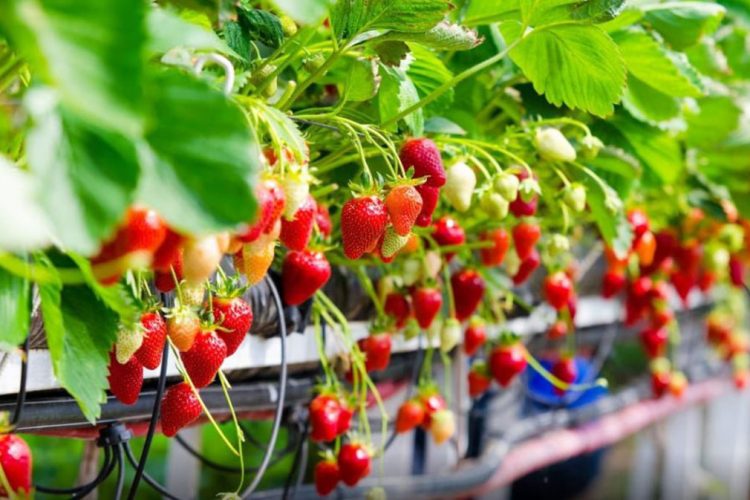
TIRANA, May 8- Statistics show that strawberry production in the country has doubled from 2016 to 2018, reaching a crop of 4 thousand tons. Even though Fier gives the highest strawberry output, farmers in Albania agree that strawberry is definitely a smart investment with three full months of production, unlike some other countries where production lasts only 15 days.
Nevertheless the sector has faced some problematics. The favorable climate has encouraged the growth of strawberries production but at the same time, farmers have complained about lack of government support, both in export demands and in subsidies to the atmospheric conditions of the winter months which led many farmers to withdraw from the market or operate with difficulty.
However, last year, farmers say they have had a fruitful year. Starting from the beginning of 2018 the strawberry business has focused only on the Fier area. Farmers dealing with its cultivation at the Frakull administrative unit in the Municipality of Fier say that a problem for them remains the lack of subsidies. Yet, cultivating strawberries remains a good business for farmers, despite the difficulties. The demand for this product is high, both in the domestic market and abroad. Some farmers claim that they do not even meet export demand. The climate has also been conducive to strawberry growth in the country. The growth of production at these rates is reflected in the domestic market at a low price. Unlike other years, one kilogram of strawberries in April found in the market in Tirana was 200-250 lek (1.5-2 euros).
In the Fier area, especially in the villages of Frakull and Kafaraj, within a period of four years a cultivation oasis of these products was created. According to figures from the Ministry of Agriculture, considering the yields that reach over 0.6 tons of production at the root, agriculture operators say that over 100 farmers are involved in this business and there is a growing tendency each year. Production in 2014 was 772 tons. According to data from the Ministry of Agriculture, production increased 1.8 times in 2015, reaching 1425 tonnes. While in 2016, production reached 2856 tons, doubling from the previous year. In 2018, the growth from a year ago was 12.7 percent, reaching over 4300 tons of production.
As far as the area is concerned, in 2015, 45 hectares of strawberries were planted, from 25 hectares a year earlier. Agriculture Ministry data show that in 2016 the area was 91 hectares. In 2018, the planted area was concentrated in the Fier area reaching 111 hectares, with a slight increase of 5.5 percent, although other areas did not have any production last year.
During the Strawberry Fair which launched its third year and was organized this month at Frakull, by the Municipality of Fier, more than 50 farmers participated with local produce, traditional cooking and strawberry pastries, intertwined with festive and entertainment elements. Farmers said that this was a good year for strawberry growers in Frakull of Fier, as a year ago from one decare the growers would cultivate and collect 30 kg of strawberries, while this year the production surpassed the historic record of 100-150 kg per decare (1 decare=0.1 hectare).
Issues faced
Strawberries growers in the Kafaraj village in Fier were damaged by floods last year. This is an incident that has been repeated for four years. Whole grains were destroyed with significant losses in the local and regional markets. Another problem for them were the strong winds. In 2016 USAID came to assistance with a 750,000 dollars fund for farmers affected by the 2015 flood, by which they could quickly recover. Three new modern greenhouse models, which guarantee longevity and climate resistance were reconstructed. Through this assistance program a collection point was created with packaging machines, which meet the standards of quality and food safety according to the requirements of the export markets. Also, more than 60 farmers were trained on new farming practices for strawberries.
Despite the difficulties and the cold winter last year, farmers claimed to have cultivated strawberries again, which was good for production. But they do not say the same about the price, which according to them the strawberry continues to be depreciated. Farmers in the Karafaj area said they have not received any help, rather they have tried to recover the huge damages themselves. They invoke for finding a solution to this situation, which has been repeated every year or more often. Farmers indicate that 2015 has been the last year they received any compensation.
Astrit Lanaj who is a farmer in the Fier area, has been cultivating strawberry for seven years. He said progress over the years has been satisfactory and growing, but with the difficulties following it. Lanaj said that in the village of Kafaraj almost all residents are dealing with the cultivation of strawberries. According to him many farmers have withdrawn from this investment, because in the absence of subsidies they have found it difficult from acquiring the seedlings until the last trading link. Lanaj said the costs have been high for all stages of production, adding the preservation and rearrangement costs in case of natural disaster. Regarding trade, Lanaj said that in addition to the growing domestic market demand over the years, demand has also increased for exports.
“Three years ago I started sending strawberries to the region, Kosovo, Macedonia, Serbia. Then, in Russia. This year we have many requests from Austria and Bosnia and Herzegovina, but we can not meet the amount,” said Lanaj.
The only income means
For most residents in the Kafaraj area working in the strawberry greenhouse remains as the only employment opportunity. Lulzim Zutaj who is owner of a strawberry farm in Fier said he’s been working for four years in the business. Upon returning from emigration in Greece, he tried to work in his lands by planting tomato-greenhouses, but the output did not work. Working on this sector is the only way for him to survive in these economic conditions, and the strawberry business doesn’t prove successful then him and many other risk to be left unemployed.
Traders, who are also the main link between the producer and the consumer, said that this current season has been more productive and the price is lower comparing to last year. A merchant in the area of ”‹”‹the Komuna e Parisit in Tirana who travels in Fier to supply his business, conduced that the price of the product is lower this year. He said he buys a box of about 700 lek (5.7 euros) and he trades the product at 150-160 lek (1.2-1.3 euros) per kg. He has noticed an increased demand, however he said that a good amount spoils so he is forced to either throw it away or lower the price.
Other traders at the Industrial Market in Tirana on the other hand, claimed that production is abundant but market demand is declining. A merchant said that the situation has deteriorated firstly because of the information circulating in the media about hormones which has negatively affected sales. The merchant who has been working for years in this trade, said that this product used to generate great sales in processing factories for jam production. However, this year he and other merchants did not have such requests.
Lanaj further added that one of the reasons that has damaged many local farmers is the large quantity imported from Greece. He appeals to the government to support and promote domestic production and to limit imports, because farmers are impaired in this way. He said that Greek production detrimented farmers because it traded with the European stock exchange and unbalanced prices in the market. In the second week of April, one kilogram of strawberries costed 100 lek (0.8 euros) out of a minimum of 200 lek (1.6 euros) that should cover domestic farmers’ production expenses.
Hormones and merchandize area
Accusations of hormones utilization for strawberry cultivation have been numerous over the years, so much that last year there was a massive reluctance for buying. Astrit Lanaj said that the charges are unfounded. For this reason, farmers are negatively affected as a huge production amount goes to waste. This has been another factor for many farmers to withdraw from the market.
“Farmers are specialized in producing strawberries, at least in the Kafaraj area that we are acquainted, seedlings are controlled because they come from European countries. We get them abroad ourselves. The inputs we use are controlled appropriately and certified within European standards. We have never used hormones for their production. Strawberry as a plant is self-cultivating, experts know this, so there is no need for hormones to boost production,” said Lanaj.
Regarding cultivation locations, strawberries are planted only in the Fier region for the first time since 2018. Previously production geography included districts like Lushnja which was second after Fier with 14 percent of production, or expressed in weight this district produced 391 tons of strawberries. Other cities were Durres with 15 tons, Dibra with 5 tons, and Elbasan with 3 tons. Figures from the Ministry of Agriculture show that last year over 6 million new strawberries were planted in the district of Fier, of which yield was 0.6 kg per root.
The entire Fier region has produced more than 4,000 tons of strawberries in 2018, which went for domestic consumption and exports. Respectively, 1.6 tons went for export, 250 tons for processing (mainly for jam), 2.5 tons for sales in local markets and 5 tons for household consumption. Farmers in the Kafaraj area said that the figures reported for household consumption are often the amount that spoils or remains stock and is not traded.
The main market is the domestic one and mainly Tirana, but strawberries especially from the Fier area are also exported abroad. The product is mostly sold in the regional countries like Macedonia, Bulgaria, Montenegro, etc.. A market which was supplied at nearly 90 percent from imported products until 2010, has been transformed into export potential since 2014, in addition to full domestic market supply. According to the figures of 2015 and 2016, Albanian strawberry exports have increased 10-fold as in weight and value. In 2015, 94 tonnes of strawberries were exported, while in 2016 were sold 981 tonnes abroad. The main trading partners remain the regional ones such as Bosnia and Herzegovina, Montenegro, Serbia and Macedonia. Starting 2016 other countries such as Italy, Romania, Bulgaria have also been added to the exporting destinations list.