By Makoto Ito*
There are three main pillars established in order to protect and promote Japan’s national interests.
The first pillar is the strengthening of our Alliance with the United States. In May 2016, President Obama made the first visit as a sitting US President to Hiroshima, while in December the same year; Prime Minister Abe paid a visit to Hawaii, Pearl Harbor.
And in January this year, our Prime Minister Abe, visited the U.S and held an official bilateral meeting with President Trump in Miami. Then this week, President Trump paid a visit to Japan to exchange views on bilateral and regional current situation and to discuss how to deal with Asian Security issues.
These reciprocal visits symbolized the strengthening of our alliance, and served as an opportunity to demonstrate the power of tolerance and peace between countries which had previously been at war.
Japan-US cooperation in the economic field is essential for the further enhancement of the Japan-US Alliance and the development of the global economy, as well as the invigoration of the economy of both Japan and the U.S. With a cumulative balance of direct investments in the U.S of approximately 411 billion USD by Japanese firms, Japan ranks 2nd after the UK and the activities of Japanese firms have created jobs for approximately 840.000 people.
The second pillar of Japan’s foreign policy is the need to enhance the relations with neighboring countries, as it constitutes an important basis for making more stable the environment around Japan. The relations with China constitute one of Japan’s most important bilateral relationships, and consequently it is important for us to build a cooperative relationship based on Common Strategic Interests.
The Republic of Korea (ROK) on the other hand is Japan’s most important neighbor which shares strategic interests with Japan. In the last two years there were frequent communications at the summit and foreign minister levels. Both sides shared the view that they would take responsibility to implement the agreement relating to the issue of comfort women made by the end of 2015.
On the other hand, the Northern Territories Issues is the greatest concern in the relationship between Japan and Russia. On this issue the leaders of both countries shared common recognition in the summit meeting in May last year, that they would continue the “New Approach” and in December last year decided to start discussions regarding joint economic activities under a special framework on the Four Northern Islands. Both leaders decided to improve the procedures for the former islands residents to visit their hometowns more freely.
The nuclear tests and repeated ballistic missile launches by North Korea pose a new level of threat, and are totally unacceptable. In this continuity Japan will continue to closely work with relevant countries, including the United States and the Republic of Korea and urge North Korea to refrain from further provocations and comply with the Joint Statement of the 6-party Talks and the relevant UN Security Council resolutions.
The issue of abductions by North Korea is not only a crucial issue concerning the sovereignty of Japan as well as the lives and safety of Japanese citizens but also a universal matter of the entire international community as it constitutes a violation of the fundamental human rights.
In the light of increasingly severe security environment, it is essential to deepen cooperative relations with partners sharing such values as freedom and democracy in the Asia-Pacific Region.
The third pillar of our foreign policy is the strengthening of the economic diplomacy:
First is to use rulemaking in order to strengthen a free and open international economic system. Japan will continue to seek agreement in principle to the Japan-EU Economic Partnership Agreement (EPA) as early as possible.
Second is to support Japanese companies by promoting public-private cooperation. In this case, the government has proactively carried out activities such as offering consulting services to Japanese companies, holding events to promote Japanese products overseas.
Promoting resource diplomacy and attracting investments and tourists is the third main aspect of our economic diplomacy. In this regard, the government achieved 24 million overseas visitors to Japan last year, with 3.7 trillion yen spent on consumption.
At the domestic level Japan faces challenges with a rapidly aging society and actual population decline which began in 2011. The population issue is significant, with a broad range of consequences both socially and economically. It is caused by a combination of the highest life expectancy at 84 years, and a low birthrate of new children, 1.4% in 2013. Estimates in 2017 show that 27% of the population is aged 65 or above.
In response, our government has implemented a variety of politics to revitalize the economy, known popularly as “Abenomics” . Together with fiscal and monetary reform, the focus of Abenomics is now on structural reforms that could potentially transform Japanese society in many ways.
One notable Abenomics initiative, sometimes called “Women-omics” , involves policies to encourage more participation by women in the economy. It includes more assistance for child care facilities, tax and other structural changes to support more women in the workforce. Immigration reform policies are also aiming to increase foreign workers in Japan’s workforce.
Abenomics fiscal and monetary reform aim to revitalize the economy and build steady GDP growth, and the government continues to implement these ongoing policies.
The government is also targeting the future with deregulation in industrial sectors such as energy and agriculture and through investment and promotion of Japan’s strengths in leading sectors such as IT, high-tech robotics, and healthcare services and technology.
So far, overall results of Abenomics have been encouraging, although the process continues. Prime Minister Abe has received an election mandate recently to continue with these plans for the economy, as well as his security policies which I mentioned a moment ago.
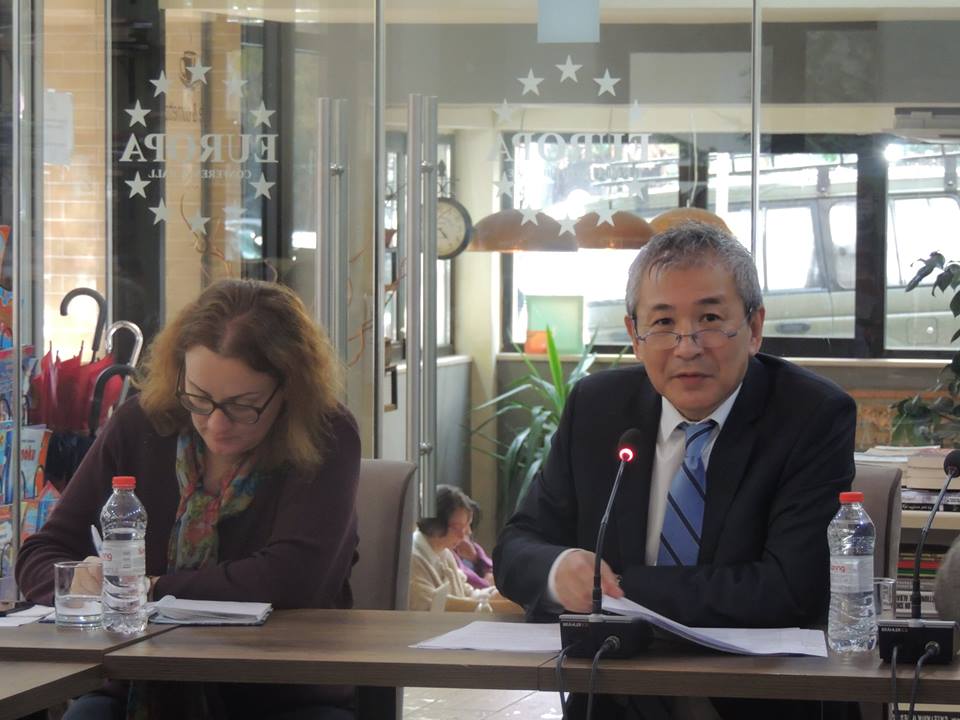
*Abbreviated remarks by Makoto Ito, Japan’s first resident Ambassador to Albania, talking “Contemporary Japan in the international arena” at an AIIS foreign policy forum held last November