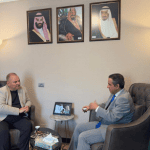
Foreign policy forum organized by the Albanian Institute for International Studies looks at Albania-Azerbaijan relations and geopolitical considerations for both countries.
TIRANA, April 3 – The construction of Albania’s section of the Trans-Adriatic Pipeline, bringing Caspian gas to Europe, will begin in early 2015, Deputy Energy Minister Ilir Bejtja said Thursday at a foreign policy forum on Albania-Azerbaijan relations organized by the Albanian Institute for International Studies, one of country’s leading think tanks.
The deputy minister said the launch of construction work had been delayed by bureaucracy and delays in the ratification of the TAP deal by the Italian parliament.
Experts from the Azerbaijani Center for Strategic Studies who participated in the forum described the presence of Azerbaijan’s state oil company, Socar, which holds a 20 percent share in the TAP consortium, as a guarantee for the implementation of the project.
Rovshan Ibrahimov, the head of Foreign Policy Analysis Department at Center for Strategic Studies said TAP would further intensify the relations between the two countries and make Albania more competitive as an EU aspirant.
Albert Rakipi, the AIIS executive director, said relations with Azerbaijan are set to take a new dimension because of the TAP project and Albania’s determination to establish new relations with countries outside the EU and NATO.
Alqi Puli, Albania’s deputy Foreign Minister, said the signing of several deals in the past three years and visits by high-level delegations prove the increased cooperation in the past three years.
He said the countries have engaged to cooperate and assist each other in energy diplomacy, science, innovation, tourism and culture.
Albania’s government says Albania will soon have its gas master plan, so the country can fully benefits from the construction of the TAP pipeline and not only become a regional hub for its distribution.
TAP is scheduled to start construction in 2015 and carry the first gas by 2019. Prime Minister Edi Rama who travelled to Azerbaijan in mid-December 2013 to sign the investment deal, described TAP as a major milestone for Albania.
“TAP is a giant project but it will be more giant when we pave the way for more innovative projects such as the union of Albania, Croatia, Bosnia and Herzegovina and Montenegro in a joint effort to promote the Ionian-Adriatic pipeline which will supply gas to new markets,” said Prime Minister Rama at the signing ceremony of the final investment decision on Shah Deniz-2 project on Dec. 17 in Baku.
Beyond the economic importance of TAP
The AIIS Foreign Policy Forum also explored the political dimension of the Albanian-Azeri relations. While TAP represents a crucial element in Albania-Azerbaijan relations, this new project does also stress important geopolitical considerations for both countries, the experts said.
On the one hand, as mentioned by Mr. Ibrahimov and further stressed by his college from the Centre for Strategic Studies Azerbaijan, Heydar Mirza, although Azerbaijan’s major geopolitical dynamics are related to the region of South Caucasus plus Russia and Turkey, its needs for diversification of oil and gas markets, especially towards European Union countries, brings the Balkans closer to Azerbaijan’s focus.
Mr. Ibrahimov also emphasized the fact that Azerbaijan perceived Albania as a closer country in light of some common history and of value-compatible societies.
On the other hand, as it was stressed by Mr. Puli and Mr. Bejtja, Albania’s involvement in this project does not just bring forward the opportunity and need for gasification in Albania, it also opens a new perspective to develop a more active energy diplomacy in the region and beyond.
Energy security is a less developed dimension of security in Albania and a more active energy diplomacy would help the country to further intensify its “360 degree foreign policy, ” according to Mr. Rakipi.
Furthermore, Mr. Ibrahimov mentioned another important point for Albania’s regional political considerations in relation to TAP: first, Albania is a strategic point for both TAP and Europe as it is the gate that brings the pipeline to EU countries, thus increasing its importance for these receiving ends; second, the project, through a spillover effect, will help cohesion among the the pipeline transit countries while “constructing” the region again as a part of a gas supplier chain.
Azerbaijan is not only e new-found ally of Albania because of TAP, it is a very strategic ally, the forum concluded.
TAP’s Albania section
The Trans Adriatic Pipeline is on schedule to start building access roads to construction sites in Albania in 2014 in order to be in a position to launch the actual pipeline construction in 2015, according to TAP’s managing director Kjetil Tungland.
In an interview for AzerNews, Tungland says TAP, recently announced as the winning project to bring Caspian gas to Europe will diversify gas supplies in Europe and give a boost to the crisis-hit economies of EU-members Italy and Greece as well as EU aspirant Albania.
A study conducted by Oxford University has demonstrated the substantial potential economic benefits for Albania by the landmark pipeline. Findings by Oxford Economics study show that during its four years of construction (2015-18), inclusive of direct, indirect and induced effects, TAP will contribute a total of Euro 370 million to Albanian GDP, create, on average, 9,900 jobs per year and generate Euro 90 million for the Albanian treasury.
In addition, during its expected 50 years of operation, inclusive of direct, indirect and induced impacts, the project is predicted to contribute a total of Euro 780 million to Albanian GDP, create 460 jobs per year, and generate Euro 470 million in tax revenues.
Albanian experts have described TAP as an opportunity that would benefit Albania both economically and politically, making the country an important hub of the international gas pipeline for the Western Balkans.
With domestic electricity generation 100 percent dependent on hydropower plants and rainfall, TAP would be another opportunity to diversify generation especially in the newly-built Vlora thermal power plant which although made available for use since more than one year has not been made operational because of its high cost on fuel operation.
TAP would also help the country’s gasification by offering gas, already massively used as a cheaper alternative to electricity for cooking and heating, although the country’s buildings lack gas infrastructure. The passing of the oil pipeline through Albania would also pave the way for the construction of the Ionian-Adriatic pipeline making Albania a gas hub to other Balkan regional countries, experts say.
TAP’s shareholding is comprised of BP (20%), SOCAR (20%), Statoil (20%), Fluxys (16%), Total (10%), E.ON (9%) and Axpo (5%).