TIRANA, Nov. 28 – US-based hotel giant Marriott International is set to launch Albania operations and become the country’s major high-end brand through a hotel downtown Tirana as the government’s support has switched to high-end investment which it says will have a stronger impact on the country’s emerging tourism industry.
The deal was announced this week by Albania’s Prime Minister Edi Rama who hailed Marriott’s Albania arrival as a milestone for the development of Albania’s 5-star hospitality industry which the government is supporting with a series of tax incentives.
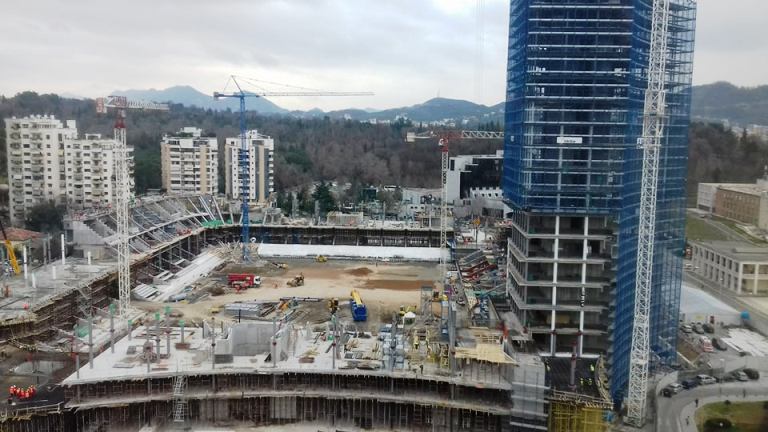
Marriott International will cooperate through a franchise deal with Albanian-owned Albstar company which is building the “National Arena” stadium, the new home of the national football side, which will be ready by next year as a stadium, a commercial center and hotel.
The new stadium is a €50 million public private partnership project with a capacity of 22,000 seats under which the Albanian-owned company was offered public land to build commercial facilities at a 24-storey tower in return for building a new modern stadium.
The arrival of Marriott International is however not new in Albania. The American hospitality giant was indirectly present in Albania throughout 2017 through Sheraton hotel in Tirana, a global Starwood brand which it acquired in late 2016.
Sheraton left Albania in early 2018 following 15 years of operation in the country under a deal with Mak Albania, a subsidiary of Kuwait-based Kharafi Group Investments, after the hotel was purchased by an Albanian-owned major oil company for €30 million.
Commenting on Marriott’s Albania arrival and tax incentives that the Albanian government is offering to the construction and operation of luxury hotels, Prime Minister Edi Rama said that promoting quality investment will have a stronger impact on the country’s tourism industry.
“Five-star hotels bring higher contribution and impact to the tourism industry and the country’s economy regarding the image which is key for the tourism industry, the high level of spending, contribution to employment, the quality of jobs, wages and above all the fundamental hospitality culture when compared to lower category hotels,” said Prime Minister Rama, speaking at a Tirana tourism investment forum.
He announced that Hyatt, another US-based giant is about to conclude an Albanian deal, which local media have unveiled could be former Sheraton, currently operating under the Mak brand of Kuwait-based Kharafi Group Investments.
Luxury competition getting tougher
Luxury hotel competition in Tirana has now become much tougher in Tirana in the past couple of years following the late 2016 opening of the Albanian-owned Plaza Hotel, a 24-storey tower in Tirana city center and the recent launch of Hilton Garden Inn.
Last September, Hilton Garden Inn, a mid-priced brand owned by Hilton Worldwide, launched its first hotel in Tirana, an Albanian investment of €19 million in partnership with the prestigious US-based hospitality chain through a franchise deal.
Competition is expected to get much tougher with the opening of the new Marriott Hotel next to the National Arena stadium next year and a new giant hotel next to the landmark 15-storey building of the Tirana International Hotel in the city center.
Austrian-owned Rogner Hotel has also been operating in Tirana since the early 1990s as the first Western hotel following the collapse of the country’s hardline communist regime.
Prime Minister Edi Rama says the government will put an end to the era of tourist villages which he says have turned into residence areas for apartment and villa owners with little value added for the country’s tourism industry and promote more sophisticated investment like four and 5-star tourist resorts.
While the Albanian government supports the idea of the need for luxury investment, some local experts say demand for accommodation in Tirana, which has seen a significant rise in the past few years, is mostly for medium-priced 3 or 4-star hotels and see the new luxury investments with skepticism.
Tax incentives
In a bid to promote elite tourism investment, Albania has been recently offering tax incentives for a 10-year period on luxury accommodation units for investments ranging from €8 million to €15 million for four and five-star units that will have to be carried out by internationally renowned chained-brand hotels or local companies under management or franchise contracts with them.
Last year, the Albanian government cut VAT on hotel accommodation to 6 percent, from a previous 20 percent and has now introduced package incentives to extend the 6 percent VAT on all services offered by new chained-brand luxury hotels and resorts which will also be stripped of the corporate income tax for a 10-year period.
The government says the incentives are similar to regional countries with a longer tradition in tourism and aimed at making the country’s tourism industry more competitive by offering quality accommodation units and services in a bid to attract a new segment of high-income tourists.
Majority MPs say the new ‘elite’ tourism investments will contribute to new jobs, increase the number of high-income tourists and boost the country’s image, but the opposition is worried new tax-free investments could serve as money-laundering schemes for drug and other crime proceeds.
Data shows construction permits for new hotels have registered a sharp hike with more than 100 permits issued in the past couple of years after almost stagnating in the 2014-2016 period when only a total of 19 new permits were handed for hotel accommodations.
Current investment in the tourism industry in the country are being mainly carried out by Albanian investors at a time when the long-standing unclear property titles remains the main concern for foreign investors, especially at coastal areas, with several major investors having quit their Albania projects during the past decade over land disputes following prolonged legal battles and protests by local residents.
Due to property disputes, several local Albanian investors have opted to build coastal resorts on development contracts rather than purchasing the land without clear ownership titles.
The tourism industry which in the past couple of years has attracted more than four million tourists and generated €1.5 billion in income, about 14 percent of the country’s GDP, has emerged as one of the country’s key drivers of growth.
Prospects are optimistic but experts say the challenge is to put in place a year-round industry making use of mountain tourism and other cultural heritage destinations to reduce reliance on the peak coastal season and new quality investment could help with that.
Unfair competition from informal businesses, mainly apartment and villa owners is a top concern for the overwhelming majority of 70 percent of businesses in the accommodation sector of Albania’s emerging tourism industry, according to a recent survey by the Albania Investment Council, a government advisory body.
Albania has more than 1,200 licensed accommodation units with a capacity of more than 41,000 beds but the number of informal units, mainly apartments and villas offered for rent informally is estimated to be much bigger, unfairly competing with licensed operators by offering much cheaper prices due to often paying no taxes at all.