TIRANA, Dec. 3 – Albania’s feuding ruling and opposition parties have reached a deal in principle to ban from political office people with criminal records and those who worked for the communist secret police.
Despite the overall consensus that the bill has become necessary, parliament held a harsh debate last week on the details of what has been dubbed “the decriminalization draft law.”
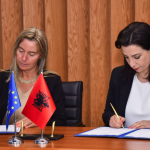
Consensus came after intensive international pressure and mediation. Knut Fleckenstein and Eduard Kukan, the two EU parliamentarians who helped broker the agreement, urged a vote on the bill as soon as possible.
A final version of the bill is expected to be approved soon. It will likely force all lawmakers and senior officials to prove they have no criminal convictions anywhere in the world and that they have not worked for the former communist secret police, Sigurimi. Those who can’t get a green light will have to leave their posts and will be banned from running again.
The so-called decriminalization law has been the focus of debate for a year.
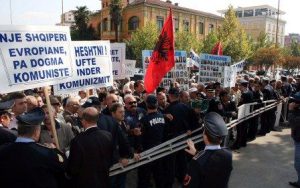
Outside the parliament, a group of former political dissidents protested and tried to break into the legislative hall as the bill was discussed. They say many current lawmakers were linked to the former communist regime that fell in December 1990 after student protests were joined by ordinary citizens.
Albanian and international observers have also expressed strong concern over lawmakers with criminal ties gaining seats in the Albanian parliament two years ago.
One Christian Democratic Party lawmaker, a member of the ruling Socialist-led coalition, Mark Frroku officially resigned this week, after he has been under arrest for weeks awaiting trial for an alleged murder in Belgium.
Another Socialist MP had earlier resigned after it became public he had been convicted of human trafficking in Italy.
The government, in power since September 2013, controls 86 seats in the 140-seat house.
The draft law will also mean that some constitutional amendments might be needed for its full implementation.
These amendments are likely to take place as part of a major reform on the judiciary system, which is currently under review by the Council of Europe’s expert Venice Commission.
Meanwhile, despite the consensus on the bill, the opposition has accused a small group of lawmakers and mayors from the Socialist-led coalition of Prime Minister Edi Rama of having ties to the criminal world.
The Socialists say there is no proof and accuse the Democrats’ leader, Lulzim Basha, and his predecessor, former Premier Sali Berisha and other top opposition leaders of corruption and ties to crimes for which they should be held accountable.
Interior Minister Saimir Tahiri called on both sides to go further, in joining forces to reform the judiciary, adding that Albanians want “murderers and thieves to be brought to justice.”
The European Union, which Albania hopes to join, has made it clear that justice reform is needed as part of the country’s bid for membership.