2016 economy review
January
Oil prices plunge to 12-year low
Then Finance Minister Shkelqim Cani admitted in January the sharp cut in international oil prices which currently stand below $30 dollar a barrel will have a considerable effect on public finances which heavily rely on domestic oil production, destined for export and oil imports for domestic consumption.
Oil prices plunged to a new 12-year low of $28 barrel last January with a significant negative impact on the country’s oil production and exploration industry affecting investments, exports and employment as companies reduced production waiting for prices to recover.
February
Shell increases Albania presence
Canada-based Petromans Energy announced a deal to sell its minority 25 percent stake in Albania to its joint venture partner Shell Upstream Albania, a wholly-owned subsidiary of the giant Royal Dutch Shell for US$45 million, with a positive impact on Albania’s oil industry, exports and its abundant unexplored oil reserves. The deal made the Royal Dutch Shell the sole shareholder in the Albanian oil exploration and production operations that the joint venture has been engaged since 2012. Energy Minister Damian Gjiknuri described Shell’s expansion to Albania as good news for the Albanian oil industry despite international oil prices at a record low having reduced interest for new investments. Shell’s increased presence in Albania came at a time when its 2015 earnings fell by a sharp 80 percent to $3.84 billion, compared with $19 billion in 2014 on slumping oil prices.
Albania ends costly Crown Agents contract
The Albanian government officially announced the termination of its two-year €8.5 million customs assistance contract with UK-based Crown Agents, saying that will no longer continue cooperation with the consultant which it described as successful, although the costly deal failed to provide the expected boost in customs revenue. The contract, which was highly criticized by some economy experts and the opposition as too costly, failed to yield its expected results of increasing customs revenue by 1 percent of the GDP or about 100 million euros.
OSHEE distribution operator turns profitable
More than a year after the launch of an aggressive nationwide campaign to curb electricity thefts and collect accumulated unpaid bills, the country’s state-run power distribution operator was back to profitable after a failed three and a half year privatization which ended in early 2013. Distribution operator, OSHEE, said the company registered profits of about 14.9 billion lek (€106 mln) in 2015 following losses of 4.5 billion lek (€32 mln) in 2014 and a record high of 27 billion lek (about 192 mln) in 2013 when the company was taken back under state administration following a failed privatization by Czech Republic’s CEZ. However, grid losses in the distribution network, the majority of which include thefts, dropped to 31.3 percent in 2015, compared to 37.8 percent in 2014 and a record high of 45 percent in 2013
March
Albania heads toward deflation
Albania’s inflation rate hit a 13-year low in February 2015 when it dropped to a mere 0.2 percent, significantly below the central bank’s 3 percent target, sparking deflation concerns. The February inflation rate was affected by a significant slowdown in food and non-alcoholic beverage prices, the key item in the consumer basket, and lower shoe and clothes, health and transport prices. The last time Albania registered a lower inflation rate was more than a decade ago in January 2003 when consumer prices fell to zero.
Court turns down heavy fines law
Albania’s Constitutional Court turned down a heavy fines law increasing fines on tax evasion by up to 50-fold as running counter to constitutional principles.
The Court cancelled 8 out 11 controversial articles in the newly amended tax procedures law in late 2015. The legal changes were challenged last November by the Association for the Protection of Traders and the Market which claimed “disproportionate” penalties to income and offences committed. The Court had earlier suspended the implementation of the law until a final decision. The changes to the tax procedures law envisaged fines of up to 10 million lek (€71,000) on big businesses operating in the wholesale trade for not issuing tax receipts, compared to a previous 200,000 lek (€1,411). Fines on small businesses were set to increase 10-fold from 50,000 lek (€353) to 500,000 lek (€3,529) starting Nov. 12.
Chinese company takes over Bankers Petroleum
Canada-based Bankers Petroleum signed a preliminary deal with China’s Geo-Jade Petroleum Corporation to sell its major Albania assets and a newly acquired minor oil block in Hungary for a reported C$575 million (€392 mln). The surprise announcement came as the country’s biggest oil producer had recently been facing tough times after more than a decade of operations in Albania due to a sharp cut in international oil prices and tax and environmental disputes with the Albanian government.
Eurosig buys INSIG insurer
The Albanian government announced Albanian-owned Eurosig as the winner of a tender to purchase state-run insurance company INSIG. Eurosig, which has been operating in the Albanian insurance market for a decade and increased its market share to 15 percent in 2015, bid 2.2 billion lek (€15.8 million) to buy INSIG, compared to a starting price of €15.3 million set by the Albanian government, beating three other competitors. Once the holder of a monopoly of the Albanian insurance market, INSIG, which also operates in neighbouring Kosovo and Macedonia, had been losing considerable market share in recent years due to the market liberalization and tough competition from private players.
April
 TIA’s exclusive rights finally lifted
The exclusive rights that the country’s sole international airport has been holding on international flights for a decade were finally lifted, paving the way for the operation of new airports that would increase competition and reduce current ticket prices, estimated among the region’s highest. The deal is expected to activate the new United Arab Emirates-funded Kukes airport in north-eastern Albania and the construction of two new airports in southern Albania serving the tourism industry. The long-awaited agreement came after two years of intensive negotiations with the Tirana International Airport concessionaire, which will benefit a 2-year extension of its original 20-year build-operate-transfer concession contract for the opening of the new Kukes airport and half a year for each of the expected new Vlora and Saranda airports.
May
Gov’t sets public debt ceiling
The Albanian government set a 45 percent ceiling on public debt, currently hovering at a record 70 percent of the GDP and considered a key risk to the country’s macro-economic stability. Under a draft law on the budget management system approved this week, the Albanian government says the public debt will be forecast at a lower level compared to the preceding year until public debt drops to 45 percent of the GDP. The new draft law also envisages a ceiling for government commitments to public-private partnerships at not more than 5 percent of annual tax revenue.
Key rate cut to 1.25%
Albania’s central bank cut the key rate to a new historic low of 1.25 percent and revised downward the country’s 2016 economic outlook to 3 percent. The surprise move came after lending continued remaining at negative growth rates in the first quarter of the year and inflation rate grew by only 0.66 percent, sparking deflation concerns considering the Bank of Albania 3 percent target. The new cut is the second for the year and the sixteenth consecutive slash since August 2011 when the key rate was at 5.25 percent. The new 0.25 percent cut is also another effort to boost sluggish lending and consumption which is keeping the country’s growth below potential.
More disclosed in Panama Papers leak
Nineteen individuals, six companies and two offshore entities linked to Albania have been disclosed in a searchable database that strips away secrecy of hundreds of thousands of offshore entities globally as part of a massive leak of the so-called Panama Papers. The database published by the International Consortium of Investigative Journalists showed there were three Albanian individuals among the disclosed investors including Ismail Mulleti, Petraq Shumka and Endrit Maloku.
June
Business climate sinks to four-year low
Albania’s business climate perception received another blow, this time by the American Chamber of Commerce, which has been critical of the government’s tax policy and publicly criticized the deteriorating business environment and the departure of top North American investors. The latest AmCham Business Index showed Albania’s business climate hit a four-year low in 2015 despite government efforts to tackle massive tax evasion and reform the energy sector. High taxes, unfair competition, government bureaucracy, the tough business climate and the informal economy were listed as the top five concerns for foreign and Albanian businesses represented by the AmCham.
Albania remains region’s second largest FDI recipient
Albania registered a slight decline in foreign direct investment in 2015 but continued remaining the second largest FDI recipient among five EU aspirant SEE economies for the sixth year in a row, according to a report by UNCTAD, the United Nations body responsible for international trade. At $1 billion in 2015, Albania registered a 10 percent decline in FDI inflows compared to 2014, but was the second largest recipient after Serbia which led FDI attraction with $2.3 billion in 2015. Albania’s FDI hit a historic high of $1.26 billion in 2013 just before the slump in oil and mineral prices in mid-2014 severely affecting the country’s key oil and mining industries. FDI inflows in Macedonia, Bosnia and Herzegovina and Montenegro ranged from $174 million to $699 million in 2015.
EBRD loan to upgrade Tirana-Durres rail segment
More than a decade after cancelling a contract with U.S. giant General Electric, Albania is planning to revitalize its dilapidated rail transport by reconstructing the key Tirana-Durres segment and linking it to the country’s sole international airport. London-based European Bank for Reconstruction and Development pledged a Euro 34.5 million loan to partly fund the reconstruction of the 35 km Tirana-Durres segment and built a new 7.4 km section linking Tirana to the airport just outside the capital in Rinas. The project’s total cost is estimated at Euro 86.4 million. The Albanian government is planning to fund the remaining Euro 52 million through the state budget or another soft loan from international financial institutions.
July
Court cancels higher taxes on self-employed professionals
Albania’s Constitutional Court turned down as incompatible some late 2015 legal changes that set reference wages on self-employed professionals increasing social security contributions by three times. The legal changes, strongly contested by private professionals in the law, health and engineering services, were challenged to court by the Bar Association which claimed the new rates promoted inequality, tax evasion and bankruptcy. Under a decision made on Jan. 21, the Albanian government set monthly reference wages ranging from 40,250 lek (€288) to 88,800 lek (€636) based on the type of profession and the area where they operate in the newly established 61 municipalities under the territorial reform.
Threshold on tax free online purchases reduced to €22
The Albanian government reduced the threshold on tax free online purchases and goods delivered from abroad in a move which sparked anger among rising online buyers but which will benefit local traders who had complained of unfair competition. The government reduced the amount of tax free online purchases from abroad to €22 and goods delivered from abroad for personal reasons to €45. The previous tax free threshold was at €140. Online buyers will now have to calculate an extra 20 percent in VAT and 2.4 percent in customs duties if they exceed the €22 amount.
Albanians are estimated to spend about €150 million a month in online purchases in Albania and abroad, according to the Association of Banks.
August
2016 budget faces surprise mid-year cut
The 2016 budget underwent a surprise mid-year cut under a normative act approved in secrecy by the government, avoiding debates at parliamentary committees over the reasons behind the decision. In what has now become an almost usual mid-year practice in the past seven crisis year, both spending and revenue expectations were slightly revised downward compared to initial overoptimistic forecasts. The July 29 normative act, made transparent only after being published on the Official Gazette, cut spending by 0.7 percent to 450.2 billion lek (€3.24 billion), and revised downward expected government revenue by 1.1 percent to 414 billion lek (€2.99 billion).
September
Way paved for first toll road
Albania’s first-ever road concession project has taken a U-turn after the country’s public procurement watchdog invalidated a Turkish-led winning bid and proposed another bidder as the winner of 30-year concession contract to upgrade and manage a 114-km highway segment linking Albania to Kosovo, making it the country’s first toll road. The Public Procurement Commission ruled the transport ministry’s bid evaluation commission must invalidate the bid by a Turkish consortium led by Vendeka Bilgi Teknolojileri Ltd and announce a United Arab Emirates-consortium led by Catalyst Viva Das General Contracting LLC which also included several Albanian partners as winner. The decision came after a complaint filed by the UAE-led consortium which also includes Salillari, one of Albania’s biggest construction companies, and Kastrati, the biggest oil importer and trader.
Statkraft delivers first electricity from Banja HPP
Norway’s Statkraft delivered the first electricity to Albania’s distribution grid following the launch of its Banja hydropower plant in central Albania as part of Devoll hydropower project, one of the country’s largest foreign investment that is expected to increase the domestic wholly hydro-dependent electricity generation by 17 percent by next year. Statkraft says its second 184 MW Moglice hydropower plant is expected to come into operation by 2018. The two power plants are expected to produce about 700 GWh annually, increasing Albania’s electricity generation by 17 percent. The Banja and Moglice HPPs, part of the €535 million Devoll Hydropower project, are being built on the Devoll River, about 70 km southeast of Tirana.
Italy scraps discriminatory Cold War tax
Albanian transport operators will now save up to €180 for a round trip to Italy after long-awaited legal changes scrapping a discriminatory Cold War tax on Albania have finally come into force. It took almost two years since Albanian Prime Minister Edi Rama and his Italian counterpart Matteo Renzi confirmed plans to lift the discriminatory tax that was applied only for Albania, Syria and Iran. At least 800 companies with 2,500 trucks are expected to benefit from the tax scrap which was one of the key concerns for Albania’s international transports, reducing their competitiveness with regional transport operators who faced no such discriminatory tax.
October
Chinese consortium acquires Tirana airport
Albania’s sole international airport, the Tirana International Airport, officially changed hands with a Chinese consortium led by China Everbright Limited acquiring a 100 percent stake for an undisclosed amount that is estimated at €82 million. The TIA airport is one of the country’s main hubs serving 2 million passengers a year. The TIA consortium’s shareholders included AviAlliance GmbH, a subsidiary of Canada-based PSP Investments with 47 percent (formerly Germam HOCHTIEF AirPort GmbH), Germany’s DEG with 31.7 percent and the Albanian-American Enterprise Fund with a 21.3 percent stake
Arbitration proceedings initiated against Bankers Petroleum
In an expected move after Canada-based Bankers Petroleum, the country’s biggest oil producer, recently concluded its sale deal with a Chinese consortium, the Albanian government decided to settle its $57 million dispute with the Canadian company at an Arbitration court. Advised by U.S.-based Curtis law firm, the National Agency for Natural Resources, a government agency overseeing concession contracts in the oil and mining industries, decided to challenge a late August decision issued by an expert panel led by PwC, one of the Big Four auditors, which ordered the Albanian government to pay back Canada-based Bankers Petroleum $37 million, $20 million less than Bankers was initially supposed to pay in instalments. The initial $57 million tax dispute involved $250 million in disputed costs from the company’s operations in 2011.
November
Netherlands emerges as second largest investor
The Netherlands emerged as the second largest foreign direct investor in Albania and is on track to further increase its presence in the Balkan country thanks to increased investment in the oil industry and most recently retail trade. The stock of Dutch foreign direct investment to Albania increased to €753 million in the second quarter of 2016, up 9.5 percent compared to the end of 2015 as Dutch giant Shell completed the acquisition of a minority stake in Canada-based Petromanas Energy for US$45 million in early 2016, according to the latest central bank data. The Dutch FDI also marks a significant increase compared to 2012 just before the Royal Dutch Shell entered Albania when The Netherlands’ FDI in Albania was estimated at €300 million.
Public debt drops to 70% of GDP
Albania’s public debt slightly dropped to below 70 percent of the GDP in the third quarter of the year while debt servicing also slightly fell as interest rates on both domestic and external debt were down due to key interest rates at a record low. Finance ministry data shows public debt dropped to 69.77 percent of the GDP at the end of the third quarter of 2016 down from a record high of 72.21 percent at the end of 2015 when it climbed to 1 trillion lek (€7.5 billion). Debt servicing, which includes interest payments plus the repayments of principal to creditors, cost the Albanian government about 41 billion lek (€300 mln) for the first three quarters of this year, slightly lower compared to the same period last year.
Fiscal package defies calls for cut in key taxes
Key taxes such as the corporate income tax and the withholding tax on dividends, rents and capital gains will remain unchanged at 15 percent even for 2017, defying business calls for a reduction in the tax burden which has emerged as the key concern for the local and foreign business community.
In its new fiscal package ahead of next year’s mid-2017 general elections, the ruling Socialist Party-led government proposed that key taxes will remain unchanged, while the business community will be mainly offered easier procedure. Several key industries, the country’s top exporting garment and footwear and the mining industry will also have some taxes cut to help the country’s poorly diversified exports recover from the slump in international commodity prices since mid-2014.
ARMO resumes refining operations
Albania’s ARMO refiner in the southern town of Ballsh resumed work after more than one year, providing a solution to more than 1,000 workers who had remained jobless. An offshore company based in the British Virgin Islands has reactivated domestic oil refining following a deal with Canada-based Bankers Petroleum, the country’s largest oil producer recently acquired by a Chinese company. The plant is now producing Eurodiesel, super unleaded petrol and other oil by-products.
Opposition Democrats offer 9% flat tax
With seven months to go before Albania holds its new general elections, the opposition Democratic Party finalized its electoral platform that is based on sharply lower taxes that would turn Albania from a country with the second highest tax rate in the Western Balkans region into one with the lowest tax burden among the six EU aspirant regional countries in a bid to boost foreign investment and domestic consumption. Opposition Democratic Party leader Lulzim Basha says the program offers a 9 percent flat tax on personal and corporate income, compared to a current 15 percent rate on the corporate income tax and the withholding tax on dividends, rents and capital gains, and a reduction in the key value added tax by 5 percent to 15 percent.
‘Shady’ PPPs to cost taxpayers €52 mln
Financial support to six concession contracts the Albanian government has signed in key sectors over the past three years and two new public-private partnerships expected to be made operational next year will cost Albanian taxpayers an estimated 7.2 billion lek (€52 million) for 2017, the finance ministry has unveiled. While experts say Albania can benefit a lot from engaging in public private partnership, the transparency over their award and implementation remains key to their effectiveness. “Currently there are six concession contracts or public private partnerships receiving budget support and it is expected that two new contracts signed by the ministries of environment and health become operational in 2017,” says the government in its 2017 draft budget.
December
Thousands of call center jobs at risk
Thousands of jobs in the booming call center industry in Albania are at risk after the Italian Parliament approved some changes making the supply of services from non-EU countries such as Albania tighter. The Albanian government had only recently lobbied the Italian Parliament which voted the legal changes along its 2017 budget in early December after Italian Prime Minister Matteo Renzi lost a referendum on constitutional changes triggering his resignation which was postponed for Wednesday after he was asked by the Italian president to submit it after the budget vote. The law puts at risk some 25,000 jobs at the booming call center industry in Albania by tightening rules for the transfer of services to non-EU countries such as Albania.
Sport Review
June
 Players receive heroes’ welcome after historic Euro debut
Albania ended their historic debut in a major football tournament in a dramatic disqualification filled with suspense after the national side was unlucky to make it to the knockout stage of the Euro 2016 as one of the four best third-placed teams.
Albania, who collected three points in their group stage fixtures following a victory with Romania and losses against hosts France and Switzerland were punished by their -2 goal difference. Portugal and Northern Ireland made it to the last 16 with three points but a goal difference of zero.
Despite the unlucky finish, Albania made a historic participation as an emerging tough team who held Switzerland in 10 men for about 60 minutes and could have earned a point with hosts France who scored two late goals.
Back in October 2015, Albania beat Armenia 3-0 to claim direct qualification in the 2016 UEFA European Championship in a decisive last qualifier for the second place in Group I of the Euro qualifiers to avoid play-offs in case of a possible third place.
Group I also featured leaders Portugal, third-placed Denmark and Serbia and Armenia.
November
World Cup qualifying bid suffers major setback
Albania’s hopes for a third place and a possible play-off opportunity in the World Cup qualifiers received a severe blow last weekend after a devastating 3-0 home loss against direct rivals Israel who capitalized on their numerical superiority as Albania were left in nine men.
With seven other qualifiers to go, Albania now see themselves fourth with 6 points, trailing Israel by 3 points and group leaders Spain and Italy by four points.
Although mathematically Albania can still remain hopeful for a miracle second place which would award them a play-off opportunity, their qualifying bid looks like a mission impossible now as former World Champions Italy and Spain seem unrivaled in the fight for the group’s first two places.
Albania were lucky to beat Macedonia with an injury time winner in the opening World Cup qualifying campaign, won 2-0 against modest Liechtenstein in the second qualifier and suffered a 2-0 home defeat against group leaders Spain in their third qualifier last October.
Culture Review
May
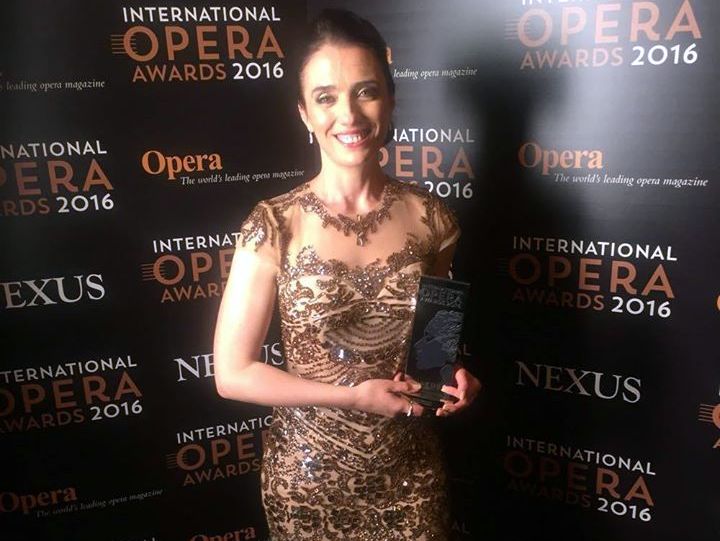 Ermonela Jaho wins 2016 International Opera Award
Successful Albanian-born soprano Ermonela Jaho won the 2016 International Opera Awards for the Opera Readers’ Award category from worldwide collected votes. Born in Tirana, Jaho made her operatic debut as Violetta when she was only 17. Today she is one of the most successful Albanian sopranos performing for various opera houses worldwide such as the Vienna State Opera, Bavarian State Opera, the Metropolitan Opera, New York, Paris Opà©ra.
August
Ancient artefact discovered in TAP construction works
A well-preserved archaeological artefact believed to date back to the 6th century was discovered in southeastern Albania during construction works for the Trans Adriatic Pipeline bringing Caspian gas to Europe through Albania.
“The find is a 40cm limestone column capital, decorated with engraved floral motifs, and is believed to have been part of a significant religious monument in the region. TAP’s Cultural Heritage experts’ preliminary assessments conclude that the artefact dates back to the 6th century AD and belongs to an early Christian monument,” the TAP consortium said in a statement.
The discovery was made during the rehabilitation of an access road in the Skrapari area, southern Albania.
Eugen Kallfani, the head of the Berat regional cultural heritage directorate, says such a discovery is testimony to the early Christian heritage while its shape and ornaments offer new facts on the importance of this region during Late Antiquity.
October
German October marks 10th Albania birthday
A premiere by German playwright Roland Schimmelpfennig opened this year’s 10th edition of the German October events in Albania which will again showcase a month of cultural events, including music, theatre, movies, graffiti and exhibitions.
“This anniversary is testimony that the German October has now turned into a real tradition, which has taken a solid place in the Albanian-German cultural life,” said German Ambassador to Albania Susanne Schà¼tz.
“Our common goal in the German October is to showcase the wide range of German-Albanian relations and bring the people from both our countries closer. Even for this year, we managed to prepare a miscellaneous programme: films, theatre, music, poetry evenings, political discussions and much more,” added the ambassador.
Korà§a’s medieval art museum reopens in new home
The museum of medieval art in the southeastern city of Korà§a and its rich collection of thousands of artworks, mostly icons, finally has a new home. The museum’s collection includes, stone, precious metals, carved wood, paper and textile works, chronologically displaying the development of Albanian iconography through 10 great masters including Onufri, a mid-16th century priest who was the most important painter of icons and murals of the early post-Byzantine era in Albania.
The new permanent exhibition will feature some 400 icons, 250 of which are being put on display for the first time in the museum, a joint investment of the Albanian and Greek governments whose construction started eight years ago.
November
Saimir Strati completes giant St. Teresa mosaic
“Peace begins with a smile” is the Mother Teresa quote Albanian artist Saimir Strati has engraved on a giant “Saint Theresa” mosaic dedicated to the famous nun of Albanian origin declared a saint by Pope Francis this year, in a work inspired by the migrant crisis in Europe which the nine-time Guinness World Record holding artist unveiled on Nov. 28, Albania’s Independence Day.
Using more than a million of staples on a 10 m2 wood platform, the artist has created a smiling portrait of Mother Teresa, paying tribute to her humanitarian work to helping the poor all her life which won the famous nun the Nobel Peace Prize in the late 1970s.
Strati, 50, completed the mosaic set to earn him a 10th Guinness World record, at Prishtina’s Kosovo Museum, where the artwork will remain on display. He says he was inspired by the migrant crisis in choosing stapes as industrial material to create the portrait.