Part I: Pyramid Frenzy
By Nicola Nixon
From 1992 to 1996, Albania appeared to have made significant progress economically speaking on the road from the Enverist communist system. During that period, the country boasted the highest economic growth in the region, a low unemployment rate and a stable currency and, as such, was roundly congratulated by its European neighbours. Indeed, at that time, the country was considered a fine example of post-communist economic transition.
From the early 1990s, numerous pyramid banking schemes had popped up all over the country offering staggering interest rates of up to 50% a month to investors. The instability of these schemes lay in the fact that, generally, rather than using savers’ money for external investments, they relied on the money of new depositors to pay interest to the existing ones. Since that requires a constantly increasing flow of money into the scheme, it is simply not sustainable. Albania was not the only country in the post-communist region to see the rise of such schemes, where large pyramid schemes collapsed in the early 1990s in Russia and Romania.
The Heyday
1996 was the boom year for the pyramid schemes which had emerged in Albania in 1994. Throughout the year people all over the country – an estimated two thirds of the population – were selling up everything they had to put their money into the schemes. During 1996, a number of foreign journalists travelled to Albania and described the scenes of the good life that people were enjoying from the return on their investments, just a few months before they began to collapse. In May, CNN’s Jamie McIntyre thought he could feel the onset of an ‘Albanian spring’ in the rising prosperity that surrounded him on his visit to Tirana. Similarly, in the same month, Steve Pagani of Reuters was impressed with the new atmosphere in the capital:
The capital, Tirana, is where it is at. The city, home to 300,000 people, is noisy, bustling and brash. The days of queuing outside monochrome shops selling shoddy Chinese-made goods or sitting over a local brandy and thin coffee in one of the few dimly lit cafes are over. Kiosk and stall owners sell a range of goods from live chickens to second-hand television sets. Bicycles crowd the streets. Spruce shops containing expensive Western-made consumer goods rub shoulders with new marble-fronted offices, such as branches of foreign banks, to whom Albania’s conservative government appears only too happy to issue licences. Downtown, the central bazaar spills over with a cornucopia of fruit and vegetables, olives, lentils, beans and sacks of paprika in a riot of colour. Nearly 3,000 privately owned bars and restaurants have opened since 1991. Some are modest, others, boasting awnings and terraces, could grace any European capital.
For a long time, the schemes had chugged along reasonably calmly with interest rates of around 6 per cent per month. Yet during the summer of 1996, an interest-rate war began between the schemes which saw rates rocket to 100 per cent or more. It was that which started the investment frenzy. Reporters in Albania later in the year, therefore, noted the direct relationship between the new found affluence and the activities of these schemes. Some of their reports provide a very human image of the hope with which people invested everything they had into the schemes. In October, for example, Jane Perlez of the New York Times, spoke to Gjergi Peci, who
sat in his easy chair and explained how, like hundreds of thousands of his countrymen, he could afford to relax, not work too hard and even buy a grander place in the future. sat in his easy chair and explained how, like hundreds of thousands of his countrymen, he could afford to relax, not work too hard and even buy a grander place in the future. A few months ago, he sold his apartment in a good section of this dilapidated capital for $30,000, paid off some debts and sank $20,000, his entire savings, into a pyramid scheme called Vefa. He collected his first interest payment of $3,200 a few weeks ago, he said, and is confident that he will get $6,400 more and his principal by February.
Similarly, in November, Joanna Robertson of London’s Guardian, spoke to a couple of investors in Tirana:
Huddled among the kiosks crammed into Tirana’s main park, the thriving Cafe Marlboro is usually filled with drinkers. This morning it is almost deserted. Kristina, the waitress, explains that most of her customers have gone to collect their monthly payouts from the high-interest pyramid schemes that have become wildly popular in Europe’s poorest country. Kristina, aged 20, is a history student at Tirana university. She earns pounds 30 a month waitressing and recently put her savings into a scheme called Demokracia Popullore Xhaferri. If the bubble doesn’t burst, her 70,000 lek ( pounds 410) investment will double in value in three months. At first, she says, she was reluctant. But she watched her friend Zana make more than pounds 3,000. She lives with the rest of her family in one cramped flat, but Kristina says things are looking up. Her father has invested his life savings in a scheme, and plans to use the interest to buy a new home.
Ƈene is queueing in the mud outside the deposit office of a Gypsy woman offering to pay 50 per cent per month on cash deposited in her scheme during the next five days. A peasant from a village in the mountainous north, Gene slaughtered his small flock of sheep when news of the interest rate reached him and brought the cash straight to Tirana. With no sheep left he is no longer a farmer but plans to live instead on the monthly interest payments – as long as they last. Next to him, clutching two carrier bags crammed with grimy lek notes, is Sokol. He grins and says that he has just sold his flat. He expects to double his money in just a few weeks. In the meantime, he will live with 14 members of his family in a two-roomed flat, as his brothers have also sold their property.
Widespread inactivity and relaxation, where thousands wiled away the days in cafes and bars – in between bouts of investment activity – was a characteristic of life in pyramid-scheme Albania that many reporters commented upon. The BBC reported that in late 1996, an Italian entrepreneur tried to start a business in the northern town of La绠a town with a very high unemployment rate. To his surprise, despite offering twice the money for a public sector job, he was unable to employ anyone. He was told quite simply, by the residents, that they earned more from the pyramid schemes than from working, so what was the point.
The frenzied atmosphere of investments in the schemes had begun to ring warning bells among the international financial community and in some parts of the local and international media. By October, the IMF was urging the government to actively intervene and put a stop to the schemes, fearing the consequences of their collapse. The Economist reported rather presciently at the time, ‘When the collapse comes, depositors may not take it quietly.’
1996 had also seen the third multi-party elections in Albania since the fall of communism that were held on May 26. These elections, which saw the re-election of the DP government, are widely considered to have been blatantly rigged. While the OSCE expressed concern over certain ‘irregularities’, Human Rights Watch was considerably less flattering. In their report, HRW identified, ‘numerous human rights violations before, during and after the vote’, ‘physical attacks, ballot stuffing and voter list manipulation’ and ‘extreme cases of police violence after the elections.’
The manipulation of these elections by the DP resulted in increased distrust and disappointment in the government, and Berisha himself, as President. Thus, there was already considerable anti-government sentiment prior to the disintegration of the pyramid schemes. Ironically, the DP campaign slogan had been “Vote Democrat and everybody profits.”
Bankruptcy
By late 1996 there were eight major lending schemes in operation throughout the country – VEFA, Kamberi, Silva, Cenaj, Xhaferi, Populli, Gjallica, Sudje – as well as some smaller ones.
VEFA Holdings, headed by Vehbi Alimucaj, was the largest of the pyramid schemes. According to the Guardian, in January 1997, Vefa was thought to have accumulated investments of around 100 million dollars. At that time, the average deposit was between $10,000 and $30,000; a lot of money for a country where the average wage hovered around $100 a month. After the collapse of other pyramid schemes, Vefa also closed its pyramid banking activities in early March 1997, owing investors some 60 million dollars.
Another large Tirana-based scheme was Sudje, set up by former factory worker, Maksude Kademi, who promised investors up to 50% returns on their deposits. It was the first to collapse and began preventing investors from withdrawing their money in November 1996 and finally collapsed in mid-January 1997 when the Gjallica lending scheme also collapsed. The declaration of bankruptcy by these two schemes marked the start of the riots that were to continue for the next few months.
The Xhaferi scheme, started in early 1996 by a former army general, Rapush Xhaferi, was one of the more surreal examples of the flamboyance that accompanied the moneylending phenomenon in Albania. Based in Lushnje, Xhaferi had bought the local soccer team and had paid a large sum to lure the former Argentine national team coach, Mario Kempes, to coach it. Xhaferi also brought out 19-year-old Nigerian forward, Leonardo Nosa Ineh, who suddenly found himself without a team to play on in early 1997. In February that year, a journalist from the Scotsman found the young soccer player stuck in Lushnje, ‘bewildered, penniless and dependent on local charity in a one-room flat without a telephone,’ when by that time, Xhaferi’s scheme had collapsed. Xhaferi was arrested in mid-January along with the head of the Populli scheme, Bashlim Driza, when both schemes had ceased to make payments.
In response to the collapse of the other schemes, the VEFA, Silva, Cenaj and Kamberi schemes attempted to demonstrate their credibility to investors by reducing their interest rates to 5 or 3 per cent. This attempt failed and they too stopped making payments to investors in the early months of 1997.
According to an IMF report released in 2000, of the schemes, VEFA had the largest liabilities when it collapsed, with 85,000 depositors. Closely linked to the government, it had attracted some of the more affluent investors in the country including employees in the government. The scale of the pyramid frenzy, however, is better illustrated by the Xhaferi and Populli schemes which, according to the IMF, at attracted some 2 million depositors during their existence.
It is estimated that overall, the schemes cost Albanian investors something in the vicinity of 1.2 billion dollars.
Penniless
With the collapse, hundreds of thousands of Albanians lost their life savings, homes, and any other valuables they had managed to turn into cash investments. In late January, a reporter from the Financial Times interviewed Agem Mucaj, an unemployed building worker in Rrogozhine, who had invested the $30,000 he had saved while working in Germany and had lost it all. Another Rrogozhine resident, Xhyer Lamani had lost $24,000 that he had saved while working illegally in Crete. “I wanted to build a house in Tirana and make a proper life for my family, but now there’s nothing else to do but go back to Greece.” Meanwhile, a Guardian journalist spoke to a bank employee in Vlora for whom the loss was not only money. “I have lost my dreams,” he said. Reporting from Tirana, in early February, Helena Smith wrote that the cafes and bars that had become ‘wooden shrines to idle luxury’ now ‘stood eerily empty.’
In the meantime, the government had done little, if anything, to prevent the crisis, despite numerous warnings from international organisation. The finance ministry did not start to warn the public about the dangers of the schemes until October 1996, at which time it was too late. Even then, according to the later IMF report, ‘it drew a false and misleading distinction between companies with real investments, which were believed to be solvent, and pure pyramid schemes.’ Companies such as VEFA were therefore defended by the government to the end.
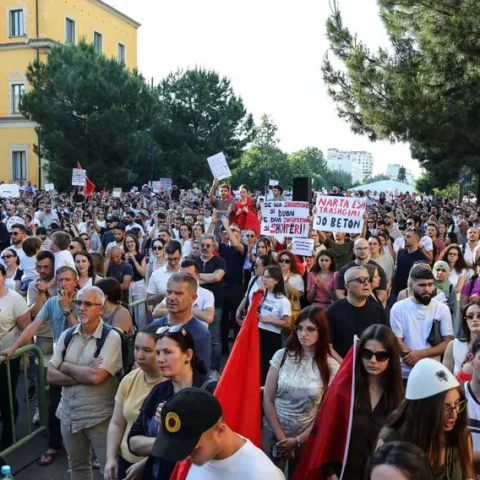
By late January, people had begun to vent their anger over their lost savings on the streetsō
To be continued.