By Paul Harris
Albania. This is the Wild West, I am thinking. A few days ago, I was sitting in the air-conditioned cool of the office of the Minister of Tourism in Tirana and being told persuasively of the warm welcome awaiting tourists.
Now I am sitting in the baking 38 degree heat in the remote mountains of southern Albania.
Outside the car, two policemen in extravagantly peaked caps and dark glasses are giving my driver the local lesson in driving etiquette. One is screwing up the bunched flesh of his cheek between thumb and forefinger while the other has hold of his chin which he jerks up and down as the other screws. I have travelled in most of the Balkans and do not regard myself as a nervous traveller. But I’d never seen anything like this before – not even in Bosnia or Serbia at war.
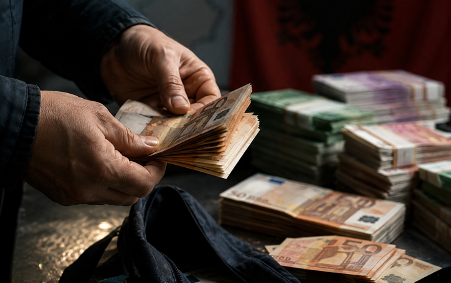
Eventually, the poor chap was reduced to tears and, at this point, his pockets were emptied and the money – $20 in local leks – provided by me that morning for petrol was carefully counted out. This would evidently do to account for some imagined driving infraction and the lot was confiscated, a ticket given and then promptly torn up. Then we were on our way again.
Not quite, though. As the policemen stopped another car and set about the next unfortunate, local people working at the side of the road in this mountain village approached with sympathy, drinks – and a fistful of leks which they energetically and noisily urged the driver to accept in compensation.
On the one hand, in 1993 Albania was Europe’s poorest and most backward country with surprises – not all pleasant – around every corner. On the other, it was a breathtakingly beautiful country of rugged grandeur and simple, generous people. Unfortunately, this incident – in an event-filled day – was not altogether untypical.
The tourist industry had hardly arrived yet. It was, after all, just two years since the country was released from the yoke of possibly the most brutal Communist regime in the world – almost one million of the country’s three million inhabitants were imprisoned at one time or another, Albania moved into total isolation from the rest of the world and its leader, Enver Hoxha, devoted himself to building no less than 700,000 concrete bunkers all over the country in defence against imagined enemies.
As he was totally paranoid, some of the bunkers faced north and east, when he feared the enemy might come form Russia or Europe, while others faced west when he feared attack from the US. Now with a democratically-elected government, Albania was opening its doors to the world but there was still much to be done – and undone – before it would become an entirely suitable tourist destination.
Minister of Tourism, Edmond Spaho, explained to me that there was a ten year plan for tourism, devised in association with the European Bank for Reconstruction and Development. “We shall avoid mass tourism and the pollution, destruction of the environment and unsympathetic building which comes with it. Instead, we shall build tourist villages with low hotels and promote the natural assets.”
These natural assets included what were termed the “museum cities” of Berat and Gjirokaster. Berat was a remarkably well preserved example of an Ottoman city with winding alleyways, mosques and semi-fortified houses, the whole dominated by the imposing mediaeval citadel.
Gjirokaster would shortly receive the accolade of a UNESCO World Heritage city, according to Spaho. Citadel, mosques, the old bazaar quarter and fortified 19th century merchants’ houses all clung to the hillside above the Drinos Valley. It came as no surprise that Gjirokaster caught the imagination of travellers like Byron, Hobhouse and Edward Lear. Sometimes, it was difficult to remember that you were, in fact, in southern Europe such was the the flavour of the Orient.