Or for printing more money
“No one should fear inflation,” writes Alqi Naqellari, discussing the monetary policies of the Bank of Albania (BoA), the central bank of the country. He expects greater profit from ignoring inflation risks and writes somewhat axiomatically that “Higher the risk is, higher is the profit”.
It’s not customary that Albanian economists contest the financial and monetary policies of the Bank of Albania (BoA). It is the core monetary institution in the country. Its policies are guided by the attention that the bank pays to the risk of inflation.
Discussing BoA’s policies
Led by the goal of stabilizing inflation and keeping it under control the Bank of Albania has maintained its interest rate at Šover the last [ quarter, 2 quarters, year]. “Aiming at the stabilization of inflation, the Bank of Albania (BoA), has over the last three years kept the base interest rate at quotes ranking among the highest in the world,” writes Alqi Naqellari quoting rates between 6.25 to 5.75 % applied over the last few years by the BoA.
Even at earlier times, Alqi Naqellari has been critical of the policies of the Bank of Albania (BoA), the central bank of the country. Naqellari believed even earlier that inflation in Albania is imported and that BoA’s policies have little impact on inflation’s course (Telegraf, interview by Albert Zholi, 10.12.2008).
With the aim of preventing inflation risks, the key threat that BoA sees is its responsibilities, the central bank has checked the national currency and has stimulated foreign currencies like the Euro or the US Dollar. One economist believes that the model of the inflation in Albania can be compared to that of the Scandinavian countries, and that inflation in Albania is imported. He explains that this kind of inflation is dependent on two factors: on prices of goods of exporting countries and exchange rates of foreign currencies to the Albanian national currency.
Naqellari argues that over the last few years the ratio of the base interest rate has followed the same tendency as the inflation base rate, while contrary tendencies should have been observed.
The need for cash
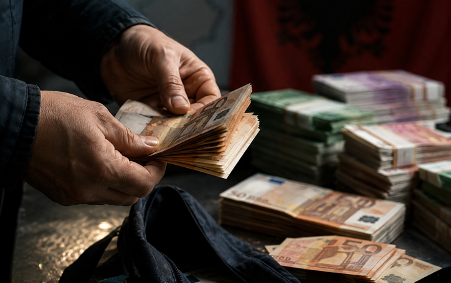
In his further analyses Dr. Alqi Naqellari outlines a need for cash. “The monetary basis has not grown with the rhythms of growth of the Albanian economy Ŭ” writes the controversial economist. “What has most influenced in the circulation of the Albanian currency has been the fastness of the circulation and not the growth or spread (volume) of money in circulation Ŭ” he believes, stating that “It is not true that the buying power of the Albanian national currency has been diminished, but the market lacks Albanian money. The market accuses a lack of cash Ţ
The analysis suggests a cash vacuum (or cash crunch) made more severe by government activity, policies and expectations. “During the three last years, the Albanian government has applied aggressive expansionist fiscal policies. Predictions for 2009 were untenable and impossible to realize,” writes the specialist in macroeconomics, continuing that, “The government orchestrated a contrary policy to that adopted by the Bank of Albania, stimulating the outcome of the Albanian national currency in circulation by the increase multiple times of wages, retirement indemnities and other operative spending,” and, “The budget spending for the electoral campaign was generally concentrated in the first quarter, creating an abyss between the cash in circulation and the absorbing capacity. This abyss creates, in an artificial manner, problems with the distribution of cash in time.”
As possible ways of coming out of this cash crunch, Dr. Naqellari suggests either the lowering of base interest rate by the BoA, or the printing out of money in agreement with the government and the Albanian parliament Šor both. “No one should fear inflation, “writes Alqi Naqellari, contradicting the monetary policies of the central bank, pursuing axiomatically that “Higher the risk is, higher is the profit”.