Tourism in Albania scores record growth
The International Day of Tourism, celebrated worldwide on the 27th of September, found Albania with a new Minister of Tourism, Culture, Youth and Sports, named Ferdinand Xhaferri, and with laudatory results in the field of tourism.
Over the last days, the press announced an increase of over 40 % of the number of visitors having come to Albania from January to August 2009, as compared to the former year.
These data give credentials to the recent declarations from the new government of having tourism as priority of priorities in the new four years to come.
A boom comes out of the loom
From January to August 2009, over 2,1 million visitors frequented Albania, according to data released by the Ministry of Tourism,Culture, Youth and Sports (Ministria e Turizmit, Kultur쳬 Rinis롤he Sporteve, MTKRS), largely echoed by the local press.
Referring to these data, Dr. Jorgji Kote, Doctor of Sciences and Diplomat, speaks of a “real touristic boom”. He highlights a “growth in the period of the harshest financial and economic crisis that the world has seen in the last 60 years” and makes observe that “the touristic season coincided with the pre- and post-electoral period in the country confirming to a high degree the composure, security and overall stability in the country” (Koha Jon묠11.09.2009).
The number of foreign citizens having frequented Albania in the eight first months of the year seems also to have increased. Reports from the press (Standard, 11.09.2009, Libertas, 12.09.2009) say that nearly 1,4 million foreign visitors (1,402,558) visited Albania in the eigth first months of the year.
Out of this stock, nearly 26 thousand (26,080) are reported to be day-trippers (called in the Albanian press “excursionists”) and nearly 1,4 million (1,376,478) are reported to be visitors with overnight stays in the country.
But no distinction seems to have been made in the data collected and treated by the MTKRS, between Albanian visitors living in Kosov롡nd in the Former Yugoslav Republic of Macedonia (FYROM) and foreign visitors. All of them are susceptible to appear in the same category.
Albania attracted visitors representing over half of its population
This year one of the most importants in the country as concerns the number of those having visited Albania. Precisely 2,111,981 visitors (roughly more than half of the population of the country) are reported to have visited the country in the eight first months of the year.
Nearly 700 thousand of these visitors (709,423) possessed Albanian citizenship and are represented as Albanians living abroad (Tema, 12.09.2009).
The press details that 78 % of the visitors (Libertas, 12.09.2009, speaks of foreign visitors exclusively) used road connections, 11 % airway coonections and 11 % maritime connections. High road connection usage may suggest large number of Albanians from Kosov련Kosovo) and FYROM, as well as visitors of other nationalities in the neighbourhood.
Europeans discover Albania
Though the data presented by the MTKRS make no distinction of the Albanian factor in tourism, the press seems enthusiastic at the large number of Europeans having frequented the country. Europeans “discover” Albania, titles Standard (11.09.2009).
The press highlights that Europeans represent amost 92 % of the visitors having frequented the country in the first eigt months of the year, while Americans represent 5 %, Asians 2 % and others 1 %.
“Compared to countries in the region, Albania has marked an increase of frequentation by foreign visitors. This increase is partially the result of a positive marketing made on behalf of Albania in displaying and recognizing the country as a touristic zone”, says tourism expert Genc Pasko (Shqip, 16.09.2009).
Though there are no official data yet on the part of the frequentation of Albanian beaches and resorts that has come from neighboring FYROM, reports from Libertas (12.09.2009) speak of an expected record of visitors from the neighboring country, (+ 20 %). The estimations refer to assessments from tourism operators in Shkup, (Skoplje), capital of FYROM.
More are expected for 2010 and the coming years, especially after the construction of what is called the Road of the Arb철(Rruga e Arb쳩t) that will conncet central Albania to capital FYROM.
New hotspots and expectations
Operators in FYROM quoted by the press say that the largest rise in numbers of visistors from the neighboring country has headed to the southern coastal cities of Vlor롡nd Sarand묠while the number of visitors going to the central beaches of Durr쳠have remained constant.
The quoted operators say that visitors fom FYROM during the summer of 2009 have also discovered new hotspots like the beaches of Velipoj련north), Himar롡nd Dh쳭i (south).
Earleir reports from the press (Koha Jon묠2.07.2009) state that MTKRS has set as a future challenge for welcoming 6 million visitors in the coming years. According to the Ministry of Tourism (MTKRS), in the following years Albania should draw 6 million tourists a year. This would represent 1 % of the 600 million tourists that visit each year the Mediterranean, says the MTKRS.
More visitors but what quantity of revenues ?
Tourism, increase of the number of visitors, decrease of spending, writes Tema, (12.09.2009). Revenues from tourism have multiplied by 5 times over the last years, writes the newspaper, but this year each visitor spent 15 % less than in the former year. This estimation is perhaps based on outdated information or aon a different timespan and may disqualify as new data will continue to agregate and to appear.
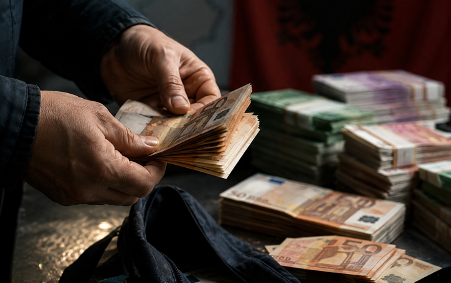
The first six months of the year, tourism revenues have brought the country nearly 511 million Euros, write some newspapers (Standard, 11.09.2009, Libertas, 12.09.2009).
Standard reports that in 2007, tourism brought 1,002 million Euros (full year), in 2008, alsmost 1,170 million Euros (full year) and in 2009, nearly 511 million Euros (in the first six months). If the rythm of the quoted first six months is not disrupted, in the next six months of 2009, the revenues of tourism may compare to those of the former years or experience an increase. The second half of 2009 will group the revenues collected in July and August, the most frequented months, with the revenus of the other less touristic months. The challenge of Albanian tourism will be to draw large flocks of visitors even in these less touristic months, (see on this matter former Tirana Times issues).
Balance and importance of tourism
Echoing data from the Bank of Albania, Koha Jon묠18.09.2009, gives another picture and another set of ciphers, but the newspaper refers to two different time-spans (January – September (nine months) and a semenster) and sectioned data are difficult to bear comparison. The important thing that comes from this set of data is that revenue from tourism in Albania has grown. The balance of revenues coming from travel services of visitors in Albania with the money spent in travel services by the Albanians abroad is finally positive. The newspaper speaks of a sufficit of 3 million Euros. This may be one of the rare times when there is a sufficit in the trade and services balance of the country.
Tourism has also been important in sustaining employment in the country. Over 1000 employees were expected to be employed seasonally at the beaches of the bay of Durr쳬 (Standard, 6.07.2009).
Albania’s Attractiveness
The rise of frequentation has supurred analyses of Albania’s attractiveness. Dr. Jorgji Kote, Doctor of Sciences and Diplomat, lists a full set of advantages that Albania has to offer to the foreign visitor (Koha Jon묠11.09.2009). The beauties of nature, socio-economic achievements of the last years make tourism in Albania very attractive. The modernization of infrastructure is making the country parcticable and is reducing sensibly the distances to touristic points, writes Kote. Moderinzation of infrastructure is also shortening distances between touristic spots.
Kote also lists the improvement of the quality and of the range of services of Albanian tourism operators, and set as comparative advantages: charming welcome, communicative abilities and especially “bio” aliments. Albanians speak a lot of languages and this makes communication very easy. They are well-disposed to the foreign visitor and food quality and variety of perparations is also benefic to the quality of welcome.
In most of the cases, prices offer also an attracting quality for foreign visitors.
Stimulating factors
The growth of frequentation of Albanian resorts is explained by Kote, by a bunchful of factors like adhesion in NATO, request for adhesion in the Europan Union (request for candidate status) and other events of integrative character, that draw Albania closer to the Western world.
Curiosity is also one of the factors, as twenty years ago Albania was one of the world’s most isolated countries. “Albania has been in the (positive) news … with a full dispaly of the symbols … Albanian flag in NATO headquarters. … These have been publicity and marketing of the name of Albania”, suggests Kote. “Being in the main chronicles and first pages of news, these images have attracted millions of watchers, many of which are potential tourists”, writes the analyst, who also lists visits of foreign personalities in Albania and cultural and sportive events.
A Set of Problems
Everything is not rose, though, in Albania. Lack of current water supply, hygiene problems, noise level and sometimes quality of service are still hurdles in the development of tourism in Albania, suggests Kote. The sheltering capacities are also short of ambitions according to him. Nearly 220 hotels of more than 5 rooms with a total of 10,000 beds are recorded by the National Institute of Statistic, according to Shqip (7.09.2009). The hotel capacity not sufficient to support even internal tourism, writes the newspaper. Kote analyses also that prices are not everywhere and at all times attractive and adequate to services and road and tourist infrastructure still need improvement.
Pollution of rivers and coasts
Tourism Threatened, Erzen and Ish쭠are polluted rivers, wrote Standard, (28.07.2009). The Regional Environmental Agency (REA) of Durr쳠stated that pollution was over allowed norms in the two rivers and posed a risk for coastal pollution near their deltas.
According to REA of Durr쳠experts, the pollution is due to the large use of rivers for the deposition of urban and inert waste.
According to the findings of a Swiss Institute (not named by Standard) from research conducted in May 2009, the river Ish쭬 may be the most polluted in the country. The river is 74 km long and is formed from the adjunction of the river of Tirana with the Rivulets of T쳫uz롡nd Zez묠runs near some of the most densely populated parts of the country.
The Ionian Coast
The Ionian Sea has a better reputation of being free from pollution. But recent development of the country has changed the data. The Ionian Sea at the Bay of Vlor롩s polluted by the sewage of hotels, bars and restaurants as well as other constructions all along the seaside and for this season this may have been one of the main problems for the holiday-goers (Panorama, 6.07.2009). Open air sewage lines can be watched running to the sea, reports the press.
Some of the constructions have carved septic fosses, but the problems remains the same since, after they collect waste waters they discharge them into the sea. Construction waste is also one of the polluting factors.
The bay of Durr쳍
Durr쳠counts the three most polluted beaches writes Panorama (6.07.2009). Some of these beaches collect the discharge of waste waters and waste remains of a population of almost half a million persons, writes the press. This situation has largely damaged quality of tourism and alerted of bacterial presence.
Through a report for the season “Summer 2009” The Directory of Primary Health (Drejtoria e Sh쯤etit Par촯r) Durr쳠has set pollution as a big concern. In the beaches of Currila, Shk쮢i i Kavaj쳬 or the sector of “Teuta”, the microbial charge of the sea-water is almost 10 times superior to the norms set by the World Health Organization (WHO), reports the press. In Currila, Shk쮢i i Kavaj쳬 Hidrovor, the presence of streptococci and staphylococci is observed.
The district of Durr쳬 with three bays and with a coastal line of 61.8 kilometers is part of the prioritary area for the development of tourism with particular national interest. It is an adequate zone for the development of the sun and sand tourism where are seated 45 % of the tourist accommodating capacities.
As the new government has set tourism as a priority of priorities, developements and support of tourism is expected to continue. It is not only determinant for other sectors, as governmental officials analyse, but also for the image of the country in the world.