Record-breaking crowds in the streets of Tirana and Vlora as Albanians celebrate Albania’s 100 years of independence. Nationalist speeches raise the stakes, concern neighbors.
TIRANA, Nov. 28. Celebrations for Albania’s 100 years of independence reached their peak on Nov. 28, with recording-braking crowds from all over Albania and the region coming to the streets of Tirana and Vlora to celebrate.
But the massive celebrations’ success in bringing about a wave of patriotism and uniting Albanians across the region under national pride, has also raised nationalism stakes, causing some concern in neighboring countries, which fear Albanian territorial claims, despite the official stance of Albania and Kosovo to have all Albanians united under the European Union rather than through border changes.
Massive celebrations
The atmosphere in Tirana and Vlora was unlike anything Albania has witnessed in decades, and perhaps the first massive celebration of its kind in terms of numbers of people who turned up in the streets of the capital and the southwestern port city where Albanians led by Ismail Qemali Vlora declared independence, raised the flag and formed the first government of a modern Albanian state on Nov. 2012, 1912.
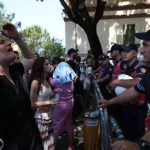
Hundreds of thousands of Albanians from Albania, Kosovo, Macedonia, Montenegro – joined by thousands more in the diaspora – from Turkey to North America – gathered in Skanderbeg Square in Tirana and Flag Square in Vlora for most of Wednesday, dancing and singing, waiving flags and listening to speeches by Albania’s political leaders, who were joined by all of Kosovo’s leaders as well as representatives from neighboring countries. In Skanderbeg Square, a record-breaking 18-ton cake was cut in honor of the festivities and distributed to the public. Fireworks lit up the skies over Tirana following a military parade and an open-air concert by by Albanian-British singer Rita Ora.
Nationalism comes to top of agenda
The centenary celebrations have brought with them a waive of national pride that has been largely unseen in Albania in the past two decades. It has led to nationalism moving up in the country’s agenda and the formation of new political forces.
Kreshnik Spahiu of the growing Red and Black Alliance Party let a rally at the Kosovo-Albania border, for example, starting an official petition for a referendum on the unification between Albania and Kosovo – the two states in the Balkans which with ethnic Albanian majorities. Spahiu’s declaration did not come as a surprise as the alliance’s support is based, among other things, on the nationalistic feelings in the country and beyond.
But Prime Minister Sali Berisha’s words were more politically daring in declarations he made in Skopje and Vlora, calling for Albanians to unite – mentioning the historic corners of ethnic Albania – all of which are currently under other countries’ rule – Greece, Macedonia, Serbia and Montenegro.
“This 100th anniversary invites, inspires us to continue and turn into reality the dream of those who in a century gave their lives for the national freedom and dignity. In fact that dream is, even if you read it 1,000 times, the dream of Albanians’ national union,” Berisha said speaking in Skopje. He called on Albanians “to work every minute, every hour, every day, every week, every month, every year for their unification. I call on my neighbors to try and understand fairly the Albanians’ unification, you will be freer, fairer and Albanians are ready for a friendly, long-term and century-old cooperation.”
Berisha later linked such words with an effort for Albanians’ vision of join Europe. “That’s the 100th anniversary of our belief, pledge, our European vision, of our vision of national union to turn into reality the dream of the fallen of this nation.”
Nationalist tone concerns neighbors
But the daring declarations from Albanian politicians, including the prime minister, has caused concern among Albania’s neighbors.
Prime Minister Sali Berisha said in Vlora that in 1912 the declaration of independence was for all Albanian lands, stretching from Preveza in Greece to Presevo in Serbia, and from the Macedonia’s capital Skopje to the Montenegro’s Podgorica.
The prime minister’s words caused uproar in Greece, where Foreign Minister Dimitris Avramopoulos canceled his visit to Tirana, where he was scheduled to attend the independence celebrations.
Macedonian President Gjorgje Ivanov had already called off his planed visit, citing incidents when after Macedonian Prime Minister Nicola Gruevski visited early in the week. His car was hit with an egg and a Macedonian flag was burned just Albanians in Macedonia planned a massive rally in that country’s capital, Skopje, declaring the city as a major center of Albanian culture.
Albania’s prime minister tried to smooth things over with Greece and the other neighbors, having his spokeswoman, Erla Mehilli, release a statement that the prime minister was speaking in a historical context and “in no way expressed any territorial claim towards our neighbors in the south, north or east.”
Serbia’s Presevo Valley, where ethnic Albanians are in the majority, has long been in the attention of Albanian leaders. No major Serb leader attended Albania’s celebrations.
Montenegro proved more tolerant, as its president did come to Tirana for the celebrations, as did the president and the prime ministers of Croatia, Hungary and Slovenia, as well as top officials from Italy and Kosovo.
Driven by political needs
The waive of rising patriotism associated with the 100 years of independence is understandable, say local analysts, but it is also leading to a political shift in the country. Tired of the two historical large parties’ quarrels, Albanians are increasingly turning to the message of the Red and Black Alliance, which sports a largely nationalist agenda.
In addition to Berisha’s increased nationalistic tone, the leader of the Socialist Party, Edi Rama, has put a lot of time in the ground in Kosovo and Macedonia talking about national issues.
“The two major parties are running scared from the success the Red and Black Alliance has had,” one analyst with knowledge of internal polls that show the alliance is gaining support in traditional strongholds of the other parties. “They are aiming to beef up their own patriotic credentials in the hope of not losing votes to the alliance.”
However, analysts note this does not mean what the western world has always feared in the Balkans, a return to ethnic warfare. It is more likely just a populist effort ahead of the parliamentary elections next year, according to analysts.
In power for a total of nearly 13 years, Berisha might also be looking to build a legacy as a leader promoting national union of all ethnic Albanians, something he has not done until now.
While there is concern, the more sound voices in in Tirana and Prishtina say the goal is to join Europe together and not create a new big ethnic Albanian state.
Divisive politics not smoothed by celebrations
Albania’s notoriously divisive political leaders, Rama of the opposition and Berisha in government, held largely separate celebrations in the southwestern port city of Vlore, where 100 years ago representatives from all over the ethnic Albanian-populated areas gathered to declare independence from the Ottoman Empire.
Rama organized an event honoring Kosovar Albanian academician Rexhep Qosja and the U.S. former Ambassador John Withers with the city medals and inaugurating Ismail Qemal bey Vlore monument.
Berisha attended a rally with supporters and a government-organized dinner on the evening of Nov. 27.
Both sides did not take part at each other’s events. But they did meet, briefly, on the morning of Nov. 28 and stood on the same stage for the celebrations in Vlora’s Flag Square.
There had earlier been some political friction on the independence ceremonies. The government tried to sideline Vlora as the center of the independence ceremonies. The opposition shout loud saying that normally Vlora turns into the country’s capital on Nov. 28. Vlora’s local government is run by the Socialist Party.
Analysts note that it would have been good form for both political sides would leave aside their disagreements and celebrated the 100th independence anniversary together, but the message of unity did not fully materialize.