Supporters of the Communist Party were not allowed to join the official procession because protocol officials feared they would roll out photos of the former communist dictator, Enver Hoxha, like they did last year.
TIRANA, May 5 – Albania marked the Nation’s Fallen Day this week with ceremonies that honor those who gave their lives for the country.
It is marked each year on May 5, the day when a senior leader for the communist resistance movement, Qemal Stafa, was killed during World War II.
Under the communist regime, the day held a high significance and focused in particular on those who gave their lives in communist guerrilla fighting against Fascist Italy and Nazi Germany during WWII.
It has however been a point a contention in post-communist Albania with different sides of political spectrum marking the day in different ways.
On one side, the governing leftist coalition of the Socialist Party and Socialist Movement for Integration held a ceremony on their own. Both Prime Minister Edi Rama and Parliament Speaker Ilir Meta laid their wreaths together.
The opposition Democratic Party of Tirana Mayor Lulzim Basha, together with former leader and premier Sali Berisha, went on their own in a separate ceremony at the cemetery.
One used a red carpet at the ceremony, the other a green one.
President Bujar Nishani, who has strong ties to the center-right Democratic Party, declined to join the ruling coalition for the state ceremony. Instead, he went to visit the family of the late Cpt. Feti Vogli who was killed in Afghanistan two years ago.
Both Meta and Basha spoke in front of reporters after the ceremony and both of them said that May 5 is a day of paying tribute to the people who sacrificed their life for the country and it should also be considered as a day of unity for Albanians.
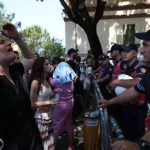
Supporters of the Communist Party, a small fringe party in today’s Albania, were not let to join the official procession.
Sources in the protocol office told Albanian media they feared they would become a nuisance like last November when they were seen at a similar ceremony keeping up the portrait of the late communist dictator, Enver Hoxha, behind the top three officials.
Albania celebrates this year its 70th anniversary of liberation at the end World War II, something local historians say is significant because the country received no direct foreign assistance from the Allies and largely freed itself through guerrilla fighting led by communist fighters that installed a brutal dictatorship led by Enver Hoxha at the end of the war.