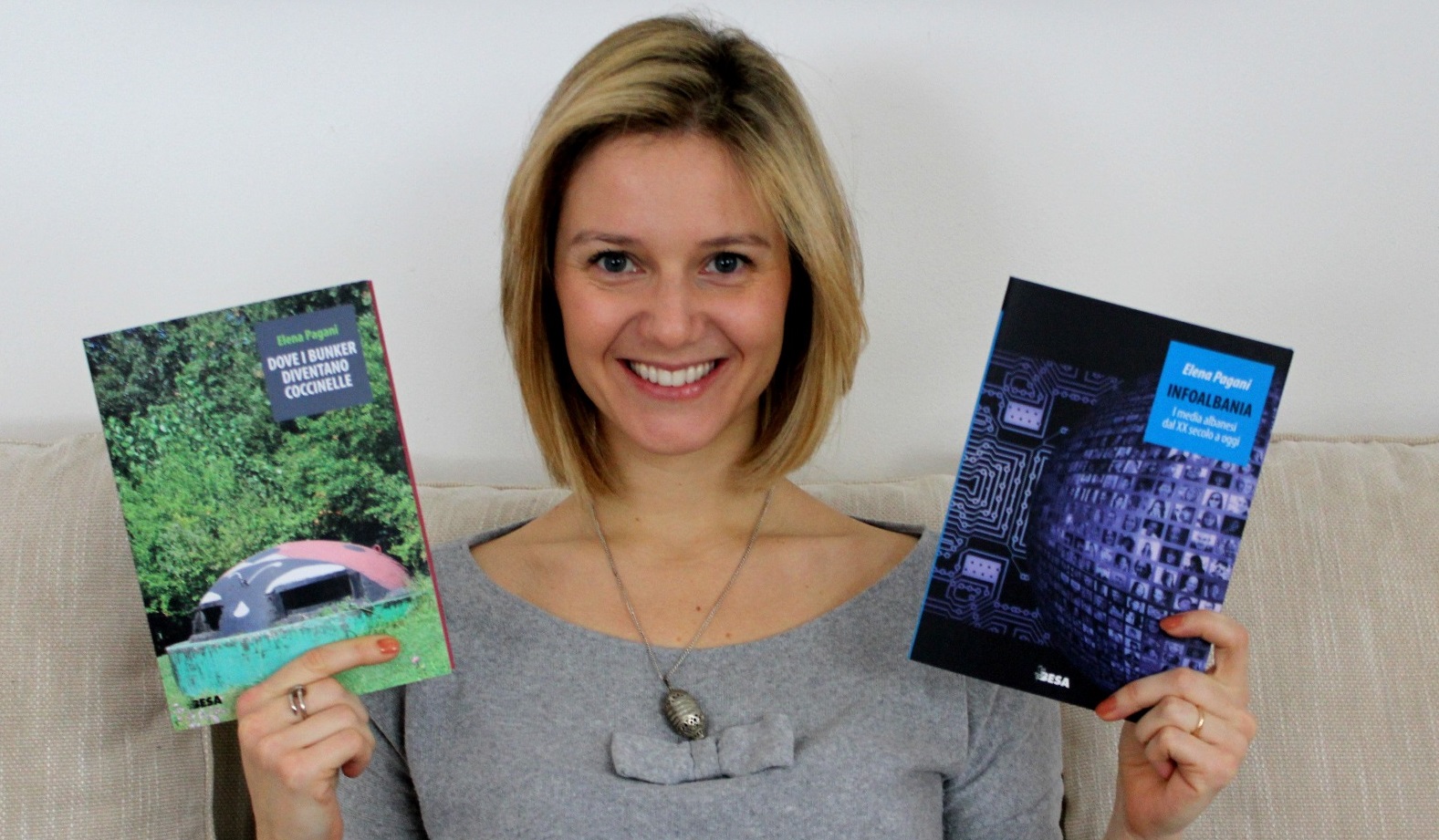
 Meet Elena Pagani, an Italian journalist and writer who has dedicated two books to Albania. “We are really very similar and everything one has to do to realize that is just go to Albania immediately,” Pagani, who is married to an Albanian, tells Tirana Times in an interview.
Elena, you are an Italian journalist with a special affection for Albania just like about half a million of Albanians based in Italy, among whom professionals and renowned artists, and about 3 million residents in Albania, have for Italy. How did this special link with Albania start for you?
-It all started thanks to my husband. I met this Albanian guy in my town. He was the owner of the restaurant I usually went to with my family and friends. Then, we started dating. He told me he was planning to return to his home country to start a new business. He left for Albania and two weeks later, he invited me to join him. I remember my first trip to Albania, it was on 30 September, 2008. It has almost been 10 years since then: we got married and we have a one-year-old child. I have written two books about Albania and I have been on a lot of trips, in some cases for more than a month.
You have published two books on Albania: the first one “Dove i bunker diventano coccinelle“ (Where bunkers turn into ladybirds) and the newly launched “InfoAlbania. I media albanesi dal XX secolo ad oggi” “InfoAlbania – Albania media from the 20th century to the present day). What can you tell us about them?
-The books are a consequence of my degree theses. While I was dating my husband and started travelling to Albania, I graduated in languages, specializing in journalism, and two years later in Human Rights and Ethics of International Cooperation. I wanted Albania to be part of my studies and for this reason, in both cases, I chose it as my thesis argument. The first thesis was based on the Albanian television journalism, while the second one on the history of Albania and its people, from the Ottoman invasion to the present day.
Albania’s communist era and the country’s transition to democracy and a market economy is a central topic in both your books with the bunker as a symbol of Albania’s hardline communist regime and its phobia as well the evolution of Albania’s media as an indicator of Albania’s freedom of expression and democracy. I guess Italians are not that familiar with those topics. What were the reactions to the books?
-Unfortunately, I must admit it, Italians know very little about Albania. For example, at school, we don’t study anything about it and that is absurd: first of all, if we consider the geographical proximity between our countries, but above all because of the ancient bond that unites them. I discovered and learned many things while writing the theses. However, in the past two or three years, I have noticed that interest in Albania has been growing exponentially. Newspapers, magazines, but also television broadcasts have started featuring that. I was interviewed by a Rai program for the first book that I wrote and also by a local television (the BergamoTv) twice. That means this is considered an interesting topic. I recently attended the National Book Fair in Milan where I was invited to present infoAlbania, my second book. I can see that people are surprised and curious about Albanian history. There are so many links between Albanians and Italians that I think that part of history should be studied at school. That is a rich, troubled story that deserves to be known.
Since you are a journalist yourself and work in Italy but also studied Albania’s media landscape evolution, strongly influenced by Italian media during the past quarter of century, what are some of the common challenges facing Albanian media nowadays and are there any similarities with the situation in Italy, which is a much larger and developed EU market?
-The Albanian media, as we consider it, does not have an early tradition. The same word, “media” in the plural form, were established with the democratic transition of the 1990s. During the communist regime, information was totally subordinated. There was no freedom of expression at all. Journalism is based on freedom of expression which is its fundamental pillar, recognized by international documents such as the Declaration of Human Rights, the European Convention of Human Rights and the International Pact of New York. In the 1990s, many TV stations and newspapers were born in Albania. Media pluralism has exploded. The problem, according to my studies, is that journalism is still subordinated to political and economic powers. This makes it not very free and independent. In the last chapter of my book, infoAlbania, I wrote about this particular issue, also considering the position attributed to Albania in the ranking of Reporters Without Borders who rate Albania in the 86th place. There are still strong ties with Italy, because often the Albanian media mechanically imitate the Italian formats, unfortunately without reworking them and adapting them to Albanian reality. Professionals should pretend more: higher protection and much more respect for their services. Even in Italy we have our problems from this point of view, in fact the Carta di Firenze (Florence Charter) was signed to protect journalistic work and fair compensation, preventing the exploitation of the profession, as editorial mobbing.
How do you find Albania, frankly speaking since it’s the home country of your husband and you could be more positive about it. Do you often visit Albania and how much do you think it has changed during the past quarter of a century, since you’ve studied Albania’s communist era?
-Albania has absolutely changed a lot. It has changed since 2008, exactly when I started visiting it. I realized it by myself and so did the people who came on holiday with me, friends and relatives. Albania is experiencing a profound, almost daily transition. There is huge ferment, especially in the capital city. Italians fall in love with Albania easily. I’m serious! The first impact is perhaps a bit difficult and strong, but then it is impossible not to fall in love with it. The scenery is enchanting, people are hospitable and welcoming, the food is excellent and that is very important for us. I think that Albania is a unique country that can compete with Italy in terms of food. In a small area you can find everything: lakes, mountains, sea and the countryside. Prices are still low, but infrastructure and tourist mentality are still lacking, although they are progressing. I am linked to Albania and its landscape, food, spirit and atmosphere. I consider Tirana my second home. And I advise everyone to visit it even just for a weekend.
Do you think Italians’ perceptions on Albania and Albanians are changing since more and more are visiting the country to work and study and the Albanian community there is getting well-integrated?
-Definitely. Visiting a country, knowing its reality, the people who live there, getting in close contact with them, helps open the mind and allows you to get a real idea of things. I would say that learning about history would not be bad, because it is only through it that we can understand aspects like the Albanian exodus on the Italian coast or the construction boom, but also the behavior of many Albanians living abroad. Italians and Albanians are cousins divided by the Adriatic. We are really very similar and everything one has to do to realize that is just go to Albania immediately.
Are you considering writing any other book on Albania and have you and your family ever thought of moving to Albania permanently?
-I thought about it these days! I would like to write a different book compared to the previous ones: this time I would like to write a book on curiosities about Albania, but above all on Albanians. For example, on the concept of hospitality, so different from ours in Bergamo, or on some customs such as that of making a mother-in-law and a daughter-in-law live together. I would like to write about the divided life that people who I met lead: migrants who made it abroad.
Is there anything else you would like to add?
-Yes, I would like to add something. The books I wrote certainly are due to my relationship with my husband, through whom I discovered a country that was unknown to me. But, there’s more. There are many Albanians I have met in the past ten years, in Italy and in Albania and it is to them that I would like to dedicate my books.