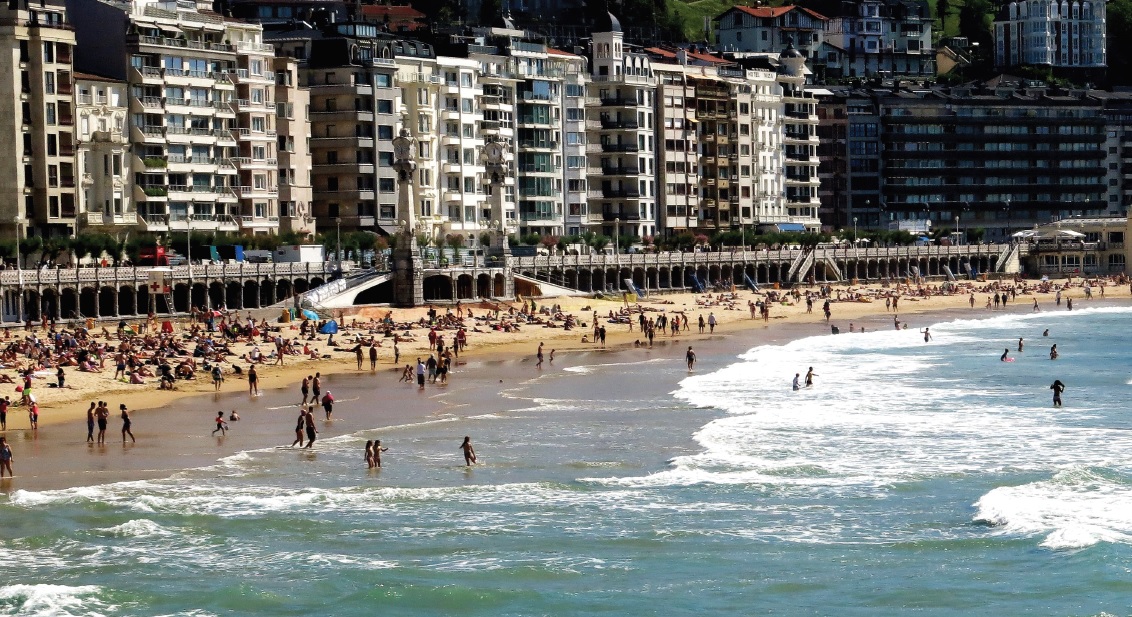
TIRANA, May 31 – Five wastewater treatment plants that Albania has made operational in recent years have considerably improved the quality of the country’s bathing waters, giving a boost to the emerging travel and tourism industry, although Albania has to further improve the quality of its excellent waters in order to catch up with leading EU travel destinations.
As the country gears up for its peak 2018 season, a report by Denmark-based European Environment Agency, an EU watchdog, has rated the overwhelming majority of about 85 percent of Albania’s bathing waters of excellent and at least sufficient quality, up from 66 percent in 2016 to account for Albania’s best ever result since 2014.
In Albania, 55 percent of bathing waters for 2017 rated at excellent quality and a combined 84.3 percent of all existing coastal bathing waters met at least sufficient water quality standards in 2017, says the report.
Only 12 bathing waters out of total of 102, mostly situated in downtown port areas and where rivers flow into the sea were rated of poor quality while quality qualification was not possible for four bathing sites due to not enough samples or new bathing waters subject to changes or closed.
“In Albania, assessed under the provisions of the Bathing Water Directive for the third time, 12 bathing water sites (or 11.8 percent) were classified as poor, which is 2.3 percentage points less than in 2016,” says the report examining the quality of bathing waters in 28 EU member states, Switzerland and Albania.
“Since 2015, when 31 bathing water sites (or 39.1 percent) were quality assessed as ‘poor’, the number of bathing water sites classified as poor has decreased significantly. This improvement can be associated with the five waste water treatment plants constructed in recent years, which provide waste water treatment for almost half a million residents and contribute to better bathing and overall water quality,” adds the report.
The wastewater treatment plants in the Adriatic beaches of Durres, Kavaja, Shengjin and Velipoja as well as the southern Ionian waters of Saranda were made available through EU support, considerably improving water quality along the country’s 476 km coastline since 2015 when about 40 percent of the country’s bathing waters were rated of poor quality.
The report shows most of Albania’s excellent water quality beaches are found along the southern Riviera in Himara and Saranda, but also Vlora where the Adriatic meets the Ionian. Excellent and good water quality beaches also dominate the more overcrowded Durres, Shengjin and Velipoja beaches in central and northern Albania.
Ten new coastal bathing waters were identified in Albania in 2017, taking the total number to 102 which represents 0.5 percent of Europe’s bathing waters.
Albania’s maximum bathing season in 2017 was at 128 days from May 16 to September 29.
Water samples are taken and analysed for two bacteria, Escherichia coli and intestinal enterococci which may indicate the presence of pollution, usually originating in sewage, livestock waste, bird faeces and water quality classified as excellent, good, sufficient or poor.
The country boasts dozens of sandy and rocky beaches along its 476 km coastline stretching through the Adriatic and Ionian, the most famous of which are found on the Albanian Riviera, south of the country.
Three UNESCO World Heritages, the Butrint archaeological park and the historic towns of Gjirokastra and Berat, in southern Albania, also unveil the rich cultural heritage in Albania, a gateway to the Mediterranean boasting a mix of Illyrian, Roman, Greek and Ottoman civilizations.