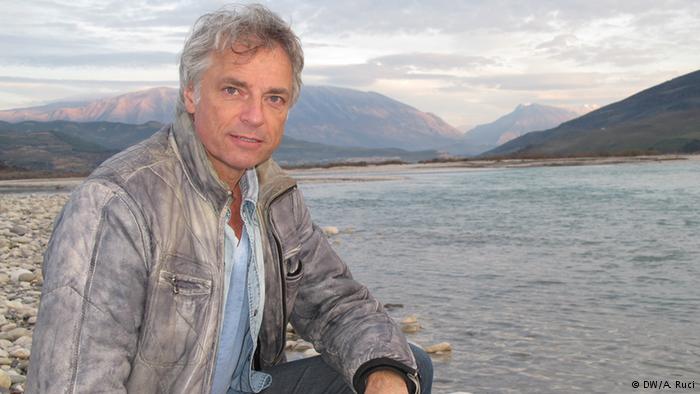
In an interview, Ulrich Eichelmann, CEO of Riverwatch and coordinator of ‘Save the Blue Heart of Europe’ campaign, explains why Albanians should take care of the the Vjosa River, one of Europe’s last untouched natural beauties.
Interviewed by Ben Andoni
The Vjosa River, with its problems in Albania as well, has been recently threatened by an attempt in Greece to divert the river on its territory. What damages could come as a results of such action, as you view it, in Albania’s ecosystem?
According to my information the project on the Aoos [the Greek name for Vjosa] has two elements. 1) They want to divert water for irrigation purposes; and 2) They want to produce electricity.
So they have to dam, to block the river. For the river with its flora and fauna the dam means that their habitat is fragmented and migration is blocked for most of the species. Also the transport of sediments will be changed and of course you have less water downstream. In short: you change a whole system, you change a healthy river into something artificial. It’s like you block an artery in your body and also take some blood out of it. That’s not healthy.
For the Vjosa in Albania it means less water in the first hand. This could lead to a reduction of the groundwater level in the Vjosa area, because the groundwater is strictly connected to the river. Less water in the Vjosa means less water for the groundwater. And as you know – the groundwater in floodplains is normally the best and purest water that nature provides for people. The project in Greece could also have an impact on the transportation of sediments (gravel, sand…).
You’re one of the key expert committed to protect Vjosa. Why is it that there is an increase in trying to get man-made intervention on it and other rivers like it, to destroy nature, in other words?
Good question. There is a more than one answer. Prior answer: It is all about money! Companies and investors simply make money by destroying nature. The more you destroy the more money you can earn. That is nothing new, but in our modern times the speed of destruction is increasing enormously. Due to the technical progress, we are for examples able to build hydropower plants in 1 year. 10 years ago the same project would have taken 3 years to construct. The machines are bigger and more efficient.
Another problem is that especially western companies are going to the Balkan to do what they are not allowed to do in our countries. Simply because the legal restrictions in these countries are not as strict as in the EU. So it is easy money for them, too.
Plus, the global warming discussion opened a unique chance for all investors and companies: hydropower is seen as “green” and supported by a lot of banks, investment funds, governments, etc. It is like a gold rush on our rivers. But, of course, hydropower is not green, not renewable. Hydropower plants destroy rivers/river stretches, the lifelines of our landscape. They are trying to sell nature destruction as climate protection. Which is ridiculous and wrong. You cannot save the climate or the environment by destroying nature on the ground.
Last, but not least the construction of dams is the biggest privatisation movement worldwide. A river runs naturally for everybody, for the animals, for fishermen, for farmers who feed sheep and cattle on the floodplains, for recreation of people, etc. When you build a dam, the water runs only for the investor. He makes money out of the water and anyone else has to go, including the biodiversity.
You have referred to the hundreds of dams planned to be built from Slovenia to Albania. How will they affect Balkan ecosystems if they are built?
You must know that the rivers in the Balkans are still of an outstanding ecological quality and beauty. We don’t have that anymore in the rest of Europe. No doubt about it, between Slovenia and Albania, we have the best rivers of the continent. And so is the biodiversity. For example the fish: we have 69 fish species here that live in these rivers and nowhere else on the planet. We have an incredible variety of trouts, the biggest predator of mountainous rivers, the Huchen (up to 1,8m long) has its global center in these rivers. This is a wonderful treasure for the region. It is a natural treasure, but can also be an economical resource, if managed wisely.
At the same time we have evidence of about 2,000 hydropower projects in the Balkans. Literally on every single river-stretch you find plans for a dam, from the big rivers to the small creeks way up in the mountains. If only part of them would be build, it would mean the end of this treasure. For example, if you build dams in the territory of the Huchen or trouts, that is the end for this species. This fact would delete the economical chance for a region to earn money from fly fishermen. Same for Vjosa: if you build dams on the river or its tributaries, you destroy the last wild river of Europe and with it, Albania’s chance to use this uniqueness for future eco tourism.
What are the the chances right now to create the Vjosa National Park? What would change if Vjosa become a protected national park?
Well, it is difficult to judge the political chances in Albania. In the end, it is a decision of the Albanian government which way to go, to destroy or to keep this outstanding jewel alive. I understand that some licences for hydropower plants have been sold years ago. More than 30 are in the pipeline in the Vjosa catchment (Vjosa and its tributaries). If they are built, forget about the river and the national park. It is an “either-or” decision. The functional chance that the Vjosa becomes a national park is very high, because this river is in a more or less natural state, which is outstanding for Europe. Therefore the first European Wild River National Park would be highly possible, and I am convinced it would be highly appreciated by the IUCN (International Union for the Conservation of Nature – the organisation that certifies Protected Areas world-wide). What would change?
A national park is for nature AND for people. A national park is not a closed area with fences or something. On the contrary, it is a place for the benefit of people, where people like you and me can see and feel nature without destroying it. So you need a concept, a management plan for the park, that clarifies where are the trails, where can you fish, feed your sheep, boat etc. — and where there are places where the wildlife shall be completely undisturbed. You need Rangers to take care of the concept, to guide people, etc. And you need a visitor centre, a house, where tourist can come to in order to learn about the park, get info about possible activities, where school classes can get educational trainings, etc.
I have been involved in the planning of a national park in Austria, the Danube National Park east of Vienna. In the 1984 Austria wanted to build a big dam into the Danube, but people protested and blocked the construction site in those days. It was a big thing. Suddenly the alternative idea of a Danube National Park came up and – after intense campaigning – the government decided to NOT build the dam, but to establish a national park instead. Since 1996 the park is in place with more than 2 million visitors per year.
Do you think that there still exist chances that the movement “Blue Heart for Europe” will manage to convince the Balkan governments on the importance of preserving of their wild rivers?
Yes I do. The Balkan Rivers are definitely the best rivers of the continent, the Blue Heart of Europe, and we are promoting that as much as we can. Problem is, that most people, even conservationists, have no idea about this natural treasure. It is simply unknown. We have to change that and we are working on this problem. We do a lot of media work, we promote the rivers in national and international media. At the same time we inform not only the national governments, but also the European Union. Bit by bit more persons in Brussels realize that the Balkan not only means post war, poverty and sometimes unstable political situations, but that this region has an incredible value, something that other European areas have lost a long time ago. The marketing people call this a “unique selling point”. It is something that you have and nobody else. If people from Europe want to see fascinating nature and healthy rivers – come to the Balkan, come to see and feel the Vjosa, the Neretva, the Drina, the Moraca, the Tara, the Una, the Kolpa, the Sava etc.
But – as always – the treasure that you have in front of you – is the hardest to see. That’s normal, because you grew up with these rivers. For you, it’s nothing to talk about. But you lack the comparison. People in Albania don’t know that the Vjosa is outstanding, because they don’t know what rivers look like in the rest of Europe. They don’t know that most of the rivers in the “west” have been turned into canals and that we have to pay the price for these mistakes: floods are getting stronger and stronger, the biodiversity loss is huge and the desire of people to see real nature grows. People in Albania and other countries don’t know that the EU spends every year millions to restore “sick rivers”, to make them more natural again. We European taxpayers pay the prize for mistakes done in the past, we finance projects to bring rivers closer to rivers like on the Balkan. In the United States, they even started to de-dam rivers. Since President Bill Clinton was in power, about 1,200 dams have been removed to re-create living rivers, to support wildlife and local communities. You must know this, at least your politicians should know this.
This is what is our biggest job: to make the people and especially the politicians aware what we have on the Balkan and what we are about to lose if we don’t act now.
*The Save the Blue Heart of Europe campaign was launched by the NGOs EuroNatur from Germany and Riverwatch, based in Vienna. In cooperation with local partners, they are aiming to save this natural European heritage from destruction. “ECO Albania” is its our partner in Albania that coordinates the campaign to save the Vjosa. More on www.balkanrivers.net