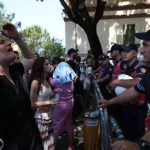
As extreme protest drags on, the formerly persecuted community’s, the government’s and the international community’s approaches are not dealing with the root of the problem.
Tirana Times
TIRANA, Oct. 18 – A small group of about eight former political prisoners continued their month-long protest as this newspaper went to press. The protest, which included a lengthy hunger strike and two protesters suffering serious injuries after setting themselves on fire, started on Sept. 22 with the goal of getting faster compensation for the formerly persecuted community’s suffering under Albania’s brutal communist regime.
As the extreme protest drags on, the formerly persecuted have vowed to continue protesting, even it means death for some of protesters. The government meanwhile says it won’t negotiate with protesters because the protest is political, not economical and the formerly persecuted are being used by the opposition. The official opposition, has largely stayed out of the debate, and says it has not ties to it. And the international community representatives in Albania have tried in vain to serve as negotiators between the protesters and government.
An extreme form of protest
Beyond some small protests in Albania and abroad, the society at large has so far not reacted to long-lasting protest.
Hunger strikes, an extreme form of protest anywhere in the world, have unfortunately become too common place in Albania.
Some are asking whether they belong in the Albania of 2012, at at a time when the country is a NATO member and and a candidate for European Union membership. Self-imolation, used twice by the strikers, is even more extreme. Many find these methods unacceptable.
Coming to terms with the past
Albania’s communist regime ruled Albania with an iron fist for 46 years until 1990, imprisoning tens of thousands of people under appalling conditions in a network of prisons and concentration camps.
Former prisoners or those suffering in camps and their family members are asking a payment of 2,000 leks (some 14 euros) per day. The law says that the reparations would be paid out in eight tranches with one installment paid per year. However, in the past five years only one segment has been paid out.
Analysts note that the issue of political prisoners and their financial compensation is an important component of how Albanian society in general and its state institutions deal with the past. Coming to terms with Albania’s communist past is a process that has not yet been completed. All laws and initiatives undertaken so far have been used for political capital and fighting opponents instead of heaving a proper confrontation with the past. The lustration law is a clear example of this.
The government’s aim to reduce the issue to purely economic compensation is an approach that cannot ensure their reintegration in society. A clear willingness to reintegrate and reconcile this part of the Albanian society has been missing. Instead the community has been used by political parties, which have divided the formerly politically persecuted for the sake of political power.
Government won’t negotiate
On Wednesday, the Tirana district court ordered an end to the strike as it was considered of being a cause for endangering their own and others’lives and that it was also held without a proper permission from the authorities.
The ruling, which came following a request by police, had not been executed as this newspaper went to press.
The hunger strike has reached threatening levels when two of the participants set themselves aflame and a third failed after being stopped from police.
The former political prisoners say the government has broken its pledges of compensation.
The government insists it has have already paid the first installment and that older people, more than 65 years old, are getting the second installment first.
Prime Minister Sali Berisha has firmly refused to consider the strikers’ requests, saying the protest has been manipulated by the opposition and pointing out that his government has already paid out some compensation. He has also accused directly some of the participants in the hunger strike of being very close to the opposition Socialists or that they have been involved in other petty criminal crimes in the last years. One of the strike coordinators was arrested Wednesday evening for allegedly deceiving an Italian citizen and asking compensation for a stolen car.
Also, the lines of the former political prisoners around the country are not united. Some of them have said they will also start hunger strikes in their cities while others blame the hunger strikers for being a tool in the opposition’s hands.
The opposition has tried to stay outside public debate on the strike so far.
Protesters vow to continue hunger strike
The remaining small group of seven hunger strikers vowed they would continue their fast to death if the government keeps ignoring their demand for faster reparations. They also said they had made a bet with each other that was next to set himself on fire. They said that if forced violently to leave the place where they are now holding the strike they will resume it at another place, possibly near the U.S. embassy in Tirana where, they said, police will be more reluctant to use force and pressure and take them away. But they insisted they need a dialogue with the government and Prime Minister Sali Berisha.
Several strikers have quit the protest over the past week mainly due to their deteriorating health.
Many policemen are seen at the strike area blocking it from entrance for other people. They provide only limited access to the strike for family members and reporters alike, usually under their watchful gaze.
On Sunday, a group of reporters covering the strike held a protest in front of the main government offices denouncing the lack of access to the strike and the government’s refusal to hear the strikers’ demands.
For the moment there seems no way out of the conflict between the hunger strike participants and the government. They are set to continue the strike, in other places if moved away from the existing one. The government says there is no need for a strike when they are already being paid. But authorities decline to sit down and talk with them.
Intervention by the international community
The international community representatives in Albania tried to serve as mediators between the protesters and the government based on the extreme form of protest and the past suffering for the formerly politically persecuted.
For many who would like Albanians to solve their own problems the approach was wrong. The argument is that the Albanian society and Albanian institutions have to face this situation on their own and try to solve it with dialogue that doesn’t involve internationals for once.
The mediation by international representatives was not requested directly at the beginning of the strike, and as such it was something done at their own initiative, which appears to put them in the spotlight again, with ambassadors serving as protagonists in something that is clearly a domestic Albanian issue, for which Albanians need to find their own solutions through proper legal channels.
It is understandable however that looking at a deteriorating situation, the international community has repeated calls for dialogue.
Both the U.S. Ambassador Alexander Arvizu and his EU counterpart Ettore Sequi have visited the hunger strike and called on the protesters not to resort to extreme acts of self-immolation. They also called on authorities to sit down and talk to strikers.
Several other international representatives in Albania have urged dialogue.