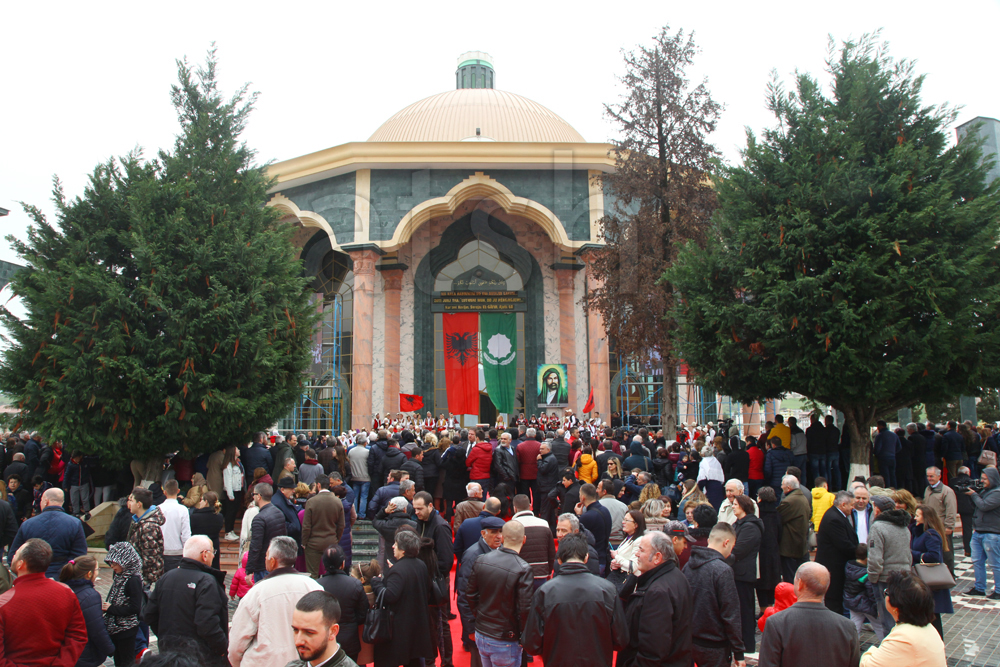
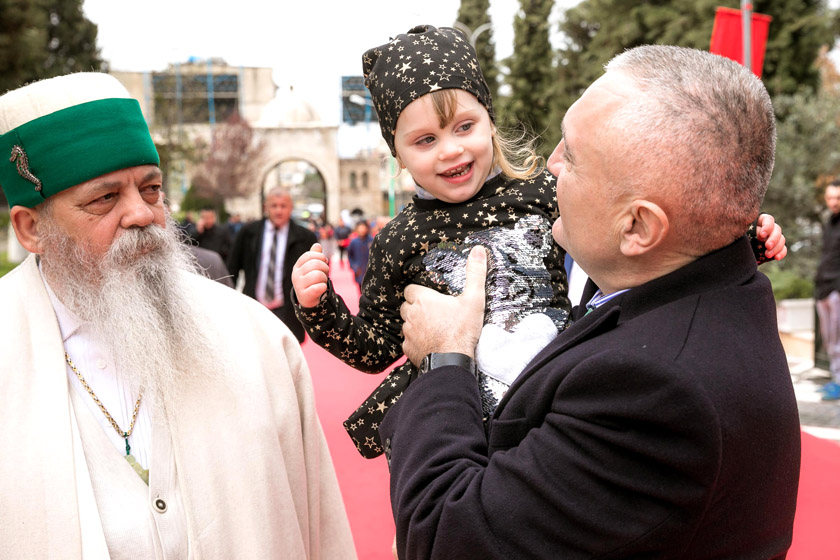
TIRANA, March 22 – Thousands of Albanians marked this week Novruz, a public holiday commemorating the Persian New Year and the birthday of Prophet Ali, with a traditional ceremony in Tirana, the host of the world headquarters of the Bektashi religion.
Addressing believers on Thursday from the Bektashi Odeon, a central place of worship and the seat of the global Bektashi community, Father Edmond Brahimaj, the head of the Bektashi community in Albania and around the world, appealed for more attention to people in need.
“Let us pray for people in need and the homeless, the orphans and their mothers. God bless them,” the Bektashi leader told believers.
Earlier this week, father Brahimaj brought to attention the lessons from Imam Ali, the son-in-law of Prophet Muhammad, and his battles with human greed, hypocrisy, struggle for money and power in the seventh century Arabian Peninsula.
“Of course, our imam Ali’s life was an example not only for followers of Islam but also others who don’t measure human concepts with their personal ego, but something much more sacred that could serve the future,” Father Edmond Brahimaj told an international symposium held this week in Tirana ahead of the Novruz holiday.
In September 2017, the Bektashi leader was awarded the Global Peace Icon award by a U.S. based NGO for his “insight and unique ability to inundate the soul with immense love and humbleness.”
One of the four traditional religions in Albania that is respected with a national holiday, the Bektashi, an ultra-liberal mystical Muslim sect with roots in Sufism and Shia Islam, make up between 2 to 3 percent of Albania’s population, mainly concentrated in southern Albania.
The Novruz Day has been a public holiday in Albania since 1996. The holiday is celebrated with a special pie and the traditional Bektashi dessert called Ashure, also known as Noah’s Pudding, consisting of grains, dried fruit and nuts.
Speaking from the world headquarters of the Bektashi religion, the country’s President Ilir Meta, a Bektashi believer, praised the Bektashi community’s role and contribution to the Albanian history.
“In this spring day, the great view that this square and the world headquarters of the Holy Bektashi See offer, especially your honored presence, shed more light and reflect even more the extraordinary values of the peaceful harmony and co-existence between religions in Albania,” said President Meta.
“Knowledge, wisdom and justice are inalienable traits, which have characterized and taken forward the Bektashi community in centuries, harmoniously interlinked with the unwavering feeling of inexhaustible patriotism,” he added.
Bektashi believers and pilgrims of all religions take to Mount Tomorr every August, commemorating Abbas ibn Ali, who died at the battle of Karbala in the 7th century, in a pilgrimage believed to bring healing and luck.
The Bektashi trace their entry into Albania to the famous 14th century legendary figure Sari Salltek associated with the town of Kruja, some 50 km off modern Tirana.
The Bektashi leaders were expelled from Turkey in the 1800s and early 1900s as heretics and found shelter in Albania as refugees because the country already had a strong Bektashi community and was tolerant on matters of religion. Some of Albania’s key figures from the national Renaissance era leading to the country’s independence, like the Frasheri Brothers, were Bektashi.
Likewise the other religious communities in Albania, the Bektashi community was persecuted by the communist authorities until dissolving in 1967 when Albania banned religion, becoming the world’s first official atheist country.
During the religion ban under communism, the Albanian Bektashi tradition was kept alive by a tekke in Gjakova, Kosovo and another one Detroit, the U.S.
The Tirana tekke and its world headquarters reopened in January 1991 as the communist regime collapsed.
Albania’s religious harmony is praised internationally as an example to be followed.
Surveys show residents of Albania to be among Europe’s least religious people in terms of practicing any of the country’s four traditional faiths, but according to the latest 2011 census, Sunni Muslims constitute nearly 57 percent of the population, Roman Catholics 10 percent, Orthodox Christians nearly 7 percent, and Bektashi (a form of Shia Sufism) 2 percent.