By Armand Mero*
Last year in Albania witnessed a series of political events ranging from local elections to decriminalization and the justice reform, which led to an intensified political stand-off whereas the economy was at a standstill. Obviously, the highlight of the year was the qualification of the Albanian national football team by reaching the finals of Euro 2016.
Decriminalization and the Doshi case
While an agreement was reached last December and decriminalization had to be resolved within the first half of the year, it would drag on amidst different proposals made at different points in time.
The Democrats would declare in the beginning of the year that decriminalization is going to be their priority. On February 19, Parliament approves the creation of a special committee on this matter. A week later, the Doshi case would explode. The Socialist MP goes to declare in front of the Parliament building that “once he starts talking, it will shake the foundations of the ruling majority and government” .
Soon after, the deputy is expelled from the ranks of the Socialist Party. Tom Doshi makes another strong declaration saying this time that “Prime Minister Edi Rama has got a tutor whose name is Ilir Meta who has paid money to kill me and Mhill Fufi” , a Democratic Party MP.
Afterwards, Doshi would publish a video involving the alleged hitman Durim Bami. Authorities are no strangers to this case and it is not clear why investigations didn’t start earlier, but only after MP Doshi spoke publicly. This case would turn into Albanian politics’ hot potato for weeks to come.
Following accusations, former Prime Minister Sali Berisha would be quick to ask for the immediate resignation of the Speaker of Parliament Ilir Meta, who in turn refused to step down.
The opposition staged a protest on March 12, asking once again for the resignation of Ilir Meta as Speaker of Parliament.
Investigations on the case were conducted quickly and like never before a large number of political figures would appear in front of the Prosecution Office to testify. Another MP from the ruling majority Mark Frroku would get involved in the case. Charges would later be filed against Doshi and Frroku together with the alleged hitman Durim Bami and will be arrested on March 26th. Soon, another case would be opened against Frroku for an alleged murder committed in Brussels in 1999, which will cost the job to the head of the State Police Artan Didi. The latter resigned on March 31, after it emerged that the request for extradition by Belgian authorities were dragged by Interpol Tirana.
The Doshi case would be exploited by the opposition which pressed on the decriminalization issue by depositing its proposals. Debates regarding politicians with a criminal background would return during the electoral campaign. A strong voice will be that of U.S Ambassador Donald Lu who went to declare that “We have identified the names of certain individuals with a potential criminal past and we are discussing their cases with the political leaders” . Three days later, the Democrats withdraw their candidate in Kelcyre for allegations of a criminal past, while the Socialists despite allegations on particular names do not take any concrete steps.
Once more the Americans would press on the matter in July, during a visit in Tirana of State Secretary for Europe and Eurasia Victoria Nuland. A few days later, a report by the U.S State Department states that an Albanian MP has been previously sentenced for human trafficking. The MP mentioned is Arben Ndoka, who in September will resign as a member of Parliament, followed by Frroku who will also step down by the end of November.
PM Edi Rama announces on July 30 in the new session that the left will present its own draft. A day later the Democrats will make their own proposals, while the government will approve the decriminalization law in September. Despite divergences, parties conducted talks and finally reached consensus in November. Consensus is reached a few weeks later for constitutional changes also, which the parliament votes in unanimity. The U.S embassy and EU delegation in Tirana welcome the approval.
Justice
For the European Union, the consensus reached on the decriminalization package should serve as an example for the justice reform as well. A reform which in the words of the U.S Ambassador Donald Lu is considered as the most important reform in pluralist Albania.
The ad hoc committee on justice reform would engage several Albanian and international experts in the first half of the year to compile a thorough analysis of the system. Upon completion of this phase, Albanian President Bujar Nishani fresh off a series of clashes with the ruling majority, voiced his criticism during a closed door meeting held on June 3rd calling the process as biased. The Democrats, who refused to be part of the committee by insisting on equal representation and co-chairing, were also critics.
During the presentation of the justice system analysis on June 8, U.S Ambassador Donald Lu spoke openly for the situation in Albania’s judiciary saying that certain people should lose their jobs while others belong in jail. Whereas the head of the European Union delegation in Tirana Romana Vlahutin said the reform should be thorough and without compromise.
Both ambassadors will be invested in the cause like never before. Initially, they work as mediators for the participation of the opposition in the ad hoc committee, which finally agrees on July 7.
Constitutional amendments on the matter are approved in September and a month later are sent to the Venice Commission. The opposition is again critical and submits its own proposals to the Venice Commission on September 28. While President Nishani, through a letter sent to the Commission, expressed his objections on the way the Commission has acted and also regarding the nature of amendments.
In the remaining part of the year, the U.S ambassador will publicly support the justice reform, which foresees the almost complete dismantling of the current system. Opposing the reform according to the U.S ambassador are “the corrupt ministers, members of parliament with a criminal past, incompetent judges and prosecutors who receive your money, but never prosecute anyone” .
Constitutional amendments receive an evaluation from the Venice Commission in December, while Albania’s General Prosecutor Adriatik Llalla and Justice Minister Ylli Manjani join the opposition in voicing their criticism. The U.S Ambassador Lu declares on December 22 that some powerful people in Albania are afraid of losing their jobs and fear of ending in prison adding that maybe they should be afraid.
The next day the U.S ambassador meets with former Prime Minister Sali Berisha and the head of the opposition Lulzim Basha, after which the latter will guarantee support for the recommendations of the Venice Commission. The Socialist Movement for Integration will reconfirm its support on the Commission’s document the same day. Nevertheless, the battle for the reform is still open.
Elections
Local elections were held for the first time according to the new administrative-territorial reform, with no substantial change between the two political camps. The coalition of the left achieved a landslide win over the right, but the first cracks in the ruling coalition between the Socialist Party and the Socialist Movement for Integration would emerge. Political tension will simmer in the second half of the year following accusations for corruption in the higher echelons of power and the opposition will once again take to the streets, this time to demand a technical government.
Local elections on June 21 were the government’s first test after coming in power, while for the head of the opposition Lulzim Basha this will be a double test, one for his four-year term in office as Tirana Mayor and another one as the leader of the opposition, the latter is the only role he would assume as he decides not to run for a second term.
Prime Minister Edi Rama forged new alliances ahead of the elections forming a coalition consisting of 37 political parties, while his main coalition ally the Socialist Movement for Integration will be trusted 15 out of the 61 new municipalities. Meanwhile, the opposition will form a smaller coalition of just15 parties.
The main battleground would be the capital Tirana with both camps announcing their respective candidates on the same day, April 16th. Prime Minister Edi Rama picked one of his cabinet members Erion Veliaj as the candidate of the Alliance for European Albania, whereas the Democrats chose as their candidate Halim Kosova, a doctor previously not involved in politics. Throughout the campaign the opposition kept stressing the fact that the ballot on June 21 would be a referendum against the government, while Socialists would stick to smearing their opponents.
The elections would result in a sweeping victory for the left which secured 45 municipalities while the remaining 15 would go to the opposition. The Municipality of Finiq would go to Mega, a party representing the Greek minority in Albania. The left would score a landslide win in big cities, including Tirana where the Socialist candidate Veliaj receives 44,000 votes over his rival, who congratulates Veliaj on his election. In terms of municipality councils, the left coalition secures over 990,000 votes versus 507,000 obtained by the right.
The day after international monitors pointed out hurdles in the process resulting from a lack of political will, while they also raise concerns over vote buying and intimidation. In his first public appearance after the elections, the head of the Democratic Party Lulzim Basha would declare that the elections were “a big step forward for the Democratic Party” , while later he will switch to accusations over vote rigging. Nonetheless, important voices from within the party would admit defeat in the local elections.
In the other political camp, the result obtained in the elections would spur the first friction in public between the Socialists and the Socialist Movement for Integration with both parties casting doubts on the sincerity of each side during the elections. The mistrust would get deeper, while not publicly voiced, after the DIA case went public following a publication by BIRN. DIA’s owner Kastriot Ismailaj, is said to have bribed a former prime minister and another high official of the energy regulator ERE to secure the contract involving the collection of unpaid bills on behalf of Czech company CEZ. The opposition immediately pointed the finger towards the Speaker of Parliament Ilir Meta calling for his resignation by considering it a prerequisite for the full investigation of the matter. These accusations were in turn publicly denied by the head of the Albanian Parliament Meta.
The opposition goes even further asking for an international investigation of the agreement reached between the government and Czech company CEZ labeling it as a mega scandal. The ruling majority say they agree in principle, but they also insist on an investigation into the purchase by CEZ of the Albanian power distribution operator. The opposition’s proposal for an international investigation would later be dropped.
The government’s main ally, The Socialist Movement for Integration suspects that behind the publication of the documents on DIA stands Prime Minister Edi Rama, and that the latter has entered secret talks with the opposition. “Basha is the only opposition leader who instead of asking for the resignation of the Prime Minister calls for the resignation of the Speaker of Parliament” , would Meta declare on September 26th. Soon afterwards, SMI intensifies voices for changes in the government, saying that “new impulses” are needed after a meeting of the party chairmanship. Prime Minister Minister Edi Rama insists there will be no changes in the government, until Justice Minister Nasip Naco suddenly resigns on November 9th and is substituted on the very same day by another SMI member Ylli Manjani. The two sides step up public meetings, but seems like disagreements are sidelined just temporarily.
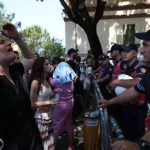
In the meantime, the opposition has raised the tone and the denouncement of corruption scandals involving public officials gets even more frequent. The opposition’s political attacks would mainly focus on Interior Minister Saimir Tahiri and Health Minister Ilir Beqja. By the end of the year, the opposition believes time is ripe for snap elections. A protest is staged in front of the government offices on December 8, which ends with the setting on fire of a bunker erected near the Interior Ministry as part of a cultural project. Two other opposition protests follow with the promise that the battle will intensify come January.
Economy
The economy would remain a topic of hot political debate throughout 2015. The government was forced to lower its previous estimates on economic growth, while it undertook a wide campaign against informality in the second half of the year, after revenues fell.
Albania’s Central Bank lowered the key interest rate to 2% in order to stimulate the economy, but in November it would have to cut again the key interest rate by a further 0.25%. Authorities predicted a growth rate of 3 percent, which was confirmed in March by the International Monetary Fund mission on March 17. Gross Domestic Product would be around 2.8 percent, reaching 2.5 percent for the second trimester. The middle part of the year would witness increasing worries over the effect of the Greek crisis in Albania. Nevertheless, Albanian authorities as well as the IMF downplay these worries saying there is no room for panic. In fact, the Albanian economy faces another problem: a sharp decline in revenues. The International Monetary fund declines to approve the next loan tranche at the end of its visit on June 30. By the end of July, the government would have to review the budget and reduce forecasts on economic growth. While in the lens of the opposition, the prime minister legalized the theft of 160 million euros from tax offices and customs. For Albanian authorities, the gap in revenue stems from market conjunctures. Nonetheless, the free fall will continue in the second half of the year, while the government will start a large operation against informality. The operation will be met by harsh criticism because it mainly focused over small businesses and task forces on the ground were often arrogant. Prime Minister Rama would later accept criticism and announce facilitation for all businesses with an annual turnover up to 5 million Leks (approximately Euro 35,750) declaring they would be excluded from the tax on profits. The opposition would later say that the government has copied their program for alleviating barriers for small businesses.
The campaign against informality would pave the way to the approval of the loan tranches by the IMF, which considered the results obtained in line with the program. But debates in Parliament on the matter would be fierce.
The struggling economy is considered as one of the main causes for an unprecedented influx of Albanians headed to Germany to seek asylum. Authorities in the beginning justified the occurrence as a misinterpretation of news for vacant job positions in Germany, then switched the blame on human traffickers and finally declared that the large bulk of over 50, 000 Albanians headed to Germany were immigrants who had previously lived in Greece, a view which was not confirmed by the German Interior Minister Thomas De Maziere during a visit to Tirana.
This article first appeared on the Albanian section of the Voice of America. It has been translated into English by Tirana Times. The headline is also by this newspaper