
By Artan Lame
1940-1943. The Game with the Crowns. In October 1940, the Italo-Greek War broke out, which lasted for roughly eight months and Mussolini only managed to win it thanks to the intervention of the Germans. The Greeks, who felt betrayed and attacked in their own country, put up a strong resistance to the Italian Armed Forces, mobilizing all the forces and means at their disposal. In the domain of propaganda, dozens of cartoons appeared in the Greek newspapers during those months, where all means available were used to take the Mickey out of the Italians. In the first cartoon you can see Mussolini (characteristic features: sagging belly and bald head), offering King Viktor Emanuel III the Crown of the Greek Monarchy too. The Greek Monarch, (also short due to a genetic defect at birth), can be seen in parade dress, with three crowns on his head; the Crown of the King of Italy, the Crown of the Emperor of Ethiopia and the Crown of the King of Albania, which were his three official titles. At the tips of the three crowns, you can make out the goat horns of Skenderbeg’s Coat of Arms, which symbolically played the role of the Crown of Albania, a Crown which the Constitutional Assembly of Tirana had offered the King of Italy in April 1939, after having snatched it from the head of King Zog. Grand gesture of patriotism!
Four and a half years after this offer and precisely three years after the publication of this cartoon, in October 1943, another Constitutional Assembly, urgently summoned in Tirana following Italy’s capitulation, decided to no longer recognize unity with Italy. Subsequently, the Crown of Albania slipped off the head of Viktor-Emanuel III, to return to Albania.
The second cartoon was published in the Albanian press of the time and echoes exactly the same event. A young Albanian lad dressed in Albanian folk costume is seen, back turned on the King, walking away, carrying Skenderbeg’s helmet on a ceremonial cushion. Viktor-Emanuel can be seen bent over, sitting on the Royal Throne, on the back of which, the Royal Monogram “VE” is stamped. Poor old Viktor seems furious, because nobody consulted with him either when he was given the crown or when it was removed from him.
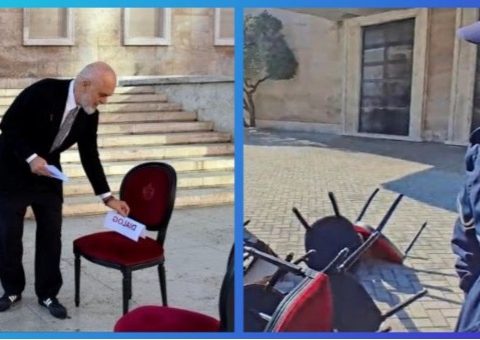
Look carefully at the shape of the throne. This chair, which plays the role of the Royal Throne, exists to this day and can be found in the Palace of Brigades, in the Grand Reception Hall. During the work done in 2004, on the re-arrangement of several pieces of equipment, when the Palace was opened to the public, I discovered it in the corridors of the cellars and intervened to have it returned to the place where it is today. The King should actually be very grateful to me that even though I didn’t manage to save his crown, at least I saved his throne. In Albania, it is only the second item that is of value.
Anyhow, irrespective of the ups and downs the Crown of Albania went through on and off the heads of different historical characters during the years of the war, it is just as well that the original is a long way from our grasp, secure and resting in the Museum of Vienna. No one knows where it would have ended up if it had been left in our midst. Today we would have been saying with our traditional pride, “Its true that the helmet is lost to us for ever, but the memory of it lives on in our hearts.”
Forsaken Albania

Change font size:
Recommended Articles

Latest from Features

The Western Balkans’ Right to Democracy Depends on the EU Enlargement
Change font size: - + Reset by Sokol Lleshi, Assistant Professor of Political Science, University of New York Tirana Background The political systems in the Western Balkan region feature politicized public administrations,

Why Waiting Is Not Neutral: The Costs of Non-Enlargement
Change font size: - + Reset Debates about EU enlargement tend to focus on the risks of admitting countries before they are ready. In her recent paper, Marta Szpala broadens the debate

Beyond Diplomacy: Ambassador Elissa Golberg on the Future of Canada–Albania Ties
Change font size: - + Reset Tirana Times, July 21, 2026 – Relations between Albania and Canada have expanded steadily in recent years, from growing trade and new bilateral agreements to closer

EU-Western Balkans Summit 2026: New Impetus for the Enlargement Debate?
Change font size: - + Reset By Odeta Barbullushi and Marina Vulovic Tirana Times, June 09, 2026 – A new proposal on enlargement was tabled by the French President Emmanuel Macron and
The Pope, AI and the Future of Humanity
Change font size: - + Reset The most important political text of the 21st century comes not from politicians but from Pope Leo XIV by Milena Harito I am an atheist, but