German foreign minister calls for an end to nationalistic rhetoric in Albania; U.S. Deputy Assistant Secretary of State Philip Reeker says no border changes will be allowed
TIRANA, Feb. 22 – Germany’s foreign minister Guido Westerwelle said he supports Albania’s bid for European Union membership but cautioned against nationalist rhetoric that could hurt the process.
Westerwelle visited Tirana last Friday, at the same time as U.S. Deputy Assistant Secretary of State Philip Reeker, and both met with all top Albanian officials in the country, including main opposition Socialist Party leader Edi Rama.
Westerwelle told Albanian Prime Minister Sali Berisha that Albania is close to demonstrating the necessary general qualifications — a functional democratic government, independent judiciary and stable economy — for EU inclusion. Westerwelle said sentiments like those Berisha expressed last year about uniting all Albanians under a common flag run contrary to the EU’s purpose.
Berisha’s words in November during the celebrations for the country’s 100th independence anniversary were also condemned by the U.S. State Department. Berisha referred to towns in Montenegro, Greece, Macedonia and Serbia as “Albanian lands,” and last month he hailed Albanian ex-guerrillas in southern Serbia as “heroes of the Albanian nation.”
That was also seen as a provocation by neighboring countries such as Macedonia, Greece, Montenegro and Serbia where there are large ethnic Albanian minorities, and Kosovo which has a majority of ethnic Albanians.
“The common goal of all the states in the region is, one day, to be part of the European Union, where we have freedom of movement for everybody,” Westerwelle said. “That is why a redrawing of national boundaries is out of the question, including the Balkans. In Europe, borders are losing their significance.”
Germany warned Albanian leaders to refrain from using inflammatory nationalist rhetoric amid international concern over growing talk of the Greater Albania.
Kreshnik Spahiu, leader of the Red and Black Alliance party, founded last year, has been pushing for uniting Albania with Kosovo. The party also started a petition and handed it to the central election commission asking for a referendum on the joining of the two countries.
Though the leadership of both Tirana and Pristina have denied of any plans for a merger and say their joint place will be in Europe, the words have sparked concerns among the neighbors.
“It is important that nationalist feelings and emotions be controlled and treated with a big responsibility and a lot of attention,” Westerwelle said. “No changes of borders are allowed in the Balkans,” he added. “To see all the states of the region joining the European Union one day has to be a common goal.”
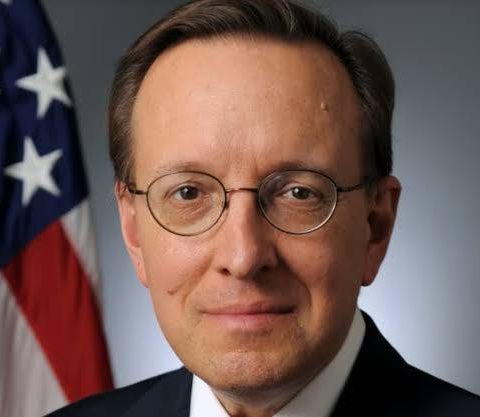
The U.S. recently warned Tirana it was playing a “dangerous game,” and U.S. Deputy Assistant Secretary of State Philip Reeker on Friday said that Albania had to stop resorting to nationalist rhetoric and focus on meeting the criteria needed to obtain the EU membership candidate status.
Washington was blunt with NATO ally Tirana last week warning that nationalist rhetoric in the run-up to a June election risked destabilizing a hard-won but still fragile peace in the region.
Albania will hold parliamentary election on June 23. Hardline nationalism could be a tool that the political parties of their leaders may exploit or use to get support and votes.
A week ago the local media had reported on an alleged U.S. State Department memo that had warned such comments could “erode peace and stability” and told Tirana to “stay out of the affairs of Serbia.”
That sentiment was openly repeated by Reeker in a talk show Thursday.
“Borders and boundaries are set, and the U.S. is firmly against any changes of borders, so calls to unify Albanians or calls to unify groups based on ethnicity or nationality are counterproductive,” he said in an interview with Top Channel private TV station.
“It concerns us, it concerns our European friends, and it should be of concern to everyone,” Reeker added.
Albanian Foreign Minister Edmond Panariti said in the joint news conference with Westerwelle that Tirana remained a force for stability in the region.
“It has not, does not, and will not have any territorial claims toward its neighbors,” Panariti said.