By Rudina Hoxha
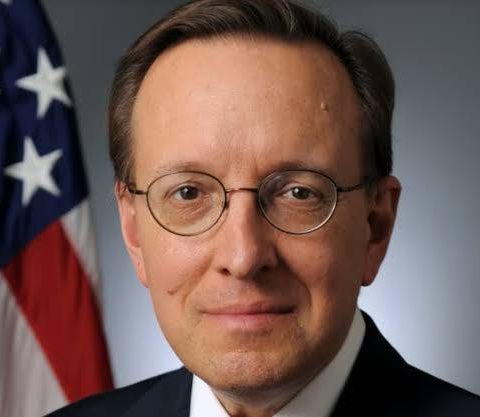
 Amidst the hot debates on the reform of the judiciary, the German Ambassador to Albania, Hellmut Hoffmann, states that “We can see through games and maneuvers and we will certainly remember, who was helpful and who was not helpful in case the reform were to fail, which I really hope will not be the case.”
Hoffmann used a German manner of speaking to explain the behavior of those who are impeding the voting of the reform in the judiciary: “Opponents will of course always publicly say ‘We fully support the reform of the judiciary!’, but at the same time – as we say in German – they throw sand into the engine all the time by bringing up all kinds of alternatives, proposals and new ideas. This is of course the oldest trick on the book of stalling tactics,” he said.
The Ambassador remains critical of the political culture in Albania. “I think in a functioning democracy there must be a minimum degree of working relations between the holders of highest public office. It is no good when they throw mud at one another” he said. Hoffman also turned down speculations about German investors allegedly leaving Albania, wondering in whose interest it could be to spread such rumors.
What are your general sentiments about the Albanian politics right now?
Albania is a country in transition which wants to become an EU member. As an EU member state representative it is only natural that I would watch very attentively how Albanian politics develop and have my own thoughts about it. Quite frankly: I have rather mixed feelings these days.
Right now I am particularly concerned about the prospects of the judicial reform, because there is so much at stake here and there is clearly too much party-political grandstanding and maneuvering going on. Looking at the wider picture, I find the strikingly bad relationship between some of the constitutional organs and between some of the constitutional organs and other holders of high public office quite problematic. Competition is certainly good in a democracy, but I think in a functioning democracy there must be a minimum degree of working relations between the holders of highest public office. It is no good when they throw mud at one another.
More generally I observe a strange culture of what I would call “a permanent full-blown attack mode” and an a priori presumption of worst intentions on the other side. It seems that whatever the other side does, almost by definition is seen as bad-intentioned and evil. It is difficult for a democratic system to function well on such a basis.
What are your expectations about the reform of the judiciary in Albania? Do you agree with the opposition’s leader declaration that rather than t deadlines, the final product is far more important? But on the other hand, the internationals press on timing – the reform should be approved in June.
I think everybody must be very clear: if this reform is not adopted by the end of June, there will be no recommendation for the opening of accession negotiations – the European Commission has been very clear on that. If that were to happen – and I truly hope it will not – Albania will lose a lot of time. The package which is on the table now has been worked out under the guidance of the experts of the European Union and the United States and it has the endorsement of the Council of Europe’s highly respected Venice Commission. The best advice I can give in what I believe is in the best interest of Albania: No games, no party-political grandstanding, no maneuvers – adopt it quickly! I really wonder sometimes when I hear people, who I think are actually against the reform, claim to be representing somehow the true opinions of the Venice Commission recommendations, or what they pretend these opinions are.
This is clearly not the case. I repeat: the proposal on the table for adoption has been endorsed by the Venice Commission. Of course, nobody is so stupid as to openly say “we are against justice reform.” They will always say “we fully support justice reform” , and at the same time – as we say in German – they throw sand into the engine all the time by bringing up all kinds of alternatives, proposals and new ideas.
Now, this is the oldest trick on the book of stalling tactics. Nobody should approach this issue assuming we are stupid. We are well informed about what is going on and we can see through maneuvers and we will certainly remember who was helpful and who was not helpful in case the reform were to fail.
The political situation has become more complex due to the hot debates over the existence or not of the eavesdropping equipment.
This is certainly a matter, which should be cleared up thoroughly and surely there must be a way to establish the facts objectively by the Prosecutor General and the Albanian State Police working together in a cooperative manner. More generally speaking from what I can see there is certainly room for improvement in the cooperation between the two institutions
Are the German investors leaving Albania or just rumors? If yes, for what reason?
I hear with some amazement this rumor that German investors are allegedly leaving the country. As far as I can say this is not based on facts. And I really wonder why people bring up such rumors and in whose interest this should be. It’s certainly not in the best interest of Albania. In fact in the last one or two years, German companies have actually opened shop in Albania. To take one rather striking example of an engagement of a very well-known German company I would refer to Deutsche Telekom which with its rebranding exercise from AMC to Telekom Albania has taken an important step in the Albanian market. But sure, it is certainly true that we would like to see more German investments coming to Albania and it is also true that Albania has to make a big effort to further improve the business climate conditions to attract more foreign investors. And that brings me back to the reform of the judiciary, because the rule of law is very much at the heart of this.
In which area has Albania benefitted from the German expertise so far?
I think there are two aspects to this. On the one hand, there is of course a wide range of German technology and machinery used in Albania. You only need to take a look at the cars on the streets!
But it goes of course beyond cars because you can see German technology in many fields – from printing presses to highly sophisticated tools for many production processes. On the other hand there is the
German-Albanian economic cooperation program, which has benefitted Albania a lot. I guess the most striking example here is the rehabilitation of water supply and sewage systems in many towns and cities.
This has improved not only the quality of life and health situation for hundreds of thousands of people, but this is also of great importance for the development of tourism in Albania.
Why has the German Embassy invested in a project on the Albanian-Serbian relationship? What are the benefits you see in this?
We are very much interested in a stable and peaceful situation in the Balkans. Not so long ago things were not good at all in this part of Europe and we are very pleased about the progress we have seen in recent years. It must be pointed out in this connection that the EU perspective held out for the entire Western Balkans region has been of the greatest importance in this regard. Now, the relationship between Albanians and Serbians is clearly central in the Western Balkans. We are pleased to see progress in this relationship, as it found expression in the visits of Premier Rama in Belgrade and of Premier Vucic in Tirana.
We support the Albanian-Serbian Center because we think that it is very important to strengthen contacts between people from Albania and Serbia – journalists, think-tank representatives and in particular young people to get a much more lively dialogue going between the two countries. I believe the Center can play a very useful role here.
My impression is that you are one of those ambassadors who do not speak out only now when your diplomatic mandate is coming to an end. If you point out one major cause for which Albania is not progressing faster as it should be, what would that be in your view?
It is probably true that I am not one of those diplomats who think twice before they say nothing or that I would try to please everybody all of the time. I am aware that not everybody is happy about that, some even complained at times about me, but that does not bother me much. Actually I believe I would be doing a disservice to Albania, if I did not speak my mind on certain issues. Now to your question: I rather doubt whether one can identify the one single cause which holds Albania back, because it is a multi-faceted issue. But if you really press me on focusing on one or two major points, I would make the following ones: Firstly, there should be more citizens with a balanced and sober judgement of things who get engaged politically in the public interest rather than pursuing only their own personal material agendas. Secondly, the major political forces should make a much bigger effort to identify and agree on personalities of competence and integrity who enjoy wide respect when it comes to filling important positions, be it in the judiciary or in public office in general.