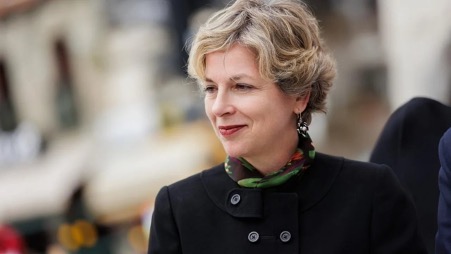
“Vivid, vibrant and buzzling” those three words uses Andrea Gebbeken, CEO of the Tirana International Airport “N쯫 Tereza” to describe her view on Albanian Society. She is heading the private owned only gateway of the country to international air traffic, in which the German HOCHTIEF AirPort GmbH has a share of 47 percent, since 2007. Her knowledge of the country’s language is now fairly good enough to buy apples on a local market – at the airport English is used as working language.
Different but not difficult, that is her verdict on the country’s business culture: “Germans plan for ages, while Albanians are more flexible and improvised.” Gebbeken regards it as quite helpful, that contacts in Albania are not very formal and tend to have a personal touch. “Once you are on the table it is quite easy to find an open ear for your matters – even the Albanian Ministers are quite easy to approach.”
Gebbeken views the development of the Mother Theresa International Airport as “success story” which also teaches some lessons about the preconditions for investment in Albania in general. “The doubling of passengers we have seen in the last two years could not have happened without having very good partners on the side of the Albanian government.”
Improved Conditions
Among those who are increasingly using the Airport in Rinas is a rising number of German businessman, approves the German ambassador to Albania, Bernd Borchardt: “The interest for the Albanian market has grown significantly among German investors.” Besides the commitment of HOCHTIEF at the Tirana Airport, the German “WAZ”-Mediagroup has recently entered the Albania media market, through the partial acquisition of the TV-channel “Vizion+” and they are several investments in the Albanian power grid, describes the ambassador. For him the reason for this development is at hand: “The preconditions for investment have improved much since 2001.” Since then Albania has introduced an attractive 10-Percent-Flat-Tax, was successful in reducing corruption and bureaucracy and first of all proved stability with the calm course of the national elections in 2005. On the other hand certain reservation against the justice system still exists among medium-sized-businesses in Germany. “That is the reason why investment mostly comes from Big-Business-Companies”, says Borchardt.
Problematic visa regime
Overcoming reservation and prejudice is part of Anduena Stephan’s work. Since August 2006 she heads SPRINT!, Marketing and Management consulting, a company based in Tirana focused on transaction management and business reengineering offering services to investors from German speaking countries and as well as other Western European ones. “We are making clear to our clients that differences can be bridged and commonness overweighs.” As a major obstacle to the trade relations between both countries she regards the restrictiveness of European immigration policy. “Imagine you are a German business man and your Albanian partner cannot be on site because she or he stands in line before the embassy to apply for visa – that puts both sides in a delicate situation.”
Ulrike Gantzer Sommer, Country Director of the German Association for Technical Cooperation (GTZ) for Albania is confident that the process of rapprochement to the European Union will soon procure a more liberal Visa regime: “Talks on the matter are going on right now and a significant alleviation for business men is predominantly discussed.” Gantzer-Sommer stresses that Albania’s approach to Brussels itself brings along a lot of improvements to investors from Germany and elsewhere. “Albania has a strong will to be integrated, that is, why this country is doing everything to catch up with Western Europe.” Although Albania has become an anchor of stability in the Balkans certain clich고about the country subsist, says Gantzer-Sommer: “The country urgently needs better self-promotion”. From her experience an invitation on site proved to be a very effective Public-Relations-measure in favor of Albania: “2007 we invited 19 entrepreneurs of the German clothing industry to an acquaintance-trip to Albania – the first contracts with Albanian partners followed very soon.”
Intensified cooperation
Where will German-Albanian trade relations be in five years and later? Ambassador Borchardt and Ulrike Gantzer-Sommer see Albania in the EU “within ten years”. Both stress that till then the rapprochement between both countries will intensify in terms of an easier access for Albanians to the German market, an alleviated visa regime and an increased technical and financial support for Albania on the side of Germany and other EU-members. “The Federal Republic is planning large scale investments into the Albanian power grid. Talks on that matter will take place, when Prime Minister Sali Berisha will meet Chancellor Merkel on his visit to Berlin on Saturday”, says Ambassador Borchardt.
Albania itself will continue to grow and attract further investment from Western Europe, believes Anduena Stephan. She regards the low Albanian average age of 35 years as a main resource for further development: “Young people in Albania are well educated, at least bilingual and they are eager to promote themselves.” As political stability within Albania advances, the economic catch up will definitely continue, she says. “Due to its geographical position a stable Albania offers an appealing platform for businesses to emerge on the Southern Eastern European market and it is only a two hours flight that takes you there from Western Europe.” Hopefully, she adds with a smile, this news will continue to spread in Germany and Western Europe.