By Alba ȥla
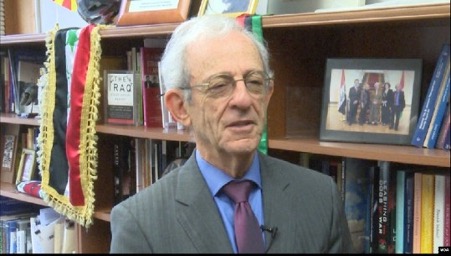
Peter Lucas was born in Boston, the most European city of the US, to an Albanian immigrant family from Kor衠and he still remembers some Albanian spoken in the house during his childhood. He counts numerous visits to Albania starting with being the first American reporter to be allowed in the country immediately after Hoxha’s death in 1986. He calls that visit “awkward, stupid, Albania was back then a police state and I was followed by spies.” Afterwards when he came to visit his parents village, the now-abandoned Orgorcka or came to see his many friends from 20 years he had absolutely no problems blending in, exploring the tough but beautiful nature of the coast and enjoying people whom he calls” wonderful and hospitable.” Lucas spoke to Tirana Times about researching his recent book on Albanian experiences with the OSS in WW II and the ambitious project to run it into a movie directed by none else but the famous New York director, Stan Dragoti, a prominent movie-maker of Albanian descent as well.
Tell us something about growing up in Boston?
It is very ethnic-aware city. The section I grew up was called the West End. No there are the high-rise apartments. When I was there they were not there. They knocked it down and put those stupid high-rise buildings up. My father and mother were form Kor衠and we grew up in an Albanian community. There were other families close, mainly from Kor衬 mainly from the South. They were part of the immigration wave from Kor衠and they were all very similar because they were all also orthodox Christian and they had the churches there in South Boston. It was a small neighborhood community. The city was very diverse with Russians, Italians, Polish, Greeks and everyone knew where they were coming from. Then there was the great assimilation, what the United States is all about.
I spoke Albanian as a young buy but then my father died and my mother had to speak both. We lost it as we grew up. When I came to Albania it started to come back very soon. Boston is also a very political town, with famous politicians: the Kennedy-s, Dukakis who is also my friend. He teaches at the Northeastern University and twice a semester I go to do his class. In 1988 when he ran for president one of my assignments was to go to Greece and do story to find his roots.
Where did you study? How did your journalism career start?
I studied at the Boston University. I studied English literature because I thought I wanted to become a writer and I thought the best way to become a writer is to read. I studied all the English and American writers. Then I became a reporter in a small town just outside Springfield, Mass. I got some experience then when I came back to Boston I was first hired form the Boston Herald, then by the Globe then back the Herald. I made a career in political journalism. I love journalism. I’d work for a paper today if they’d hire me. I free lance now. I covered American politics and traveling in important events such as the war in Vietnam in 1967, the fighting in Northern Ireland in the 1980s, Central America, Cuba. There is a rush to it, it’s exciting. I enjoyed both things, you can’t do one continuously.
The desire to come to Albania?
I have always wanted to come to the country. Especially when it was closed. For reporters when something is closed you want to open it. The story I wrote in 1986 was a series run in the Herald but other papers picked it up. I returned in 1988 and I made very good friends. I did a book called “The Rumpalla”, capturing the period since 1986 which people tend to forget how it was. I have been always writing about Albania. Even when president Bush visited the Globe asked me to do a story on that. I regret that I was not able to come here for that.
What was your reaction to that day?
I was not surprised because I was here when Baker came. Any president [US] would have gotten the same given the historic nature of the relationship.
How did the idea of the book come to you?
I wanted to do a story on Enver Hoxha in his young days, before he became the diabolic dictator. I started interviewing old veterans. It was interesting, at that time they were young 15-16 year olds and he was a charismatic 35 years old, commander. In the course of my research I came towards a picture of Enver Hoxha coming into Tirana in a parade with Mehmet Shehu and all other generals, and in the second row there was this American Tom Stefan. He wasn’t really identified, so I said who is he? I never heard of him. I started looking for Tom which led me to the OSS (the CIA during the war). There were still four men alive, but I couldn’t find Tom because he was dead. He was born in Laconia, NH and he worked in Boston, and he went to college nights. In 1942 he joined and went to OSS because he could speak Shqip. His job was to befriend Enver Hoxha, to meet and bond with never Hoxha in order to obtain intelligence and to help Hoxha to keep the Germans engaged here.
Has this story taught you something new about Hoxha, has it clarified anything?
It showed me that he was cunning, even more than I thought; he was shrewder than everybody else. He was a true politician; he got all the other people to do all the duty work and he took the credit. He was not a fighter. Mehmet Shehu was a fighter and not a politician. Hoxha was the exact opposite.
Lucas had not met Stand Dragoti before Stan read the book and had the idea to have Lucas turn it into a script. The author says he wouldn’t mind having three sets of different actors for it: Americans for American roles and Albanians and Europeans for the others. The famous director has also arrived in Albania to talk to Albanian cinematographers to make this a joint project and check out some potential shooting sites.