By Lutfi Dervishi
If you’d like to wear a jacket at night these days and still feel cold it’s time to go to Valbona. When you arrive in Valbona, you’ll get another proposal: “Let’s go the mountains.”
But in order to go to Valbona, there’s a dilemma: taking the Highway of Nation or going through Lake Koman?
If you take the Highway of Nation, you can reach Valbona in four hours, but there’s nothing interesting about the trip. You can continue along the Kukes-Gjakove road and cross the Albanian border twice or go through Has.
The trip through Lake Koman is tourists’ favorite trail.
I traveled through Lake Koman six years ago in an unforgettable trip and when I was notified that it’s better to depart at 8 in the morning to catch the noon ferry, this is the first sign that few things have changed during the past six years regarding infrastructure.
The invitation to travel with a group comprising diplomats and journalist is tempting. The Tirana-Koman distance is only 124 km.
– Departure at 8 a.m. to reach the ferry after four hours gives you the idea that the route will be crossed by bike.
– No. It’s a 20-seat mini-bus.
The reason is a road segment, not more than 10 to 15 km long, as soon as you cross Vau i Dejes.
When you turn right to the national road and cross Vau i Dejes until the road sign showing the direction to Puka and Koman, the road is passable with no problem. From here to the Koman hydropower plant, it seems time has stood still.
It’s a past century road which allows you to drive at a speed of not more than 5 to 10 km/h.
After driving from Tirana for about two hours, a stop to Perla Restaurant-Bar is advisable to prepare for the tougher part of the trip.
The Perla restaurant is a new nice investment along the lake. Two fish farms built behind the Koman HPP dam, are the only new investments in this area.
The road to the HPP is painful. Now the concern is whether we will manage to reach in time, because Rasim Hajdari, the man who accompanied us during the whole trip is firm when he says: the ferry departs on time.
We are lucky. We were the last to step on the ferry and what everybody is wondering about is how is it possible that a normal bus made it through the paths we crossed.
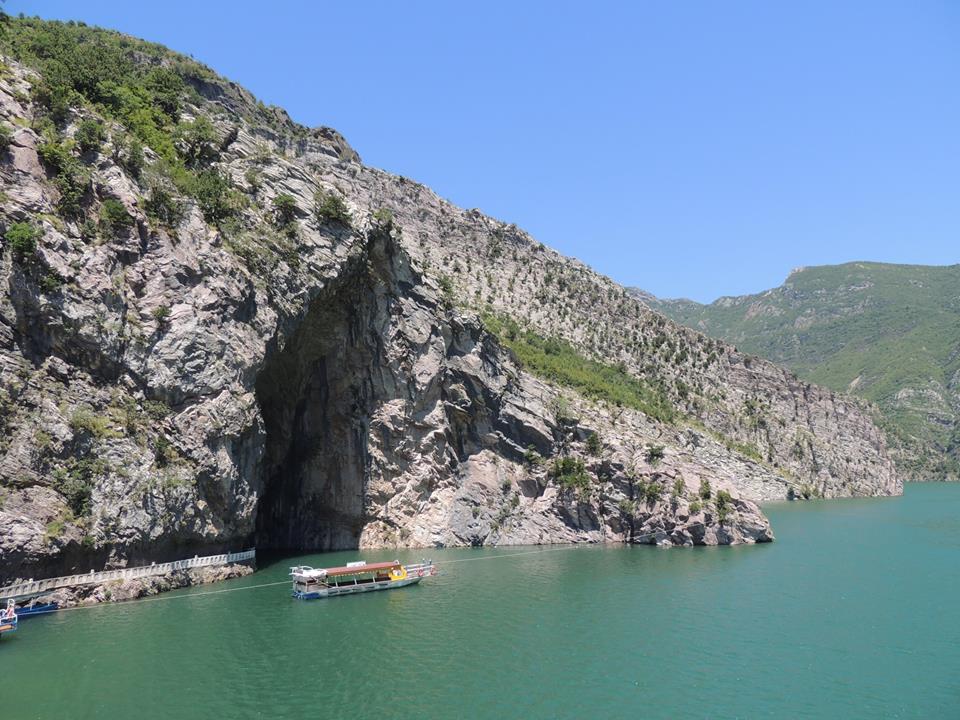
The “Alpin” ferry is clean and very comfortable for the 2-hour trip to Fierza. The Koman-Fierza distance is only 30 km but it is one of those cases when you get the adrenaline flowing not because of the speed but the slow movement across the lake. There are more than 100 passengers in the ferry, mainly foreigners, groups of Israeli, French, Italian and American tourists. An Albanian-Israeli woman proudly told me that she often comes along this route and that Israeli tourists are impressed by both the landscape and traditional hospitality and affection shown by the local community.
On the ferry’s third floor, there’s folklore music playing and a wedding atmosphere where men and women dance freely as if they were in their own front yards – even the foreigners join the dancers.
The trip through Lake Koman is amazing. The landscape is just great and the beauty is hard to confess. It is the moment when you feel that cameras and mobile phones be they iPhones or the latest Samsung are powerless to grab the beauty of these mountains on both sides of the route. Human traces are quite rare which makes the beauty fabulous. The lake formed by the construction of dams in Drin River not only supplies the country with electricity, but has all the potential of turning into the best tourist trail Albania can offer. Mountains on both sides of the route are as tall as 1,000 to 1,500 meters and the view you are offered has been intact for centuries. You can spot quite a few separate houses in the mountain slopes. And even gardens being watered with pumping systems using lake water.
Two hours just fly – although the speed of travelling by ferry is almost the same to the speed of driving in the “no road” taking you to Koman.
During these two hours – the environment and the landscape are amazing and the atmosphere of the nature – tolerates even loud music ranging from traditional Kosovo tunes to central Albania wedding music and closing with the “Red & Black” chorus of Euro 2016.
You feel the trip is coming to an end when you see the nature’s beauty waning – the moment when you face a road and vehicles travelling. Right there you notice humans and can tell what the Homo sapiens is able to do. To where we are headed, there are plenty of bears and wolves, but there is no comparison with the man’s destructive hand and this does not appear only with the ugly apartment blocks, but even with the (former) effort to open up new agricultural lands in Tropoja.
As soon as you come closer to Fierza, you notice the massive plantations of chestnuts, (300 to 900 meters) above sea level. The Alps’ view is impressing especially the Shkelzen Mount summit and the white “old snow.”
The trip takes an extra hour. On the way, the “Alpin” ferry becomes a shelter to another 20 to 30 passengers and their cars. The smaller ferry has broken down and the “rescue mission” takes 35 minutes.
The trip from Fierza to the town of Bajram Curri takes nearly 15 minutes.
Bajram Curri among others is known as the town that had one of Albania’s best museums. Looted during the 1997 turmoil, the municipality is currently trying to reconstruct it. Its pavilions are being renovated – the local ethnography and assets as well as the families persecuted by the communist regime, bear testimony to a region full of history and culture.
Valbona, the Mountain pearl
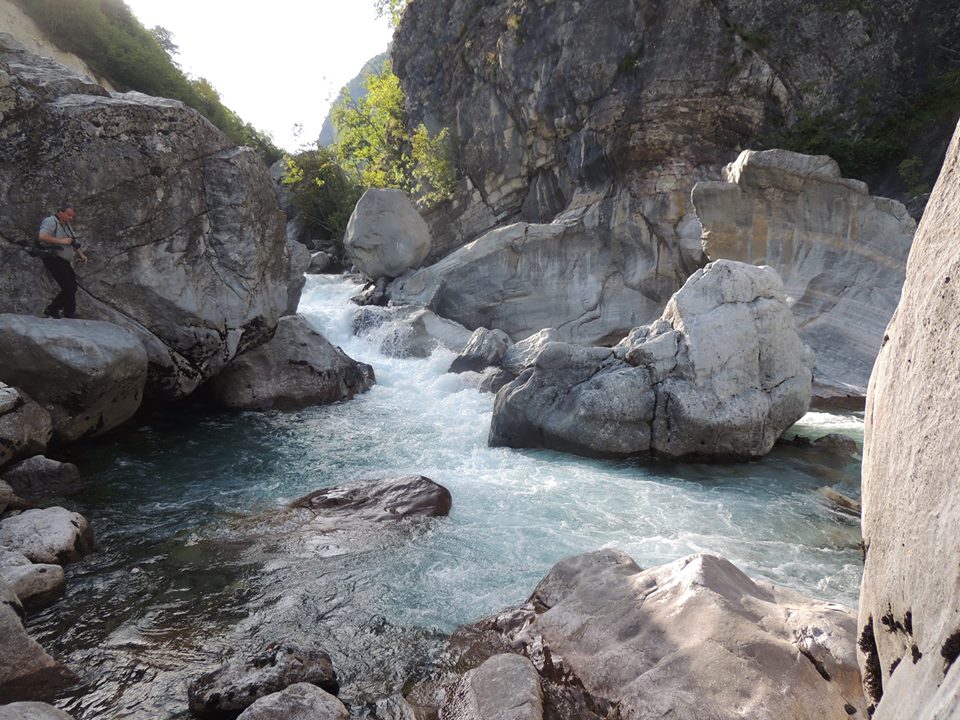
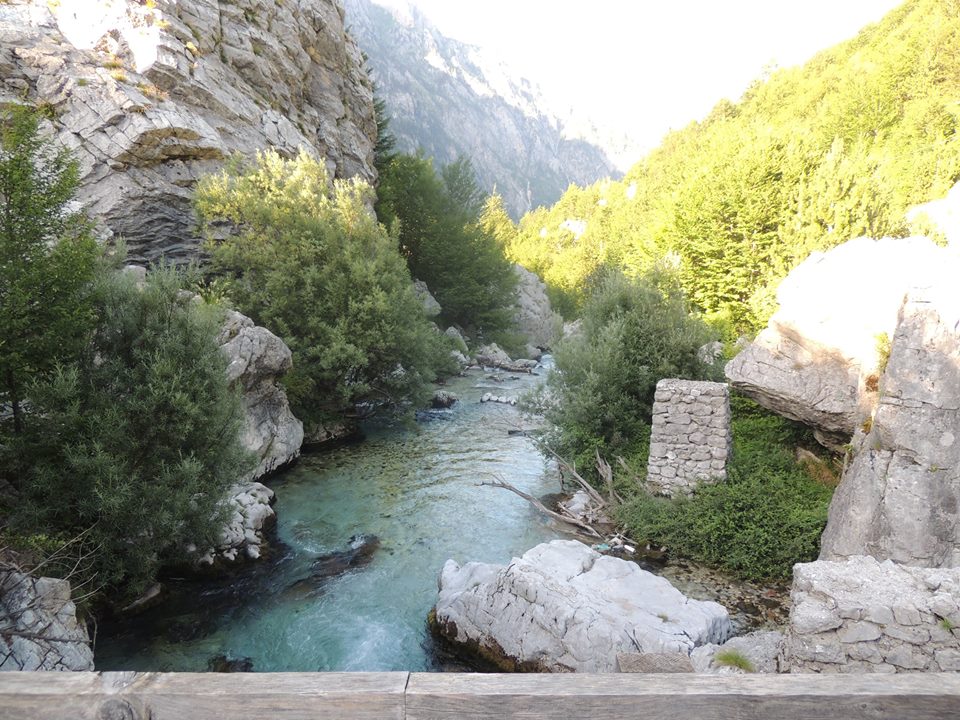
Valbona is located 29 km from town. Our first stop is on the river bridge just past Markgegaj. Even though July, flows of the river water suffice to grab the beauty of Valbona, the most beautiful river. The cleanliness, the lighting and the big white clean-cut cliffs make Valbona and its rush amazing.
The water depth in the first bridge as soon as you leave town is 2 to 3 meters, but the sediment seem so close that you think the depth is no more than two feet.
This is where the trip through the valley named after the Valbona River kicks off. On both sides of the road, the mountains are great and it seems that not only photographers but also painters cannot grab the splendor of the green mountains. This is a case witnessing that words were made to depict what the eye cannot catch.
Despite all efforts to provide details, you feel powerless to depict the Valbona valley.
A stop to the Mulliri Bridge gives you the opportunity to taste the Valbona water, one of the few places where you can take pictures to show that words depicting the river can be scarce but real. The camera feels like God here. When you raise your head up, you witness the mountains meeting the clouds. You can drink water in Valbona and when you feel the taste and freshness of Valbona what you wonder about is: how is it possible that there are dozens of local and imported brands of bottled water but there is no Valbona water…
The Valbona River is 50 km long and from its spring to where it joins River Drin it crosses through Rragam, Valbona, Cerem, Dragobi. It does not appear everywhere, it gets lost in the whole Rragam area and reappears rushing in Valbona. The whole area has about 800 residents, but its accommodation capacity is several times higher.
Guesthouses and hotels are being built along the valley. The reconstructed road until the Fusha e Gjese has given an impetus to construction works, but also raised the first question marks, not only about the mad story of the hydropower plant construction, but also about the construction of hotels.
Towers are the traditional buildings in the area. If you think of attracting tourists, you cannot lure them with Swiss-like alpine constructions because there are lots of them in Switzerland and elsewhere.
Valbona’s most beautiful part starts where the road comes to an end. It is the last stop where you can see constructions: the Fusha e Gjese, once a battlefield for bears and other wildlife. The mobile phone go in an offline mode. There is no longer internet access and no mosquitoes, there are no TV sets in the hotel rooms, but yet you don’t feel anything missing.
The Fusha e Gjese has been expanded, and the hotel accommodation capacity has increased. But in the end, those who come here come for the nature and not the hotel room. They come for the mountain tea, the flower and chestnut honey, the dairy products, the traditional fli pie, the meat, the fresh air and another atmosphere.
Along the big reconstructed hotel there’s a snowfall with ice cold water. If you drink a glass of water, after an abundant lunch you will very likely feel hungry. The only thing that doesn’t suit here is that water here is served in plastic bottles.
In the evening, temperatures drop and the clothing should be as for the third autumn.
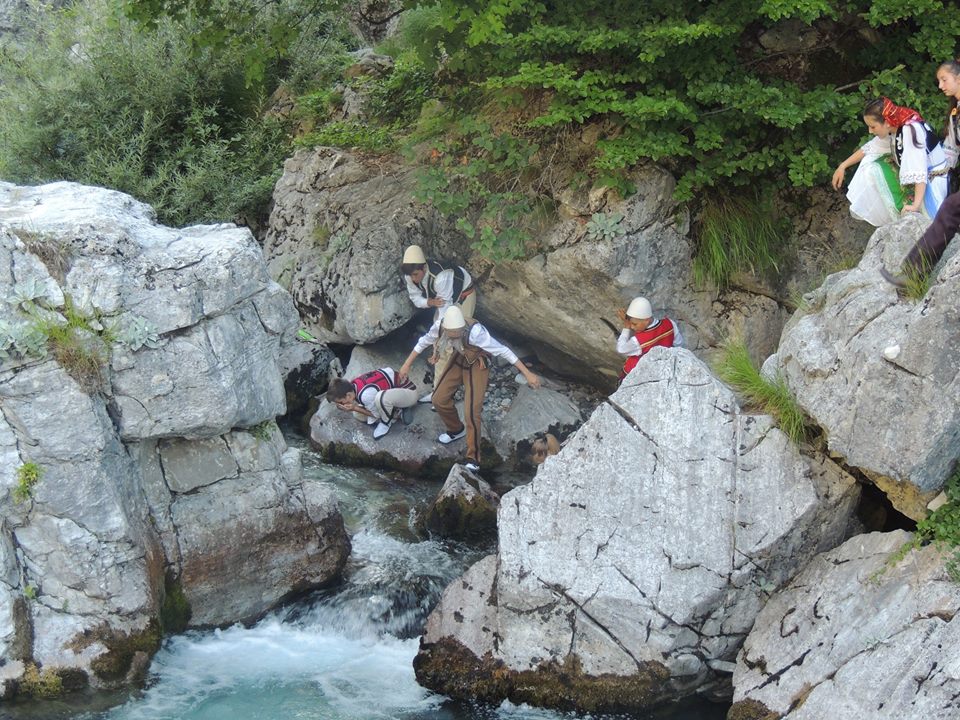 Here, Valbona is hidden during summer. Past of the river bed is only covered with stones, but the autumn and spring rainfall on both sides of the valley can also cause flooding. The old school at the Fusha e Gjese bears testimony to this. Its yard has disappeared and there are only remains from the old school.
If you travel to Theth – the youth’s favorite itinerary – you have to travel for at least one and a half hours from the Fusha e Gjese to reach the upper Rragam. On the way, we encounter 2 or 3 families who have come from Shkodra and work by offering the traditional coffee, the fli pie, tea and medicinal plants.
Besnik, his wife and children aged 10 and 12, come to the mountains in summer and go back to Shkodra when school kicks off. He has set up a tent, only several meters away from the former border crossing point. An abandoned warehouse which leaves a bitter taste.
Close to the shelter, his wife is baking the traditional fli pie in the oven. The surroundings, including the valley, the trees, the animals are biblical and there’s absolute silence. Everything is different and the sense of time quite different. You don’t have to take a look at your watch and you can waste your time watching without losing anything. This is also where you can watch the Valbona spring more clearly. The water coming out of the mountain, rushing like a cataract and winding down to Tropoja.
A group of youngsters from Kosovo, the U.S. and Albania have departed to Theth. From the upper Rragam to the other side, it’s a 5-hour journey amid a path in-between two summits of the Alps. There was a proposal to open the road and make it the “northern” ring road. But maybe, we are lucky there is no road, because unfortunately where roads are asphalted, concrete and plastic are the first guests. Where today you notice green areas and virgin nature, tomorrow there will be plastic bags and car emissions.
The Alps here are closer than ever. It is a place of snow and winter is very tough. Along all the Valbona valley, from Dragobia to the Rragam i Eperm, there are only a handful of families staying here even during winter. The old formerly abandoned towers have started reinvigorating during summer.
 And yet, there is enough time to watch only the Valbona valley and the trip becomes nicer than the destination.
Rasim tells us about another wonder, the Mountains in à‡erem, the lowlands, the plateaus, the valley, lakes and even thousands of hectares of virgin woods – the tough thing is the open but unpaved road. There are a lots of farms and if you walk for two days you’ll be on the other side of the border in Kosovo.
– There’s a common denominator in the thoughts of all guests to the Fusha e Gjese, the quality of sleep at night gets the highest ratings.
A group of young men and women, with the local dances turn the fresh evening into electrifying. The Tropoja dances, or the Kukes traditional dance roam along the valley and the holidaymakers get an unforgettable spectacle.
Different from the coastline, Valbona has the luxury of being attractive to tourists in every season, but care should be shown.
The whole concern about Valbona is human kind, our destructive ability which can lead to genocide toward nature proved both during communism and the transition.
We get back from Kosovo with a short stop to the Stone Castle, one of the region’s biggest wine producers. More than a winery, this could be another tourist attraction that can be offered as part of the joint Albania-Kosovo tours.
Artur, the Stone Castle manager, passionately explains the advantages that the Rahovec area offers with its 3,000-year tradition in wine production. “This is an area which feels Valbona’s breeze and through it the Adriatic, that’s why the grapes here are of special quality.”
Even on our way back to Tirana, when Valbona is mentioned, what worries everybody is whether it will be preserved? A building in the “wrong” place can ruin everything. We have a lot of apartment blocks in Tirana and Golem beach. If we want the Alps with tourists and holidaymakers we have to quit bricks and concrete.
Ambassadors, civil society representatives and journalists were part of a tour organized by the Municipality of Tropoja and the Albanian Institute for International Studies (AIIS) last weekend, aimed at promoting the beauty of the unique Valbona valley in northeastern Albania