Migration reduces jobs
Job losses in the educational sector
The new school year has witnessed locally a reduction of the number of classes and teachers. Migration has brought about losses of 54 teacher jobs in the district of Berat, informs the local press (Sot, 11.09.2009). The rural zones are the ones that have been touched most heavily by the phenomenon. Migration is described as displacement within the district, for example from distant villages to the city of Berat, or as a flee from the harsh rural life to other Albanian big cities like the capital Tirana or the adjacent sea-port city of Durr쳬 but also as an escape from the burdensome Albanian reality to reach out for brighter horizons out of the country. This has caused not only a reduction of the number of pupils in rural zones, but also in the heart of the district, in the city of Berat.
In this district, the migratory effect has mostly been felt in the cities of Ku谶롡nd ȯrovod뮠To date, 54 teachers have been thrown out of their jobs and some more may still experience the same fate during this month.
Less pupils and fewer teachers
The new school-year began in the district of Elbasan, a few kilometers south-west of Tirana, with 500 pupils less than during the previous year and with three of the existing schools closed in consequence, reports the local press (Shekulli, 14.09.2009). 68 teachers are reported to have lost their jobs in this district. The local authorities explain that the reduction in the number of pupils is not only caused by migration but also by a fall in the number of births in the district during the last years.
The district of Elbasan is also witnessing job losses in other sectors than that of education. Telegraf (14.09.2009) informs that more and more workers in the numerous industrial plants of the district are losing their jobs. The newspaper blames the effects on the global crisis. Elbasan is the heart of the metal industries in Albania and was in the elections of the 28th of June 2009 one of the largest administrative units.
School and kindergarten closures are reported not only due to the fewer number of pupils, but also due to lack of hygiene. Standard (14.09.2009), reports that 7 schools and 3 kindergartens were closed due to the lack of hygiene in Durr쳮 The local press (Shekulli, Korrieri, 14.09.2009) also reported the closure of a kindergarten for not meeting hygiene conditions in Elbasan. There has been demand that some of the schools of this district make healthier living and studying conditions for their pupils. Shqip (14.09.2009), also reports school closures in the district of Kuk쳬 due to hygiene problems.
Reverse situation
At the same time, in the district of the capital city of Albania, Tirana, over 4000 teachers are waiting to find a job, reports Shekulli (14.09.2009). Not only are young pupils leaving remote places to come to somewhere central, but also a growing number of teachers are making themselves available in the capital and in other major cities of the country, swelling numbers of the unemployed. The daily suggests that less than 5% of them will be employed and that the number of teachers in the district of Tirana remains almost the same, though an increasing number of pupils is observed in this district from year to year.
Return of emigrants
The adjacent sea-port city of Durr쳠and its region finds itself in a similar situation. The district of Durr쳠lists 700 new applications for 180 teacher jobs, reports Shqip (14.09.2009). The newspaper believes that higher wages in the education sector are making it more attractive. Wages have been constantly increasing in this sector during the last years. The newspaper believes that improving wages in the educational career as well as economic difficulties due to global downturn in the countries where many Albanians had migrated are making numbers of them turn home and head towards the education sector to find job opportunities.
Nearly 4590 new pupils are reported to sit for the first time in classes this year in the district of Durr쳬 while nearly 42,000 will continue obligatory schooling during the new academic year 2009-2010. Over 400,000 pupils and students of high schools are registered throughout Albania, reports the local press (Shekulli, 14.09.2009). Nine-year schooling and high school are obligatory in Albania. 1749 directories for nine-year schooling and 376 directories for high schools operate throughout the country.
Lagging behind in academic and professional schooling
Concerning education, Albania lags behind the neighboring countries and the rest of European countries with an average of only 11.9 years spent in schooling. This seems to be roughly only 3 more years than the compulsory nine-year basic schooling. It has to be reminded that the former educational system comprised only eight years in basic schooling and four years of high school. Under these conditions this data would mean roughly that the average Albanian completes only obligatory schooling (former eight-year basic schooling + high school). This is an average profile and the extremes seem to be very disproportionate. Though the country has numerous state and private universities, the number of those going to the university does not make for the number of those that abandon school after the basic schooling.
In this respect data are very negative. Only 57 % of Albanian pupils register in high schools, according to information from the Ministry of Education and Science, (Ministria e Arsimit dhe e Shkenc쳬 MASH), the National Strategy on Education, quoted by the local press (Panorama, 14.09.2009). Professional high school education in Albania seems also to be very poor. Professional high school students in Albania make up only 19 % of the high school students, at a time when in the European Union (EU) they are reported to make up 62.7 % of the total and in Former Yugoslav Republic of Macedonia (FYROM) and Croatia 65 % and 70 % respectively.
However, concerning the pre-school system, Albania receives a better score than all the countries in the region other than Slovenia. With 50% of the pre-school age population registered in pre-school facilities, Albania does better than the Former Yugoslav Republic of Macedonia (FYROM) which has only 29 % registered in pre-school facilities. Serbia and Croatia with 45 % each, also lag behind Albania in this respect.
CURSIVE
The curriculum of the Albanian high schools should undergo structural changes to be better equipped for the needs of the time, writes the National Strategy on Education, (MASH document), quoted by the local press. According to the document, the curriculum is overcharged conceptually and reveals a more theoretical than practical character. Contemporary methods of teaching aiming at stimulating critical thinking, working in groups and independent work are lacking. In some cases, the students do not manage to make concepts their own, says the document.
EDUCATION IN DATA
[Source: Ministry of Education and Science, (Ministria e Arsimit dhe e Shkenc쳬 MASH), National Strategy on Education. Quoted by Panorama, 14.09.2009]
3.5
An adult in the capital city of Albania, in Tirana, follows on an average of 3.5 more schooling years than the average of the whole republic. The education profile in the country varies by region.
19 %
Only 19 % of the students that go to high school will attend a professional school in Albania. That is nearly 4 times less than the average of the Balkans.
38,000
Nearly 38,000 teachers are employed throughout the country this year (2009). Some of them lack training and qualified education, reports the press.
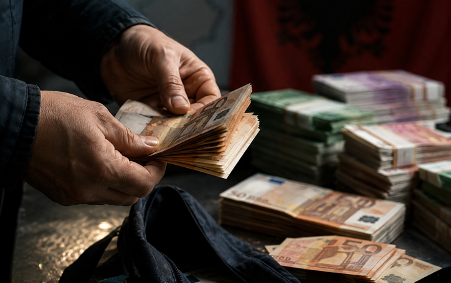
The cost of the new school-year for a family may be calculated by taking into account all the objects that need to be bought and all the spending that needs to be made for the new school year. A quicker indication on the cost was brought this week as an announcements’ newspaper published a call by two children who asked help [50,000 Albanian Lek련ALL), or nearly 370 Euros] to buy school-books and school articles. The announcement, worded: “Two children in Tirana, at the impossibility of their mother to work for health reasons, ask for your help Ţ was published in the pages of ȥl촩. Their call indicates that the new school year represents a cost reaching 25,000 ALL (nearly 185 Euros) per child.
In the upcoming issues, Tirana Times will publish a series of special reports with special focus on education.