The privatization list also includes more than 200 plants and enterprises as well as 450 military bases identified by the Defense Ministry
By Ervin Lisaku
TIRANA, March 6 – The Albanian government is determined to privatize almost all remaining state-owned assets, hoping to collect 100 million euros within this year in an effort to improve the country’s crisis-hit public finances. The government’s intention was reconfirmed last weekend by the Economy, Trade and Energy Minister, Dritan Prifti, a few days after Prime Minister Sali Berisha had announced that 2010 would be the privatization year.
Speaking at a press conference on Saturday, Minister Prifti said the government would put up for sale every remaining state-owned property except for the hydropower plants on River Drin cascade, and education and health sector services and premises. He announced that the privatization process for the remaining state-owned shares had already kicked off for the fixed-line operator Albtelecom, oil refiner ARMO and the Energy Distribution System Operator (OSSH).
The insurance company INSIG, whose privatization process has failed despite being put up for sale several times, is the only remaining important company in which the state owns 100 percent of the shares.
The privatization list also includes more than 200 plants and enterprises as well as 450 military bases identified by the Defense Ministry. Some small hydropower plants will also be privatized.
According to Minister Prifti, the privatization of these enterprises is a necessity because of their degradation under state management and being a burden to the state budget which continues paying staff although some companies have gone bankrupt years ago.
A special working group headed by Premier Sali Berisha has already been set up to decide on the assets which will be privatized. The government has appealed to Albanian business to be involved in the privatizations, saying that it is interested in selling to them.
Minister Prifti, who represents the Socialist Movement for Integration in the government, admitted the privatization process would enable government to save more from its expenses, bringing a contribution of 100 million Euros to the state budget.
Elaborating on the tendering process of the privatizations, Prifti said that ex-land owners will be given the opportunity to pre-purchase the assets on sale. Those who have rented public assets will also be given special consideration in the tendering process if they have invested in them.
The privatization process comes at a time when the country’s public finances are in question with delays in payment of salaries and debts owed to construction companies for their 2009 public works. Last January the Finance Ministry took a direct loan from the Bank of Albania, considered an extreme measure used in extraordinary circumstances. The government hopes to overcome the situation by borrowing 350 million Euro from the international market through the sale of Albania’s first ever Eurobond.
Another measure the government has taken to collect money is the recently approved fiscal amnesty law placing a 10 percent tax on any money that firms used to increase their capital but had not previously declared.
Albania’s economy is forecast to grow 2.2 percent this year after 0.7 percent expansion in 2009, according to an October report from the International Monetary Fund.
Opposition, Experts against Privatization in a Time of Crisis
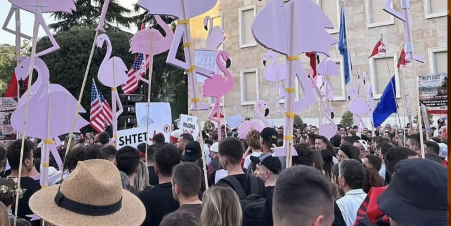
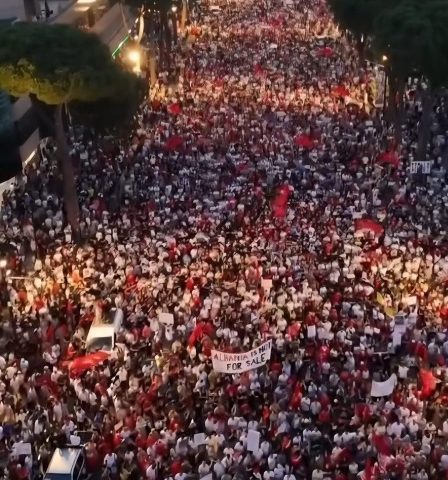
The latest government move to collect money by privatizing the remaining state-owned assets has sparked negative reactions among the opposition and some experts who say this is an inappropriate moment because of the ongoing international financial crisis. Representatives of the opposition Socialist Party (SP) have called the privatization process undertaken by the government at this time, “ơ robbery of the remaining national treasury” and an effort by government to fill up the budget considering the deepening of the financial crisis in Albania.
Reacting last Sunday, SP deputy Pandeli Majko described the privatization of everything owned by state as a money-laundering process. He said the government stance to give owners the pre-purchase right was not normal because owners were being forced to buy something they already possess.
“This is more or less translated into the final failure of the possibility for the physical compensation of old land owners,” said Majko.
Meanwhile, the former Bank of Albania Governor, Shkelqim Cani, told BBC in Albania last month that, “ưrivatizing at a crisis time was putting the sale price of the national treasury to a minimum.”