TIRANA, Nov. 27- As already known, year 2018 was declared by Prime Minister Edi Rama as the ‘pan-national year of Skanderbeg’, since our national hero died 550 years ago, on Jan. 17, 1468. A special commission was raised for organizing a series of activities honoring this figure, and also organizing other events concerning figures and dates linked to our national identity.
A number of festive and educative activities have taken place around Albania regarding this special year. Conferences, exhibitions, commemorations, theatre plays, festivals. A scientific conference regarding the figure of Skanderbeg took place since early May until Nov. 3, where scholars shared their research findings on the the national hero. An exhibition of pre-19th century history books was shown at the National History Museum, along with many painting exhibitions about the figure. Ceremonies have been taken place in other Albanian-speaking regions, such as Macedonia, Kosovo, and even Romania.
One month separates us from the end of this year, and a few more events are yet to see the light of day. At the Center for Openness and Dialogue (COD) PM Rama will display on Nov. 27 a sea map dating from 1455, as one of the concluding events in respect with the pan-national year of Skanderbeg. The rare artefact was made from Genoese hartograph Bartolomeo Pareto for Pope Nicholas V. This map depicts a contemporaneous view on Europe in 15th century, and especially the pressure coming from the Ottoman Empire in the Balkans. It represents an accurate historical view and brings itself as a proof for the activities and reverberation of Skanderbeg in Albania and the region against the Ottoman Empire and its armies. What is interesting about this map is that it names the area of medieval Albania as having Skanderbeg for suzerain.
Another festivity will happen on Flag Day Nov. 28 in Puglia and Bari, Italy. The event surrounds an exhibition titled ‘’Albania in Puglia,’’ where the Albanian art and culture will be shown through paintings, mosaics, films, music, photographs, etc.. These are works mainly from Albanian artists living in Italy made for the celebratory days of our nation’s independence, but works from Italian artists inspired from the culture and history of the ‘’land of eagles’’ will be also shown.
A number of activities will be organized in Italy along the exhibition as the cultural event lasts until Dec. 5. Other events will be ‘’Albania is called Italy’’ by Adrian Haskoj, the Albanian consul general in Bari; ‘’Opportunities for Italian enterprises in Albania’’ by Roberto Laera, the administrator of Network Italia; ‘’Relationships between Albanian history and culture’’ by Artur Beu; ‘’25 year an emigrant in the land of eagles’’ by Carlo Bollino; ‘’Arbereshe culture, Albanians in Italy’’ by Lucia Martino; painter and sculptor Albert Methasani will be presenting ‘’Albanian art’’; etc..
Nov. 28 is an important date for Albania, as it doesn’t only mark the declaration of Independence from the Ottomans by the raising of the flag in Vlora from Ismail Qemali and other compatriots in 1912, but it has accompanied Albania in a couple more instances. On Nov. 28 1443, is the day Skanderbeg the Turkish army in Hungary and fled in Kruje to fight the Ottomans from the Albanian side. This year is the 575th anniversary of the first event that changed the curse of Albania’s history for centuries.
The second most important event is the declaration of the Independence on Nov. 28, 1912, where Ismail Qemali raised the flag in Vlora. Another historical moment which guards the same date, is in 1944 when Albania was finally let free from Nazi occupation which occurred in the second world war with Scutari being the last Albanian city to be freed.
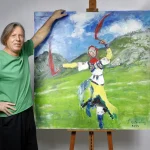
Another event taking place in Tirana honoring the figure of Skanderbeg and the 550th anniversary of his departure, is an exhibition from renowned artist Agim Sulaj, who brings ‘’Roots 3’’ in hotel Plazza. Sulaj, who has been living in Rimini for about 30 years, was inspired by the monument of Odhise Paskali, (the statue of Skanderbeg at Skanderbeg Sq. at the center of Tirana), and sought to create a series of paintings regarding the roots of our national identity. He brings an exhibition of 20 oil paintings, where the central painting is a portrait of the national hero depicted meditative.
‘’I started the exhibition with a meditative portrait of Skanderbeg, which reflects his history on that meditation, which also reflects perhaps the history of those succeeding him. The hands remain in the air, to descend somewhere. Supported perhaps in our national memory,’’ said Sulaj.
Through this exhibition Sulaj seeks to spread love and keep his Albanian roots. He also brings a few scenery from Rimini where he has been living for quite some time, but also scenery from Albania as he remembers it, with no longer existing streets from Tirana, the sea, Karaburun, a portrait of Ali Pashe Tepelena, etc.. This exhibition will be open for the public at Plazza Hotel for one month.
But another exhibition for Independence and Skanderbeg’s year at the National History Museum, where 50 painters from Albanian speaking regions are displaying 60 pictures on the theme ‘’Kruja and Skanderbeg.’’ The exhibition shows the life of the national hero in different periods of his life, and scenery from the city of Kruja.
‘’Skanderbeg should not be seen only as a hero, but he was also a man, who knew how to lead and was on top of religious issues of external politics. For Skanderbeg there is more to be done, and we have made few works, we hope that more beautiful activities can take place,’’ said painter Kujtim Buza.
The two consecutive celebratory dates of Albania’s Independence, are Nov. 28 when the declaration and flag raised in Vlora happened, and Nov. 29, which is the Liberation day of Albania, as it corresponds with the Albanian liberation from the Nazi occupation in 1944. This day is annually renowned and celebrated also as the ‘White Night’ of Tirana. The municipality of Tirana organizes a series of cultural activities on this day, and what is special about this day is that the museums are closed throughout the day and open their doors in the afternoon, and remain open during the night. Tirana will bring beloved singer Aurela Gace this year in the annual concert organized on this day.