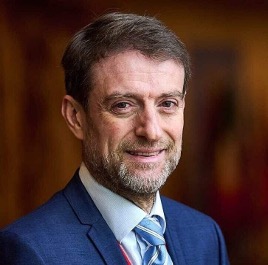
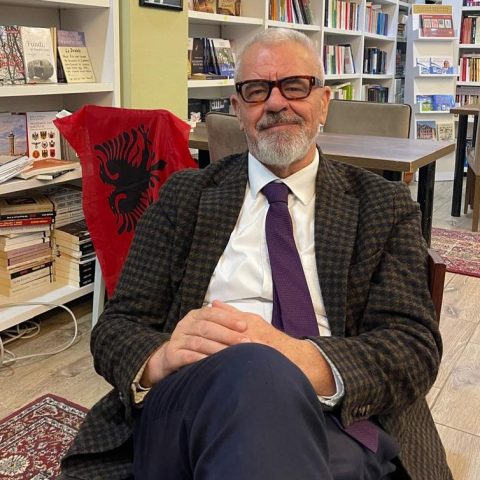
Prince Leka II will be the Albanian Minister of Foreign Affairs’ advisor. Minister Basha, who publicly introduced him as his new advisor, said he felt honored the Prince had accepted the invitation to contribute to the foreign service of the Republic.
The ministers’ cabinets in Albania are full of all sorts of advisors, many of whom one may not know, and, of course, there is no reason the common people would know them. However, Prince Leka II’s employment and, especially, his employment as an advisor to the Foreign Minister makes an event in our small Republic.
Taking into consideration the somewhat contradictory relationship of all post-communist governments with the royal family, Prince Leka II’s employment in the public administration of the Republic could be considered from three viewpoints:
First, the invitation that the Foreign Minister extended to Prince Leka II to serve as an advisor is another government’s step of reflection, reconciliation, and respect toward the royal family.
It was this Berisha administration again that had decided to recognize and restitute part of the properties belonging to the royal family.
Despite that spirit of reconciliation, the society and the political elite have still not coped with a deep process of reflection with history in general, and with the King Zog’s governance in particular. King Zog built the foundations of a modern state with an administration and a bureaucracy in accordance to the western model of the time. Through a combination of oriental rule and western reforms, there were achieved results, unimaginable for the time, in the justice system, the country’s infrastructure, the army and the security forces, the educational system, and the unity of the nation.
Despite the fact that seventeen years have passed since the fall of the communist regime, the Albanian historiography has still not offered a credible prospect on one of the most important periods of the country’s history. (Meanwhile there have been serious studies by foreign historians who have offered a very realistic and balanced account of King Zog’s rule. Among them, the best may be considered Bernd J. Fischer: King Zog and the Struggle for Stability.)
Second, Prince Leka II’s employment in the Republic’s public administration seems to be a silent recognition of the Republic and, at least for now, a give-up of the idea of the restoration of Monarchy. The most serious attempt on the restoration of monarchy in Albania after the fall of the communist regime was that of 1997. In a very turbulent period for the country, a referendum on the form of the regime was held alongside the parliamentary elections of June 29, 1997. According to official sources, supporters of the Monarchy, who posed serious claims of manipulation, lost with a narrow result. It is, of course, very hypothetical to ask how Albania’s political actors would behave if the 1997 referendum finalized with the victory of the monarchy supporters, which wasn’t unlikely. In the last 2005 parliamentary elections, the pretender to the royal throne, Leka I, turned into a leader of the “Movement for National Development”, part of which was also the monarchist Legality Party. However, results were discouraging, as they could not take a seat in Parliament.
Following that, the throne pretender declared he gave up of the leadership of that political movement and during the last two years one may not say anything about any qualified political involvement for him. Although it cannot be said that the peaceful duel is over between the republic and the monarchy, for as long as it has existed in post-communist Albania, it is nevertheless hard to believe the Albanian society could be mobilized to favor the restoration of monarchy, at least under the current circumstances. This could be another reason why Prince Leka II decided to contribute to the Republic.
Third, Prince Leka II, nephew of a born statesman who built the state foundations and also with an excellent western education, has much to offer to the Republic’s foreign service and, of course, to Minister Basha as well.
Princes, both those of the past and those of our times, in line with the old monarchy codes, normally choose to initially build their career as soldiers in the armed forces, or as soldiers in diplomacy- junior diplomats in the foreign service. Someone may think the Prince is too young to be Minister of Foreign Affairs’ advisor. Sometimes the age is not important. As a general rule, besides a great knowledge, advisors should also have experience. Lots of it. But every rule has its own exception. And it is very likely that Prince Leka II could be the exception.
There is nothing new in the fact that a very young man becomes Foreign Minister’s advisor. Because in our Republic prime ministers and ministers prefer to employ as their advisors young just-graduated girls and boys, who have now overflowed the Republic’s offices, though without a single hour of experience. The new thing is that the Minister’s advisor is a Prince.