Leaders of Albania and Kosovo have called for a full investigation of the armed clashes that left 22 people dead in northern Macedonia
TIRANA, May 14 – Albania’s top leaders have said transparency is needed following armed clashes in an ethnic Albanian neighborhood of the northern Macedonian city of Kumanovo that left 22 people dead, including eight police officers.
“Under no circumstances should the crisis in Macedonia be allowed to escalate,” the Albanian government said in a statement, which also called for the protection of the lives and property of the ethnic Albanian population in Macedonia.
It was a sentiment echoed in separate statement by President Bujar Nishani and Prime Minister Edi Rama as well as other Albanian officials.
“We express our grief over the loss of human lives and encourage the Macedonian authorities to conduct a transparent, cooperative and full investigation to establish the cause of the incident,” said the Albanian Foreign Ministry, adding the language of hatred and extreme actions should be put aside to pave the way for guaranteeing basic human rights, democracy and the rule of law.
Albania sees the harmony of inter-ethnic relations in Macedonia, defined in the Ohrid Agreement, as fundamental to democratic stability and a Euro-Atlantic future for Macedonia, officials said.
Two days of clashes led to deaths, arrests
Macedonian police launched a major operation in the northern town of Kumanovo early last Saturday to destroy and detain “members of an international armed terrorist group,” Macedonian authorities said.
Eight policemen and 14 ethnic Albanian gunmen were killed during the operation, with tens others injured and more than 40 homes suffering damage.
About 30 people were arrested. The suspects face terrorism-related charges. They are accused of participating in the fighting that killed eight police and also injured 37 people in the northern town of Kumanovo, which has a mixed population of Slavic Macedonians and ethnic Albanians.
Most of those arrested came from neighboring ethnic Albanian-dominated Kosovo, where officials called for a “credible and transparent investigation into the killings.”
A court in Macedonia’s capital, Skopje, identified the suspects Monday as 18 Kosovo residents, 11 Macedonian citizens — two of whom were living in Kosovo — and one citizen of Albania who also resides in Kosovo.
The weekend fighting is the worst since 2001, when an ethnic Albanian insurgency nearly developed into all-out civil war in the small country of 2.1 million, more than a quarter of who are ethnic Albanians.
Macedonian authorities have blamed the clashes on ethnic Albanian paramilitary groups that fought Serbian and Macedonian forces in the area in the late 1990s and early 2000s.
The conflict ended with the Ohrid Agreement, a peace deal signed by the Macedonian government and ethnic Albanian representatives. It set the groundwork for improving the rights of ethnic Albanians in Macedonia.
International concern grows
Kosovo President Atifete Jahjaga and Prime Minister Isa Mustafa jointly condemned the involvement of their citizens in the Kumanavo incident, calling it an attempt to “destabilize Kosovo and the neighboring countries.”
International officials also expressed concern. A spokesman for U.N. Secretary-General Ban Ki-moon called for a full investigation “in an objective and transparent manner.”
“At this sensitive time, the secretary-general calls on all actors to exercise maximum restraint and to refrain from any rhetoric and/or actions that may escalate tensions further,” Stephane Dujarric said.
European Union Enlargement Commissioner Johannes Hahn also called for a thorough investigation and said the event “cannot and should not distract from the very serious internal political situation” in Macedonia.
The fighting came as Macedonia faces its deepest political crisis since independence from the former Yugoslavia in 1991, amid opposition claims that the conservative government tapped the phones of 20,000 people, including police, judges, religious leaders, journalists and foreign diplomats.
The government denies that, blaming the wiretaps on unspecified foreign spies.
In a strongly worded statement, the ambassadors of the United States, European Union, and other European countries said the government’s reluctance to address the allegations showed a lack of commitment to democratic principles — and “will undermine Macedonia’s progress toward EU and NATO membership.”
A U.S. State Department official said the U.S. government is closely watching the situation in Macedonia and is in constant contact with the authorities and political leaders of this country.
The U.S. diplomat urged Macedonia’s leaders to cooperate and open a dialogue to address the challenges facing their country, as prolonged political crisis and the implementation of necessary reforms.
Tirana residents rally against Kumanovo violence
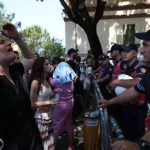
Scores of Albanians gathered for about 30 minutes last Sunday near the Macedonian embassy in Tirana in support of their ethnic Albanian brethren in Kumanovo, who were caught in between violent clashes between Macedonian police and an armed group.
Shouting “I am Kumanova,” they called on the Albanian, Kosovo and Macedonian authorities and the western embassies to protect Albanian population in neighboring Macedonia.
“Let them resolve their internal conflicts on their own, but they should not touch Albanians,” said a young participant quoted by the Shqiptarja.com site.
Participants also called for the resignation of the Skopje government, including their ethnic Albanian coalition partner led by Ali Ahmeti.