Tirana, Sep. 1 – U.S. Senator Richard Lugar and Nuclear Threat Initiative Chairman and retired Senator Sam Nunn visited Albania to honor it being the first country to complete the destruction of its entire chemical weapons stockpile as part of the Nunn-Lugar Cooperative Threat Reduction Program.
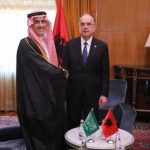
The Senators, accompanied by U.S. Ambassador John L. Withers II, called on President Bamir Topi, Prime Minister Sali Berisha and Defense Minister Fatmir Mediu. The Senators were awarded the “Gjergj Kastriot Skenderbeu” medal by President Topi for their contribution to the safety of Albania.
The highlight of the visit was a conference organized by the Albanian Ministry of Defense. Both Senators Nunn and Lugar expressed their delight at the fact that Albania was the first country to complete the destruction of its chemical weapons stockpile, utilizing the Nunn-Lugar Cooperative Threat Reduction program.
Through the CTR program, the U.S. assisted Albania in destroying approximately 16 metric tons of blister agents, the existence of which was first disclosed in June 2002.
In 2003, the U.S. Congress approved the Nunn-Lugar Expansion Act, authored by Lugar, which lets the President use up to $50 million in Nunn-Lugar funds for activities outside the former Soviet Union. In December 2004, the U.S. Department of Defense and the Albanian Ministry of Defense (MOD) concluded an agreement to destroy the stockpile in compliance with Albania’s obligations under the Chemical Weapons Convention. Senator Lugar has visited the Albanian chemical weapons storage site several times to review progress in its destruction.
A special destruction facility, designed by German company Eisenmann AG, was built where the stockpile was located to avoid risks associated with moving the chemical agents. The Pentagon’s Defense Threat Reduction Agency managed the project. After testing the destruction equipment and making required modifications to the system, destruction operations started in February 2007. Destruction was successfully concluded in July.
Lugar says Albania’s case may be used in other areas, calling it “An Albanian Success”
Here is the text of the speech given by U.S. Senator Richard Lugar in honor of the completion of the destruction of Albania’s chemical warfare stockpile:
Often when so many distinguished people gather together, they come to celebrate the construction of something important, perhaps a bridge or a hospital. But today we are grateful for the opportunity to celebrate a successful destruction mission. Albania and the United States have destroyed 16 tons of chemical weapons and materials.
This event is especially gratifying because it completes a journey that I began with my friends here in Tirana, almost three years ago. When I came to Albania to inspect the drums in which these lethal chemicals were being stored, I was encouraged at that time by the meetings I enjoyed with Prime Minister Nano, Foreign Minister Islami, and Defense Minister Majko. They demonstrated strong leadership in seeking the assistance of the United States to help organize the appropriate response to the dangerous situation they confronted. These chemical weapons had been brought in by another government secretly during the Cold War, and had not been declared, as required, under the Chemical Weapons Convention. There were other courses Albania’s leaders could have chosen, but to ensure the safety of their citizens and the rest of the world they sought assistance in eliminating the threat. As America builds new partnerships with friendly nations to control the designs of terrorists, we are grateful to Albania for a major contribution to global security.
The United States acted promptly to meet the Albanian request for assistance. We responded first by improving security around the weapons stockpile. Then American experts met with their Albanian counterparts to devise and implement a plan for the permanent destruction of these materials. Fortunately, the United States was prepared to respond to Albania’s call for urgent cooperation. In 2003, Congress acted favorably on my draft of the Nunn-Lugar Expansion Act, which allows the president to use up to $50 million in Nunn-Lugar funds for activities in countries outside the former Soviet Union. President Bush used that new authority in 2004 when he signed the authorization to begin work in Albania.
The Nunn-Lugar program has established a deep reservoir of experience and talent that we could bring to meet the challenge in Albania, and for other non-proliferation objectives around the world. The original Nunn-Lugar bill was concerned with the former Soviet Union where the vast majority of weapons and materials of weapons of mass destruction were located. And while the former Soviet Union will continue to be a major focus of Nunn-Lugar activities, the work in Albania demonstrates that we can and must be prepared with money and expertise to extend the Nunn-Lugar concept wherever it can be usefully applied.
That expertise was needed here in Albania. Destroying this deadly stockpile of chemicals proved to be a dangerous and complex operation. It was determined that it would be unsafe to try to transport the weapons agents down from the mountains from where they were first discovered. Thus, a destruction facility had to be built on-site, in very rugged territory, as I can personally attest. Experts at the Pentagon’s Defense Threat Reduction Agency first had to arrange for the fabrication of the necessary equipment and then, in cooperation with Albanian authorities and an American contractor, they had to arrange for the transport of this equipment and other materials up the winding mountain roads to the location of the bunker where the weapons were stored. There, they had to construct a large facility, about the size of a warehouse, in which to conduct the destruction activities. This work began quietly last year and, the Albanian government announced last month that all of its chemical weapons stockpile had been destroyed.
This is a truly remarkable achievement. This marks the first time in history that any nation has completely eliminated its stockpile of chemical weapons. In light of the fact that the proliferation of nuclear, chemical and biological weapons is the most serious national security threat we face, this is an important milestone. I would ask everyone here to join me in applauding Albania for this accomplishment.
It is also important to point out that this is not an isolated instance of Albania’s cooperation on matters of international security. In fact, Albania has proven to be a strong and reliable partner with the West in a number of areas. It has played a constructive role in resolving inter-ethnic conflicts in south Central Europe, it generously accepted refugees during the 1999 Kosovo conflict, and, today, it provides logistical support for the Kosovo Force troops there. Albania was one of only four nations to contribute troops to the combat phase of Operation Enduring Freedom, and Albanian troops are serving with distinction in the International Security Assistance Force (ISAF) in Afghanistan, and in Iraq.
Here in their home country, Albanians have also worked arm-in-arm with their western friends on matters of common security interest. Another unfortunate legacy from Albania’s Cold War era was the hundreds of conventional weapons depots scattered about the country. These storage facilities were often poorly secured, and the weapons were at risk of being stolen and sold into the black market, where they could have been purchased by terrorists and insurgents. There were far more small arms, ammunition and machine guns than Albania’s own forces needed, so they generously donated them to the new Afghan military forces. More importantly, Albania requested help in dismantling some of the most dangerous of these conventional weapons, in particular man-portable anti-aircraft missiles, known as MANPADS. These are of special importance because of their potential use by terrorists to shoot down civilian airliners. Al-Qaeda has reportedly attempted to acquire such missiles on a number of occasions. When I was here three years ago, I personally saw 79 of these MANPADS at a military storage facility. With assistance from the United States, Albania has destroyed these and other missiles, reducing yet another terrorist threat.
My experience in Albania, in fact, helped me realize the broad threat from the many other stockpiles of conventional weapons scattered in countries around the world. With my friend Senator Barack Obama, I introduced legislation that was signed into law earlier this year. The Lugar-Obama proliferation and threat reduction initiative applies the Nunn-Lugar principles to conventional weapons, expanding U.S. cooperation to destroy them.
Finally, even as we reflect upon our cooperative success in Albania, it is important to look forward and seek opportunities to apply these lessons elsewhere. Albania has shown that former enemies can work well together, and that Nunn-Lugar is a valuable tool outside the former Soviet Union. Albania’s secret stockpile may not be the last. We can and must be prepared to address similar risks in the Middle East, Asia, and any place else where supplies of weapons of mass destruction may be located. We must also stand ready to move quickly into situations such as North Korea, which has resumed the Six-Party negotiations aimed at eliminating its nuclear weapons program. If a final agreement can be reached, the Nunn-Lugar program could play a central role in neutralizing the grave threat posed by the nuclear weapons and materials that Pyongyang has accumulated.
The United States has, through the Nunn-Lugar program, developed a unique capability to meet a variety of proliferation threats, and we should be actively seeking new opportunities to dismantle dangerous weapons programs.
For the moment, we celebrate an historic moment for Albania and the United States of America
Also, speaking on August 27 in Moscow to commemorate the 200th anniversary of U.S.-Russian relations, Lugar specifically mentioned Albania, saying:
The important track record built by the U.S. and Russia has already produced results beyond the borders of the former Soviet Union. In 2004, new leaders in Albania discovered sixteen tons of chemical weapons that a previous government had failed to declare under the Chemical Weapons Convention. These chemical agents posed an enormous danger to Albanians should they have leaked, and to the rest of the world if they fell into the hands of terrorists or criminals. The government in Tirana recognized the risk and promptly sought assistance. Using personnel and expertise developed through the Nunn-Lugar program, all sixteen tons of chemical weapons have been safely destroyed. Our success in Albania is due in great part to the important lesson learned from cooperating with Russian colleagues.
Albania was an important test, but even bigger cases await our attention. The U.S. and Russia should be exploring how the Nunn-Lugar experience can be applied in North Korea. While difficult diplomatic work remains, we must be prepared to move forward quickly if the Six-Power Talks succeed. If negotiations yield an agreement from Pyongyang to eliminate its weapons of mass destruction and their means of delivery, the Nunn-Lugar program represents a ready-made framework for beginning the weapons elimination process.
Senator Nunn speaks on Kosova:
One of the things, when I look at our form of government, and the fact that we’ve had a constitutional rule of law for over 200 years now, one of the main ingredients of that is not simply majority rule, but also minority protection. Your country is moving to establish democratic institutions and minority protections and rule of law. And I congratulate you for moving in that direction.
I would only say that I believe you have a chance to set an example here that will apply in the whole region, and particularly apply in Kosovo as that independence is being sought.
When the independent nations were formed after the break-up of Yugoslavia, the single greatest omission, in my view, that led to a great deal of bloodshed, was the lack of assurances to the minorities that, once the power had been assumed with the majority, their lives, freedoms, and property would be protected. So Albania has a real opportunity here, not only to set the example that you have already done in the chemical arena, but to set a very important example of protecting your ethnic groups, protecting your religious groups, so that people in this region can see that that indeed is the essence of democracy.
That is of course a big challenge in Kosovo, and I believe that you will play a very important role in helping meet that challenge.
So I thank you, Mr. Minister, for making this day possible, I thank you for your leadership in the chemical weapons destruction arena, I thank you for your country’s fight against terrorism, and I thank you for the example that I believe you will be setting in the future for this entire region.