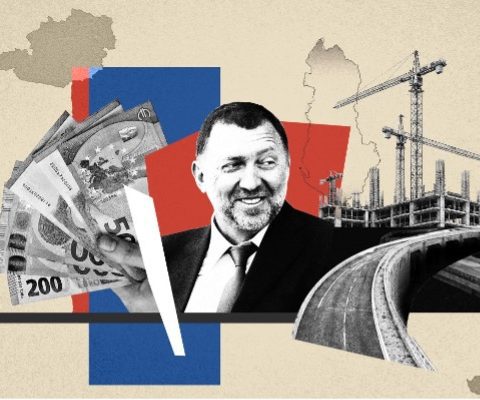
TIRANA, July 9 – The Albanian legal system grants foreign and domestic investors equal rights of ownership of local companies, according to Investing Across Borders (IAB) 2010, a new World Bank initiative comparing regulation of foreign direct investment (FDI) in 87 countries. Of the 33 sectors covered by the Investing Across Sectors indicators, 30 are fully open to foreign equity ownership in Albania. The only exceptions were the domestic and international air transportation and the television broadcasting sectors. Foreign ownership of airline companies is limited to a maximum share of 49% for both domestic and international air transportation. These equity restrictions, however, apply only to investors from countries outside of the Common European Aviation Zone.
The Law on Public and Private Radio and Television also stipulates that no natural person or legal entity, foreign or Albanian, may own more than 40% of the share capital of a television company.
Prime Minister Sali Berisha praised the report during a government meeting saying that Albania performance was 95 percent in all sectors, exceeding by 5 percent the OECD countries, the developed countries, and by 2% the countries in the region.
Starting a foreign business
It takes 7 procedures and 7 days to establish a foreign-owned limited liability company (LLC) in Albania. This is faster than both the IAB regional average for Eastern Europe and Central Asia and the IAB global average, said the report. A foreign company is not required to seek investment approval, although, if it wants to engage in international trade, it must register with the customs system in order to import goods. Registration with the National Registration Center (NRC) takes only a day and the required documents are available online.
Entrepreneurs can complete company, tax, social insurance, health insurance, and labor directorate registrations using a single application procedure with the NRC.
Accessing Industrial Land
Albania was ranked in the economies of the 80th percentile rank which are an anomaly as they both have abundant land information but less government effectiveness.
In Albania, it is possible to lease or own both privately and publicly held land. The process of leasing public land, though legally possible, is difficult in practice. Public land can only be leased through a competitive bid and requires several administrative procedures. Lease contracts are limited to 99 years for agricultural land and
30 years for other land. Only lease agreements for a period of more than 9 years require registration with the relevant office. The lease contract can offer the lessee the right to sublease and/or subdivide the land as well as the right to mortgage the land or use it as collateral. There are no restrictions on the amount of land that may be leased. Key land-related challenges that investors are likely to face are the result of unresolved conflicting
claims rendering title documents insecure. One should exercise due diligence when seeking to acquire land in Tirana, warns the report.
Arbitrating Commercial Disputes
Albania was among the only 8 out of 87 countries which do not have a specific arbitration law along with Bosnia and Herzegovina and Montenegro. The report said there are some provisions scattered throughout civil codes or other laws which do not provide sufficient regulation of arbitration.
The Albanian Civil Procedure Code (1996) has a short section on domestic arbitration and notes that international arbitration will be regulated by a special law that has not yet been adopted.
Thus a stable and predictable arbitration regime, as part of the broader legal framework, is another factor that can affect conditions for FDI.
FDI
Foreign direct investment (FDI) continued its growth even in the first quarter of this year. Central bank data show FDI reached 154 million euros in the January-march period, increasing by 34 million euros year-on-year.
FDI in March 2010 was 65 million euros, 19 million euros more than the previous month and 21 million euros more year-on-year.
Foreign direct investment (FDI) registered its lowest level in years last December. Statistics published by the Bank of Albania show only 0.6 million euro entered Albania in FDI in December 2009 and 1.6 million went out, registering a total net of minus 1 million euros. Experts say the deficit of FDI was caused by declining interest of foreigners in the Albanian economy and the transfer of profits foreign companies made in the previous years.
Last year, FDI registered a 7 percent growth compared to 2008, reaching 664 million euros. However, an important part of these investments came from the sale of public assets such as the minority stake at mobile operator AMC and the privatization of the Distribution System Operator.
The FDI is considered as the most important factor for the development of the country because of the capital, technology and new experience it brings.