January
Landmark Gorica bridge restored
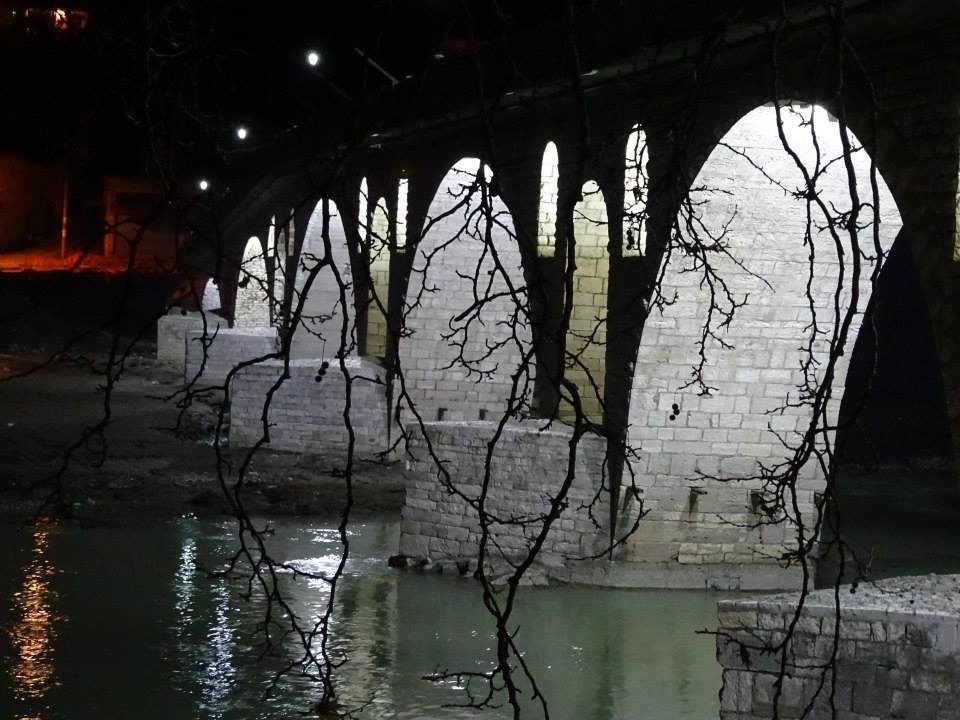 The landmark Gorica bridge in the UNESCO World Heritage site of Berat, south-western Albania, was finally restored under a $130,000 fund by the Albanian Development Fund.
“The famous Gorica bridge, another jewel of our cultural heritage, gets out of the mud and darkness where it had been plunged for twenty years,” wrote Prime Minister Edi Rama on his Facebook profile.
The reconstruction works renovated the electricity and water supply systems, the cobbled streets, placed a lighting system and tourist signs.
The Gorica Bridge, which connects two parts of Berat was originally built from wood in 1780, but was later rebuilt with stone in the 1920s. The seven-arched bridge is 129 metres long and 5.3 metres wide and stands about 10 metres above the average water level.
Kadare wins Jerusalem Prize literary award
Internationally renowned Albanian author Ismail Kadare was awarded the Jerusalem Prize for his works which best express and promote the idea of the “freedom of the individual in society.”
“Kadare is an ironic and very interesting storyteller who excellently and subtly confesses about the collective blame especially the non-punishment of this blame. Even though his characters are mainly local, the understanding and importance are undoubtedly universal,” says the jury of the Jerusalem Prize, the cultural highlight of the Jerusalem International Book Fair.
Kadare, known for writing about Albania’s totalitarian government, has works translated into over 30 languages. An internationally renowned poet, novelist and essayist, Ismail Kadare has been perennial candidate for the Nobel Prize for literature. His international acclaim for his works peaked in 2005 when he won the Man Booker International Prize.
February
Opera stars home for Puccini performance
Two of Albania’s most prominent international opera stars, soprano Ermonela Jaho and baritone Gezim Myshketa, were back home to perform in Suor Angelica” and “Gianni Schicchi,” two operas part of Puccini’s The Triptych.
Back in 2014, the internationally renowned Albania soprano Ermonela Jaho was honored with the highest medal by the Prime Minister as an ambassador of Albanian art and culture.
Jaho’s first international performance as Sister Anegelica in Suor Angelica took place at London’s Royal Opera House in 2011, receiving critical acclaim.
Gezim Myshketa, another Albanian rising international star performed in “Gianni Schicchi,” opera.
The 32-year-old baritone from Durres received critical acclaim for his starring role as Enrico in Donizetti’s Lucia Di Lammermoor in the Marseille Opera Gouse in early February 2014 with the French press describing him as the real surprise of the production.
March
Francophone Spring revives cultural life
Dozens of events were staged in Albania’s main cities for ten days as part of Francophone Spring celebrations in Albania, an annual event celebrating French culture which revives cultural life each March.
Music, cinema, theatre, exhibitions, conferences, dances, poetry, gastronomy and even wine tasting were some of the events held in Tirana, Shkodra, Korà§a, Fier, Elbasan, Durres, Vlora, Saranda, but also smaller towns such as Permet, Gramsh, Bajram Curri from March 18 to 28.
Organized by the French Embassy in Albania and the French Alliance in cooperation with Albanian state institutions, the Francophone Spring events revived cultural life in Albania, further promoting the French culture and arts in the country which numbers thousands of French speakers.
Durres archeological museum reopens
After a five-year reconstruction saga, the landmark Durres archeological museum which houses around 3,200 items dating back from prehistory to the Middle Ages, finally reopened to the public in the country’s second biggest city.
Speaking at the inauguration ceremony, Prime Minister Edi Rama described the newly reconstructed museum as the biggest and most realistic in Albania.
The archeological museum of Durres, a testimony to the ancient city’s 3000-year-old history along with the ancient Roman amphitheatre, had been under restoration since September 2011. The initial project envisaged the museum restoration project would conclude in 2012 during the country’s 100th anniversary of independence.
May
Gjirokastra folklore festival
More than 1,400 Albanian artists from Albania, Kosovo, Macedonia, Montenegro but also the Albanian communities in Italy, the U.S., Switzerland, Turkey participated in the tenth edition of the Gjirokastra folklore festival, one of the most important cultural heritage events held in the southern UNESCO town of Gjirokastra every five years.
Culture Minister Mirela Kumbaro, who has also been heading the festival’s organizing committee since the start of preparations last July, described the festival which has been regularly held every five years since the late 1960s under communism as a great treasure and the biggest monument of Albania’s intangible cultural heritage.
The whole of the historic town of Gjirokastra turned for one week into a huge stage where apart from the festival’s regular programme, there were also exhibitions, street art, movie projections, open air performances and several trade fair on handicraft, books, gastronomy, tourism and agriculture.
The local fortress and the town’s historic centre, both part of the UNESCO World Heritage list, were the two venues of the festival which returned after its last 2009 edition.
Food, story and mystery at Milan Expo
Under the local hospitality slogan, “My house belongs to God and to guests” Albania invited visitors to the 2015 Milan Expo to get to know its Mediterranean food, story and mystery.
Albania participated in the Bio-Mediterraneum Cluster, offering international visitors a great opportunity to experience its natural beauty and cuisine, but also, the productivity and creativity of its regions, its history and particular products, organizers say.
With its participation at Expo Milano 2015, Albania strongly committed to the ambitions of “Feeding the Planet, Energy for Life,” and create partnerships that will promote Albania’s traditional cultural identity and develop its agriculture and organic farming, with new measures of production and trade, Albanian representatives said.
Mussel festival opens tourist season in Saranda
A characteristic mussel and olive oil festival opened the new tourist season in the southernmost Albanian town of Saranda, nicknamed as the pearl of Albanian Riviera.
The Butrint archeological park and its famous lake known for its quality mussels just outside Saranda, was also the host of a special concert marking Europe Day on May 9 when internationally renowned Albanian soprano Inva Mula performed at the ancient amphitheatre of Butrint, a UNESCO World Heritage site.
“Tourism holds a great promise in stimulating economic development and employment growth across this beautiful country…I wish Saranda and Albania’s coastal regions a wonderful tourism season,” said former U.S. embassy Deputy Chief of Mission Henry Jardine
June
Butrint theatre festival makes comeback
After last year’s absence due to lack of financial support, the Butrint international theatre festival, made its comeback to mark its 13th edition but with a limited number of shows due to ongoing problems with funding.
Alfred Bualoti, the festival’s director, says this year’s edition held from July 18 to 22 at the amphitheatre of the UNESCO World Heritage site of Butrint would showcase only three performances by foreign theatres.
The Butrint 2000 is an annual theatre festival that takes place on a historic site in the ancient Albanian town of Butrint, on the shore of Lake Butrint. The festival started in 2000 and has presented works by Albanian artists, as well as more than 50 international companies.
August
Classical music biennial brings Albanian-Spanish sounds
More than a dozen musicians from Albania, Kosovo, but also Spain, Italy, Switzerland and Germany participated in the seventh edition of “Classical Music Nights” biennial staged in the city of Durres by internationally renowned Spain-based Albanian violin virtuoso Florian Vlashi.
This year’s biennial was held under the motto “Spain: A musical journey in Cervantes’s home” bringing different genres of classical music and three ensembles from Spain, Kosovo and Albania.
Violinist Florian Vlashi says the Albania-Spanish relations are as ancient as 17 centuries old.
“In fact Durres is the Albanian city which has most played Spanish music and where many musicians, composers and artists were represented in Spain,” he said.
The festival, held in Durres from August 1 to 7, featured the surrealist, ancient music, baroque, classical, romantic modern and contemporary music nights.
October
Deutscher Oktober events mark transformation
A concert by the Amadeus Guitar Duo composed of Thomas Kirchhoff and his Canadian partner Dale Kavanagh opened this year’s German October events in Albania which offered one month of tight calendar of cultural events under the motto “25 years of German reunification, 25 years of transformation in Albania.”
Movies, literature, theater, music, ballet and workshops were staged all over Albania in this ninth edition of the Deutscher Oktober held from Sept. 29 to Nov. 3.
“Together with our partners we have managed to compile a programme which is testimony to the diversity of German-Albanian relations in the field of culture,” said German Ambassador to Albania Hellmut Hoffmann. “The idea is that both Germans and Albanians come closer and get to know each other better,” he adds.
2015 was a special year for both Germany and Albania. On October 3, Germany celebrated its 25th reunification anniversary while Albania commemorated the beginning of a new political era in December 1990 which brought the collapse of one of the harshest communist regimes.
Spaৠprison among the world’s 50 at-risk sites
New York-based World Monuments Fund announced the former notorious Spaৠprison for the politically persecuted under communism located in northern Albania as one of the world’s 50 at-risk cultural heritage sites.
“SpaৠPrison, the notorious labor camp, is in an extremely advanced state of deterioration, and deserves to be transformed into a modern place of remembrance,” said the organization in its 2016 World Monuments Watch.
A notorious labour camp in communist Albania, the organization describes the forgotten site as a powerful place of memory that deserves to be preserved for future generations.
Albania’s SpaৠPrison, in operation from 1968 until the early 1990s when the communist party fell, is now in an extremely advanced state of deterioration.
Preserved spoken Albanian in Bulgarian village
Bulgarian researcher Ludmill Stankov published a monograph on spoken Albanian in the Bulgarian village of Mandrica, founded in the early 18th century by Albanian migrants from Korà§a, and whose inhabitants of Albanian origin still preserve an archaic dialect of the southern Albanian Tosk dialect.
The Mandrica village located on the right bank of the River Byala Reka, 19 km South of Ivaylovgrad and 2 km West of the River Luda Reka, on the Bulgarian-Greek border was founded in 1636 by three Albanian brothers from Vithkuq village of Korà§a, southeastern Albania.
Mandritsa is the only Albanian village in Bulgaria, where even today native people speak this unique archaic Albanian language. “The village was founded in 1636 by three brothers Albanian Eastern Orthodox dairyman (Mandritsa – mandra (dairy), hence the name of the village,” says the Association for revival of the village of Mandrica
November
Tirana book fair kicks off
More than a hundred publishers from Albania, Kosovo, Macedonia, Montenegro and the Albanian Diaspora participated in the 18th edition of the Tirana Book Fair, the largest event bringing together Albanian publishers who have expressed rising concern over a sharp drop in sales in the past few years.
This year’s fair, held at the Palace of Congresses from November 11 to 15, focused on the future of digital books in Albania. Several embassies and international organizations also participated in the book fair.
The Albanian Association of Publishers says the economic crisis Albania has been facing in the past few years has also affected book sales and led to the closure of dozens of bookshops and fewer new publications.
Albanian heritage month in Canada
It is a historic day for Albanians in Canada, said the Albanian-Canadian Community Association after the Legislative Assembly of Ontario proclaimed November as the Albanian heritage month.
“Proud to speak about The Albanian Canadian Community Association & introduce The Albanian Heritage Month Act,” wrote Canadian politician Laura Albanese who submitted the bill to the assembly.
November is a significant month for the Albanian community. Each year, during the month of November, people of Albanian origin celebrate the Albanian Declaration of Independence, which declared Albania an independent sovereign nation on November 28th, 1912, say the bill.
In November, Albania also commemorates Liberation Day, which is the day that Albania was liberated from Nazi Germany forces after the Albanian resistance on November 29th, 1944.
Sports
December
Albania to play France, Switzerland, Romania in Euro 2016
Albania will face France, Switzerland and Romania in Group A of the Euro 2016 in a bid to make another surprise campaign after a historic qualification as an outsider.
Albania will make its first-ever appearance in a major football competition on June 11, 2016 against Switzerland in what is considered a derby as the Albanian side features as many as seven Swiss-born players while five of the Swiss internationals have Albanian roots. The odd thing about this match is that two Albanian brothers, Granit and Taulant Xhaka, will be playing for different sides in the derby in an encounter they had hoped to avoid.
“Our advantage is that there’s no pressure on us, so everything we do will be an achievement. This is a very important experience for us, and we’ll try to show that because the players are proud to be taking part in this edition of the European Championship,” said Albanian-Italian coach Gianni De Biasi.