TIRANA, Nov. 21 – Support for Albania’s EU membership continues at high levels and Albanians see no other future than that of being part of the big European family. This is the conclusion that the annual study of Albanians’ perceptions of the EU has showed for the year 2006. The study pointed out that the increase in support can be explained by the signing of the Stabilization and Association Agreement (SAA) between the European Union (EU) and Albania on June 12, 2006 which restored some confidence and faith on the integration process. After three years during which the public perception was that the integration process was stalled, the relatively optimistic annual progress report of the European Commission at the end of 2005 created an upbeat atmosphere which culminated with the signing of the SAA. The study showed that the importance of EU-Albania relations is valued highly by all respondents.
The aim of this study, which is traditionally organized by the Albanian Institute for International Studies, is to monitor and examine Albanians’ knowledge of the European Union (EU) and its institutions as well as their perceptions on the country’s progress towards EU membership. AIIS posed a questionnaire to five target groups: public administration, local government administration in ten major Albanian municipalities,1 media, NGOs, and businesses. The survey was done during the period July-August 2006, an interesting timing given the signing of the SAA, thus the results are conditioned by a certain “vulnerability” of the public opinion to such an event. AIIS implemented the first Perceptions and Realities survey in October 2002 and since then it has been carried out every year, making it possible for its use in a comparative and analytical perspective. This project was supported by the Balkan Trust for Democracy and the Network of Open Society in Albania.
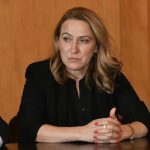
The AIIS organized on Tuesday a conference to promote the successful completion of their study “Albania and European Union: Perceptions and Realities 2006.” In the conference, Sabina Ymeri, deputy executive director of the Institute summarized and discussed the main findings of the study, illustrating them with graphs and tables through a multimedia presentation. The following speaker was the Minister of Integration, Arenca Trashani who expressed high enthusiasm at the corresponding priorities between the study and the Ministry’s goals for public information related to integration. Trashani then gave a summary of the governmental projects and initiatives related to providing information to all actors of Albanian society about each consecutive step in the long route towards Europe. Trashani also commented on some new features of local actors involved in the integration steps. She said that in the local administration she has found worthy partners in the larger effort of integration. She finalized her speech by repeating her favorite conclusion remark from the study: Integration starts from Tirana, nor from Brussels.
Head of the Parliamentary Commission for Integration, Ilir Meta, praised the study and invited the working team to present the main findings to the Commission in order to institutionalize and strengthen the relationship between the parliament and civil society actors and benefit from the additional information provided in the presentation. Meta commented on of the findings of the study that showed the percentage of Albanians that know how to rightly interpret the SAA to be 14.3percent. To the people that this seems a low percentage, Meta said that he is actually impressed by it and that even if you survey the deputies of the Albanian Parliament you might not find a higher value. One of his main concerns was the improper attention and coverage of the media to the process and the specifics of integration. There is complex matrix of requirements that could be as well investigated by the media and presented to the public in order to assist information. Nevertheless, according to Meta, the media is bewitched by the political controversies and cannot see beyond the electoral battles.
AIIS chairman Albert Rakipi discussed one of the primary goals of this study, to prepare a worthy class of integration skeptics in order to offset the alarmingly high rate of approval that were showing a blind faith in a European miracle. Albanians are so pro-European that the debate lacks the vigor displayed in other Eastern European countries. By having taken for granted Albania’s European destiny, we have ceased to struggle for a European Albania for its own sake.
The last part of the conference was taken by a question and answer session. First the issue of the dichotomy between security issues, such as corruption and organized crime and political events was analyzed, in order to see that Brussels and Tirana might have different preconceptions about priorities. Former Foreign Minister, Alfred Serreqi presented some objections and questions to the study itself. Other participants presented their questions to Trashani or Meta. The discussion included a view on recent Albanian political developments and the potential effect they can have on the process of integration. On December 1, Albania will be bound to start implementing the Interim Agreement which will impose different customs fees to imports and exports. Some of the participants expressed a concern that this will hurt local producers. This question was addressed by Arben Kashahu, who commented that the different rates would be applied selectively and would boost local products instead of harming them.
ؠThe 2006 survey shows that support for Albania’s EU membership has increased significantly since 2005 from a low point of 83.9 percent in 2005 and 84.9 percent in 2004 to 92.5 percent in 2006.
ؠWhile the SAA restored support for the country’s EU membership, it did not radically alter perceptions on the challenges and timeframes of the integration process.
ؠThe majority of those polled support EU membership primarily for economic reasons. Yet, free movement remains a burning issue with 37 percent justifying their “pro-membership vote” because they expect to move freely in the EU.
ؠ Respondents continue to see the EU as the most important strategic partner for Albania. Its first place compared to other states or international organizations remains undisputed as in all previous Perceptions and Realities surveys.
ؠDespite a higher level of knowledge and understanding of the integration process, serious misconceptions continue. 72percent of the respondents have a wrong perception on the SAA’s impact for Albania.
ؠOverall, respondents are becoming more unified over time in their estimation of the length of the process. Expectations on the length of the process of integration have become more realistic.
ؠAs in 2004 and 2005, the business community is the leading social group in its ambivalent attitude towards EU integration with only 80 percent of business people surveyed supporting EU membership.
ؠAlbanians perceive political conditions as much more important than economic ones for EU integration. Albanian politics, free and fair elections and corruption top the list of factors which are deemed important.