Threats of stopping the EU integration process oblige Albania’s hopeful political compromise
Tirana Times
TIRANA, May 20 – Albanian opposition lawmakers and supporters on Wednesday ended a 19-day hunger strike after political leaders agreed to EU-sponsored talks to end a political crisis. The European Parliament sent a letter Wednesday to the two top Albanian leaders bluntly telling them that unless they reach a political compromise, with their assistance, the country could not proceed more on its path toward integration into the European Union.
The main opposition Socialists say top officials from their party and Prime Minister Sali Berisha’s Democrats will attend a Thursday’s meeting or dinner in Strasbourg. The Socialists said that Enlargement Commissioner Stefan Fuele will also be at the meeting.
Berisha and Rama are invited at a dinner in Strasbourg from the European Parliament’s head of the right and left-wing groupings Joseph Doul and Martin Schulz respectively.
The ltter from Doul and Schulz invited Berisha and Rama at a dinner in Strasbourg saying that better they reach a compromise than expect a negative response to the country’s candidate status and the thousands of pages of responses to the questionnaire needed for that.
Albania expects a positive answer to the candidate status, likely this year. It sent the answers to the 2,284 questions from Brussels last month and is also to prepare answers to 170 added questions until June 10. EC missions are also to come to Albania to check the responses.
“During the dinner there will be broadly discussed on the ways and manners to give an end to the political deadlock in Albania,” said a statement from Berisha’s office.
The two top leaders will be accompanied by a three-member team that will normally be involved in direct negotiations, under the EU officials’ auspices, for the technical term of a possible compromise agreement.
The Socialists claim last June’s parliamentary elections were rigged to ensure Berisha’s re-election. Berisha, who controls 75 of parliament’s 140 seats, has rejected calls for a re-count from the opposition, which holds 65 seats.
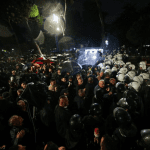
Twenty-one opposition lawmakers and 180 supporters started the hunger strike, camped beneath Berisha’s office.
“Let’s wish tomorrow will be a lucky day,” said Rama in front of his supporters, adding, “We guarantee we will not stop, we will not withdraw and we are ready for new sacrifices if the solution does not come.”
The Socialists claim vote transparency through a partial vote recount, something which has been considered as illegal from Berisha.
Earlier Berisha said that the majority was open “to the opposition’s options. The government is obliged to create space.”
So, it is very likely that the new agreement will be what Rama mentioned late last week following the statement from the OSCE Ambassador Robert Bosch, that is, opening and investigating the vote documentation while letting the Venice Commission decide whether the ballot boxes should be open or not.
What is important for common Albanians is the fact that the country’s two main political parties, which govern and are the decision-makers, will compromise. That means that many institutions, including the parliament, will become functional, something which is not only so much needed in a tiny country, but which is also been pressed upon from Brussels along Tirana’s efforts of integration into the bloc. Albania needs to be ready to cope with the challenges asked from Brussels while it is asking for the candidate status.
Another major issue, at least for Albanians, is whether the European Union will decide in favor of giving the visa-free regime to the country at its summit June 2.
There will be many comments on the strike, on its goal and the opposition leader, on the reaction and stand from the government and Berisha, on the wins and losses for each of them, including their coalition partners and also on how Europe convinced the two leaders to sit and negotiate but only if they are present.
There will be comments whether the international community had presented the two leaders with a draft compromise proposal, as Bosch said.
But all of them will be easily forgotten or become useless if the new deal will turn the country to normalcy and will help it become a truly democratic one.
Moreover its effect will be seen at the local elections planned to be held next year, a test for the political parties but also for their leaders.
Opposition ends strike, talks to start in Brussels
TIRANA, May 20 – After 19 days of a hunger strike in front of Albania’s government building and continuous rallies of support, Albania’s opposition Socialist Party has called off the strike and protests to leave room for talks with the government to start in Brussels with the assistance of the European Union.
Before the strike ended, the political deadlock continued, leaving behind a busy week in Albanian politics. Here is a recap.