Momentum growing on better checks and governance for Albania’s booming private education sector as cases of fraud and poor quality raise red flags.
Tirana Times
TIRANA, June 21 – Private education at all levels is increasingly coming under scrutiny in Albania, as questions linger about quality and appropriate checks over accreditation.
That scrutiny comes as the sector is booming following massive investment in private institutions seen as a lucrative business by their owners. However, the investment and massive advertising campaigns that come with it have also been hurt by high profile cases of fraud and allegations that some institutions are merely serving as diploma mills. Experts worry Albanian private university diplomas are often obtained under little supervision by Albanian education officials in charge of guarding the quality of the country’s education system. And beyond the university level there are now calls to increase scrutiny on private schools at lower levels too.
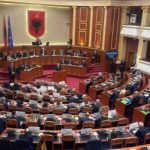
It led some members of parliament to act in parliament last week, as members of the Education Commission discussed a bill that would increase the fines for unlicensed institutions by 50 times – up to 1 million leks.
But even with institutions that are licensed or are in the process of getting licensed, there are still issues to sort out, authorities admit.
“The system is not immune to problems,” Education Minister Eqerem Tafaj said in a recent parliamentary meeting. “What we need is a complete digitization of supervisory structures to strengthen and empower the Accreditation Agency.”
But Valentina Leskaj, the Education Commission chairwoman and opposition member of parliament, says there are serious problems with the licensing process itself.
“The problem that starts with licensing, which for the sake of truth has been licensing some who do not meet standards. If criteria are not met, let’s deny the licenses. There are checks, but they have not identified fake diplomas that we know are out there,” she said.
Despite the boom, private universities and schools face an uphill battle in attracting students. Eighty percent of Albanian students attend public schools which come with lower costs and often with better reputation.
In addition to the questions over quality, there are added costs to going to private universities – on average, by graduation time a student would have spend about 5,000 euros, a hefty sum for Albanian budgets.
Debate over accreditation, inflated grades
The debate over accreditation reached its peak when media revealed that Renzo Bossi, the son of an Italian politician has obtained a private university degree licensed by the Albanian Ministry of Education without ever stepping foot in Albania or attending the needed three-year term.
Public and political pressure and an ensuing investigation led to a one-year license suspension for Kristal University, which had issued Bossi’s diploma. It means the university can’t admit students in the upcoming year and will have to reapply in a year.
Minister Tafaj admits there is a lot to do, and explains that there are actually only three official private universities in Albania, while others, which often call themselves universities, are simply accredited as institutions of higher learning. There are 44 of these.
In addition to right-out fraud, as in Bossi’s case, there is also widespread perception that even in places where students attend a full curriculum grades are inflated and the quality of education is affected.
“If you have money, to the private university the grade does not matter,you will get the best grades regardless of performance,” says a private university student.
Testing the assumptions
Some of these trends and assumptions about private education are being discussed as part of a recent American Enterprise School of Albania project with the support of the U.S. Embassy in Tirana and the National Endowment for Democracy.
The project aims to test some of the public’s assumptions on whether universities require only financial benefits, instead of offering a competitive education to students who pay for it. There clearly are are abusive cases when students pass the exams by offering bribes or else by buying a diploma according to their choice, and experts now want to look deeper to see how extensive these problems are.
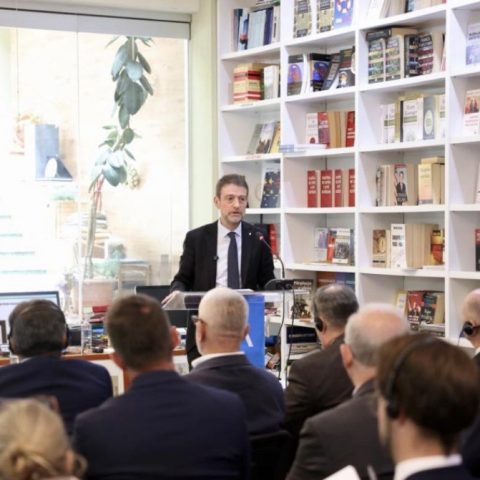
At a recent roundtable organized by the project (see full article on page 8), Avni Meshi, who heads the Agency of Accreditation for the Higher Education, said most of the private universities which opened after 2009, have not been accredited but are still in process. He said there are new systems which take time to consolidate, in terms of the academic staff which they employ and their infrastructure.
The main aim of the agency he leads is to evaluate the weaknesses of the private education, Meshi said. And that missing tradition is very important. One has to take in consideration that the majority of the private universities, and many public ones are quite new in Albania. In contrast they face European universities with decades or even centuries of tradition, he added.
Meshi argued that the problem goes further than the universities themselves – and it’s part of the society as a whole. A diploma is perceived as more important than the vocational training, he said. So a diploma is not simply a piece of paper which does not have any value in the labor market, as it is the market that will show the value of the private and public universities in the future, he noted.
Investigating backgrounds
As is often the case, Albania did not invent the wheel when it comes to shady practices. The rest of the region (and beyond) faces the same issues, says Florian Bieber, a professor at the Center for South East European Studies of the University of Graz in Austria.
In often biting blog posts, Professor Bieber mocks the lack of credentials and gives fact after fact that many universities in the region make a mockery out of higher education.
In his latest article, Bieber, gives the example of European University in Belgrade, which appears to offer no classes but has build its reputation thanks to man who serves as its rector.
“The rector also has a ‘Grand Doctor of Western Philosophy’ and is Commander of the World Order Science from the European Academy of Informatization,” Bieber writes. “Now I have never heard of a ‘grand’ doctor, but presumably it is bigger than a regular Doctor.”