 “With government and household consumption failing to thrive, the country’s economy still begrudges the growth rates achieved in 2010 and earlier years,” says the Vienna Institute for International Economic Studies
TIRANA, March 16 – Citing reforms in the energy system and a recovery in foreign direct investment in energy infrastructure, the Vienna Institute for International Economic Studies has revised upward Albania’s GDP growth for the next three years, but the forecasts remain less optimistic compared to expectations by the Albanian government and top international financial institutions.
In its March forecast, the Vienna Institute, which is one of the top centres for research in Central, East and Southeast Europe, has upgraded its forecast for 2014 to 1.5 percent and expects the Albanian economy to grow by 2 to 2.4 percent in the 2015-2017 period, which is around 1 percent higher compared to its previous forecast last November.
“GDP growth is expected to increase progressively over the next three years, increasing by 2 percent in 2015, 2.2 percent in 2016 and 2.4 percent in 2017,” says the Institute whose forecast is 1 to 2 percent below expectations by the Albanian government, the IMF and the World bank.
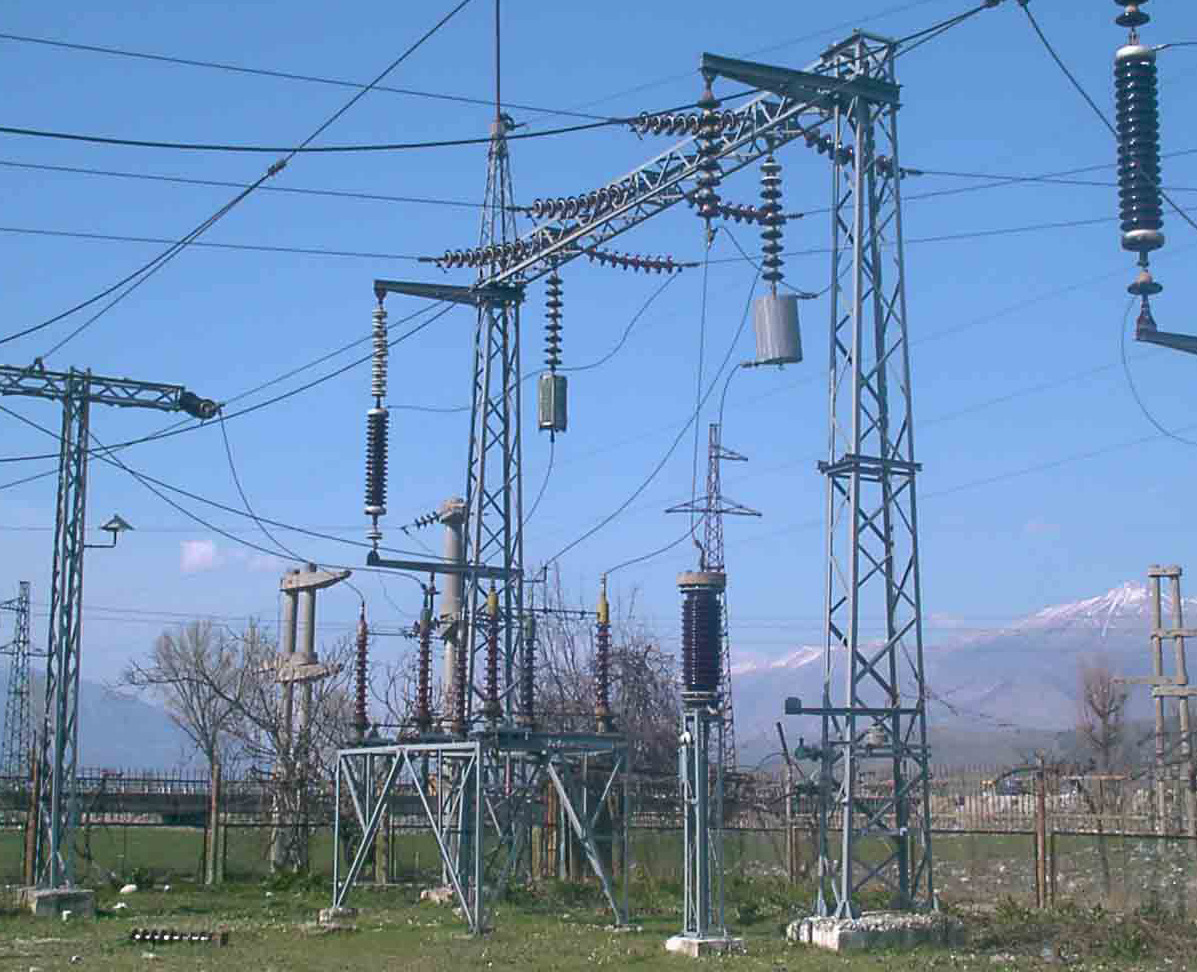
Implying the nationwide campaign to curb electricity thefts and reduce grid losses of around Euro 150 million annually and investments in energy sector from the Trans Adriatic Pipeline and major hydropower plant projects such as the Devoll HPP, the Vienna Institute says “the economy might benefit from a resolute reform in the energy sector and growth in gross fixed capital formation stemming mainly from foreign direct investment in energy infrastructure.”
The Institute says the low level of government spending and household consumption continue keeping the Albanian economy below growth rate achieved in 2010 and earlier years at the onset of the global financial crisis when Albania was more immune to spillover effects from the Eurozone crisis.
“With government and household consumption failing to thrive, the country’s economy still begrudges the growth rates achieved in 2010 and earlier years,” says the Vienna Institute.
The Institute expects Albania’s inflation rate to range between 1.5 to 1.7 in the next three years which is around half of the country’s central bank target of 3 percent estimated to have a positive impact on consumption and private investments.
Meanwhile, FDI is estimated to have dropped to Euro 800 million in 2014, down from a record Euro 945 million in 2013. Lack of privatization revenue and the increase of the corporate income tax by 5 percent to 15 percent are estimated to have had a negative impact in the FDI performance.
In its previous forecast in late 2014, the Vienna Institute expected Albania’s growth rates to to hover around 1 percent in the next couple of year.
“Weak domestic demand, especially due to fiscal austerity measures, is the main reason for the sluggish development that is a far cry from pre-crisis economic dynamics. The signals emanating from the private sector are contradictory and do not make for a more optimistic outlook at present,” said the Institute.
Despite the recent upgrade, the forecasts by the Vienna Institute remain the most pessimistic about the Albanian economy which has been struggling with growth rates of 1 to 2 percent in the past three years compared to an average of 3.5 percent annually in the 2009-2011 period and a pre-crisis decade of 6 percent annually.
The Albanian government and the IMF and World Bank which are assisting in reforms, expect the country’s economy to accelerate from an expected 2.1 percent in 2014 to 3 percent in 2015, 4 percent in 2016 and 4.5 percent in 2016 and 2017.
Meanwhile, London-based EBRD has revised downward its 2014 growth forecast for Albania’s to 1.5 percent, down from 1.7 percent, citing weak external demand outlook.The European Bank for Reconstruction and Development expects the Albanian economy to slightly accelerate to 2.5 percent for 2015, up from 1.5 percent in 2014 and 1.4 percent in 2013.
The EBRD had earlier warned spillover impacts from top trade partners Italy and Greece continue having a negative impact on Albania’s economy. “Albania’s strong trade, investment and remittance ties to Greece and Italy, both of which face continued economic gloom, are likely to continue to constrain growth and the high level of public debt will limit the room for fiscal manoeuvre.”