A Tirana Times interview with the Apostolic Nuncio in Albania, the Vatican’s ambassador
Your Excellency, welcome to Albania. Can you tell us about the priorities in this country?
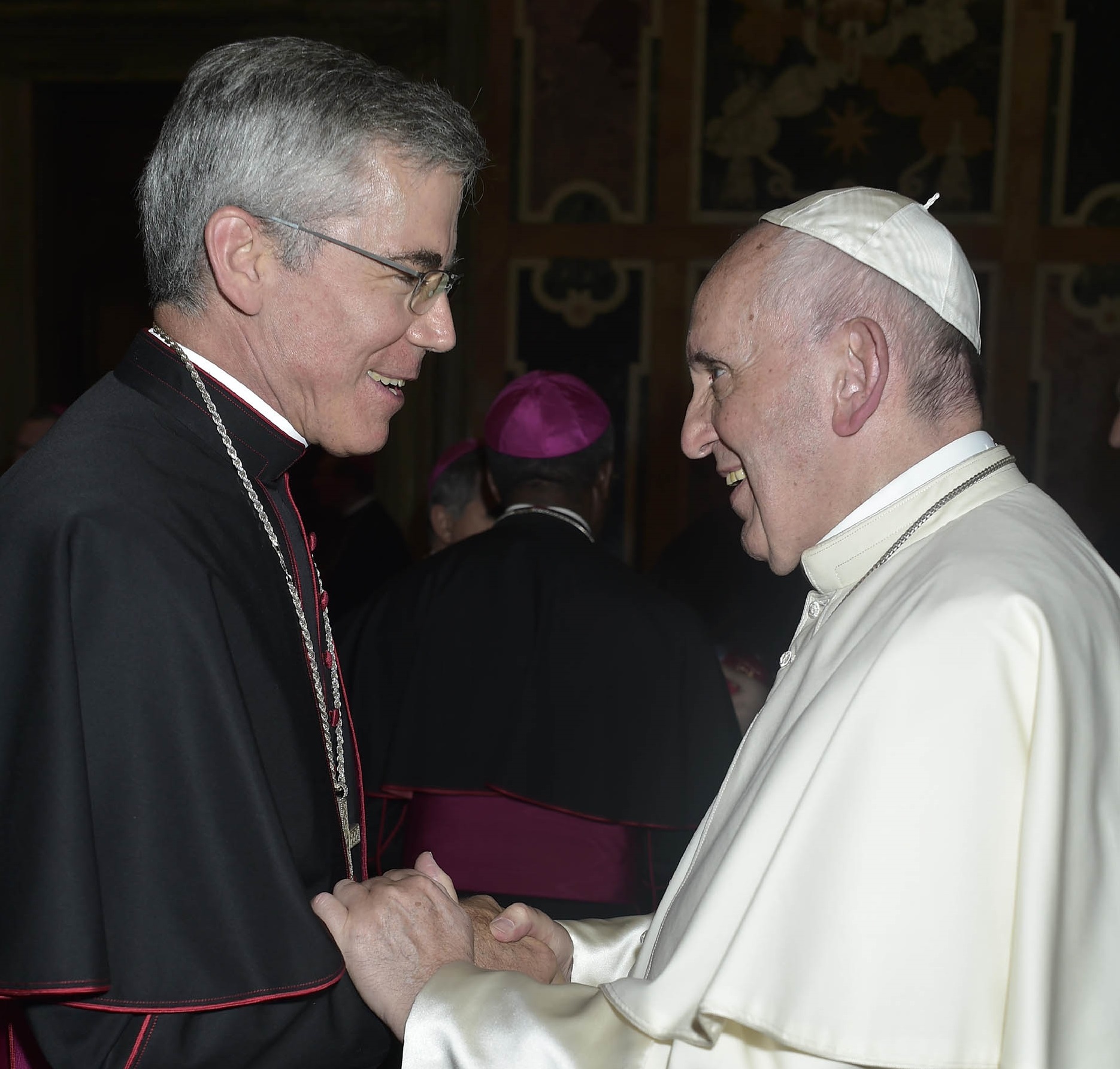
Thank you very much for the chance to speak with you and with the readers of The Tirana Times. I am really delighted to have this opportunity. As your readers know, the name “Apostolic Nuncio” simply refers to the Ambassador of the Holy See, which has its territorial base in the Vatican City State. So, as Ambassador, my priorities would be very similar to those of other Ambassadors, that is, to strengthen the ties which exist between the entity that I represent, that is, the Holy See under the authority of Pope Francis, and the country of Albania. And in that sense, I have a very pleasant job because the relationship between the Holy See and Albania is in excellent shape! As Nuncio, I also have the responsibility of acting as a link between the Holy See and the local Catholic Church here in Albania, which makes my position somewhat different from that of the other Ambassadors in Tirana. Pope Francis, as your readers surely know, has a special love for Albania, and I think that his affection for Albania is reciprocated in Albania’s love and respect for Pope Francis, which was very evident when he visited the country in September 2014. I will never forget my meeting with him soon after he had appointed me as Apostolic Nuncio to Albania. I met with him on 7 April 2017 and he impressed upon me his great affection for Albania, as well as his well-informed knowledge of the political situation here. One of the things he asked me to do as Nuncio was to go out of the Embassy as much as possible and get to know the people of Albania. I’ve been trying to do that since I arrived in Tirana last May.
Albania is well-known for its harmony between its various Muslim and Christian communities. What can the country do to promote these values more to the world at a time when they are needed?
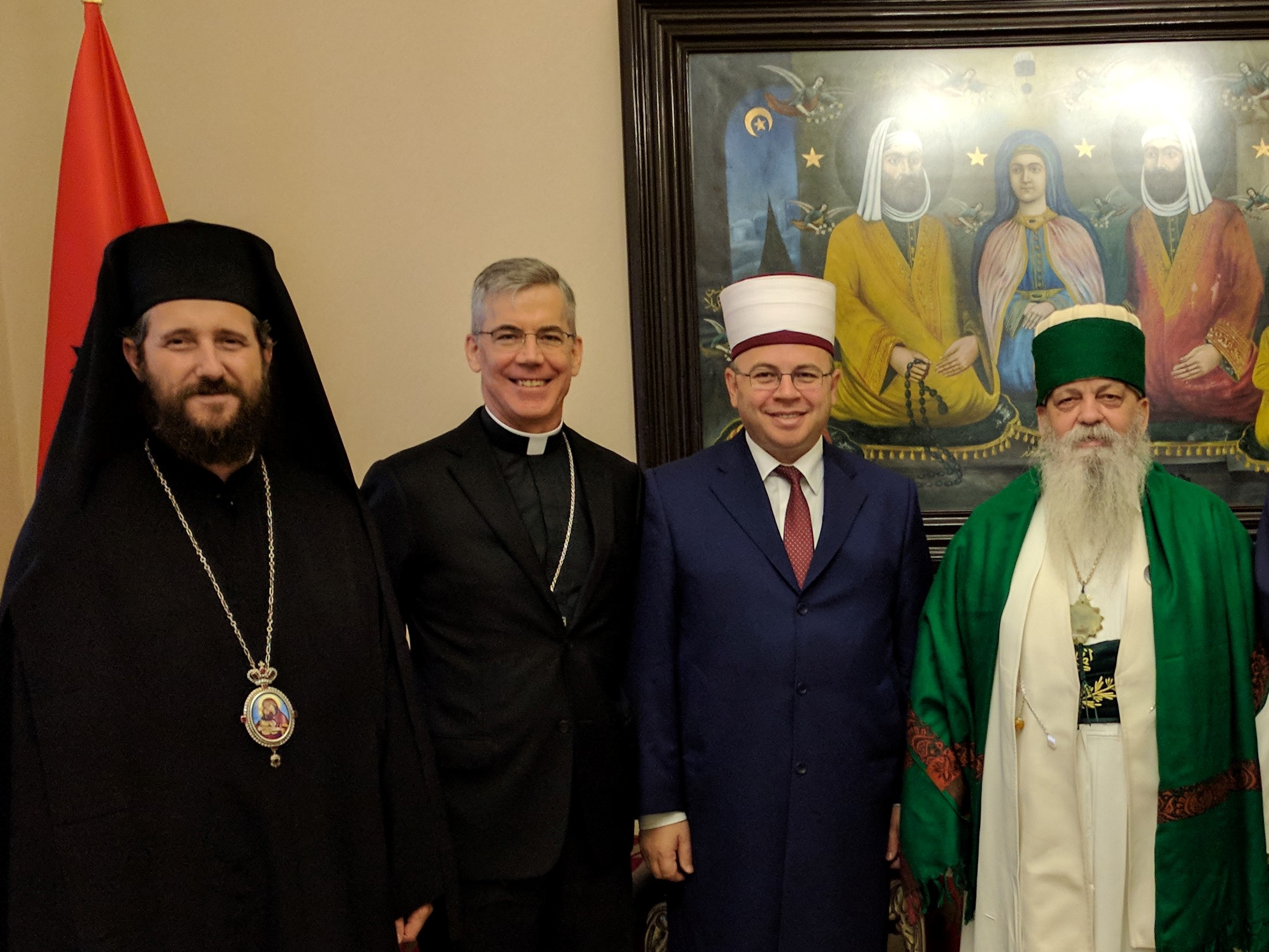
I think that the inter-religious harmony which exists in Albania is one of the greatest aspects of this country. In a world where we often see examples of distrust and even violence between people of different religions, Albania stands out as a place where followers of different religions do not simply coexist, but cooperate harmoniously with each other. It is well known that Albania has a high number of inter-faith marriages, so many Albanians trace their family roots to two or more religious traditions. Of course, one way to promote inter-religious harmony is through dialogue, communication and contacts between religious authorities from the various communities. I would certainly say that my experience of Albania in the seven months since I arrived has been of numerous contacts and healthy communication among the various religious leaders in Albania. The example of Albania in the area of inter-religious harmony is indeed a witness to the world of what can be possible.
This country also has a dark side in its history, when the communist state persecuted religious leaders and clerics and banned religion altogether. Has Albania done enough to educate the younger generation to remember this dark stain in its history to make sure it does not happen again?
There can be no doubt that part of the reason for the exemplary inter-religious harmony existing in Albania today is because all the religions were cruelly persecuted by the Marxist-Leninist regime that finally imploded in 1991. Muslim and Christian believers suffered together in prison and in other forms of internment. That common experience of atheistic persecution and suffering surely created a bond of unity and understanding among believers of the various religious traditions, which, thanks be to God, still exists today. From my relatively brief experience of living in Albania, my sense is that young people are indeed aware of the Communist past and, to some degree, are also aware of the persecution that people of religious faith endured in those very dark decades. At the same time, however, we must never tire in studying that period, and especially in studying the individual lives of the people who were persecuted for their religious faith in those times. It’s by being familiar with the lives of those who were persecuted that we can prevent the same thing from happening in the future. With regard to the Catholic Church, last year thirty-eight martyrs from the Communist period were beatified in Shkodà«r, which was a beautiful way of remembering their witness of faithfulness and integrity. Of the many crimes of Communism, perhaps the most characteristic one was the suppression of freedom of thought, freedom of conscience. People were told not only how they were supposed to live, but also how they were supposed to think. For Christians, freedom is a necessary precondition for faith, in the sense that faith, if it is to be authentic, needs to be free, a free personal response to the God who reveals himself to us in the person of Jesus. If religion is imposed or forced, then it is not really faith, precisely because it is not really free. This is why Pope Francis has often spoken out against “proselytism” which we would define as any form of illegitimately constraining people to accept a religion. But, in actual fact, in the modern world, there is a kind of secular proselytism, which seeks to impose a secular ideology, which seeks at times to marginalize or even to silence voices of faith. Pope Benedict spoke famously about the danger of a “dictatorship of relativism” . This is a danger in some places today, thankfully however not in Albania.
Were you familiar with Albania and Albanians before being assigned to the country? Pope Francis, in choosing Albania as the first European country to visit, said it was “on the margins” and needs more attention. It is a major change from your last posting in Ireland, is it not?
I must say that my knowledge of Albania before being named as Nuncio here was relatively superficial. A year ago, if someone had asked me about Albania and Albanians, perhaps one of the first things that would have come to my mind would have been the person of Mother Teresa of Calcutta, whom I had the great privilege of meeting many times in Rome and in other places. The second thing which would have come to my mind would have been the particular history of Albania in the twentieth century, with its unusually harsh form of Marxist-Leninism. Finally, as I am from the city of New York, mention of Albania would have called to my mind the Albanian diaspora community in New York, with whom I would have had some interaction. Having arrived in Albania in May, I have tried to learn as much as I can about the country, its history and its people, and I must say that in these first months, I have been extremely happy here in Albania. As you mentioned, I had spent a bit more than five years in Ireland before Pope Francis sent me to Albania. Ireland is a country with some similarities to Albania. Both are relatively small nations; both had been conquered and incorporated into large empires and only regained their national sovereignty in the first part of the last century; both have very large and influential diaspora communities, especially in the United States. Among the differences would be the fact that Ireland is a country in which a large majority identifies itself as Catholic, and it is a country in which the economy has made huge progress since the 1970’s, so that it is now a prosperous country where the GDP per capita is among the highest in the world.
Albania’s population is shrinking at an alarming rate, with high emigration and low birthrates. This is not just an Albanian problem, but some local Catholic clergy have been vocal on this issue. What can be done to reverse this trend? (Both to improve life here and to value it more.)
I grew up in America in the 1970’s, and I remember vividly how my father had a book called The Population Bomb, published in 1968, which contained all kinds of apocalyptic predictions of the disasters that were going to be caused by overpopulation in the world. It turned out that it was almost complete nonsense. Indeed, for many countries today, the problem is precisely the opposite: the drop in population. In the case of Albania and other countries of Europe, I firmly believe that those in positions of responsibility should do everything possible to counter this trend, by implementing child-friendly and family-friendly policies that will encourage parents to have more children. The loss of population through emigration is another issue, and a complex one. It is obvious that the great majority of people who emigrate from Albania do so for economic reasons and therefore the solution to population loss through emigration is the development of the economy in Albania. In that area, there has been real progress in recent years, but of course much remains to be done.
On a personal level, Your Excellency, you represent the Holy See, of course, but you are a New Yorker, an American by birth, and Albania is one of the most pro-American countries in the world. Do you think that will affect your work in Albania and dealing with the people of this country?
There’s no doubt that my American background is an asset for me here in Albania, because, as you say, Albania is a very pro-American country. There are indeed many Albanians in the United States, especially in New York where I was born, and also in Detroit, where my mother is from. I have been very well received during my seven months here in Albania. Having said that, however, my contact with my international colleagues in the Diplomatic Corps in Tirana has shown me how well all foreigners – and not just Americans! – are treated in Albania. There is a tradition of hospitality to strangers, to foreigners, which is very strong in this country. Indeed, it is said that for Albanians, there are no foreigners, but only guests. It is a quality that Albania should be extremely proud of, especially in a time of increasing xenophobia in many parts of the world.
Is there anything else you’d like to add?
Only that it is a particular pleasure for me to begin my diplomatic service in Albania in this commemorative year marking the 550th anniversary of the death of Gjergj Kastrioti Skanderbeg, which was recently inaugurated by Prime Minister Edi Rama. I am sure that this year will serve to increase awareness and appreciation of your great national hero, as Albania looks towards the future. The present moment in Albanian history is an important one, as your country seeks to move toward integration in the European Union, an objective that is greatly desired by the people of Albania. I feel very privileged to be representing Pope Francis in Albania at this time, and I have been immensely happy since arriving in your beautiful country last May. Allow me to conclude by wishing all the readers of The Tirana Times a merry Christmas and a happy, peaceful and prosperous New Year 2018!