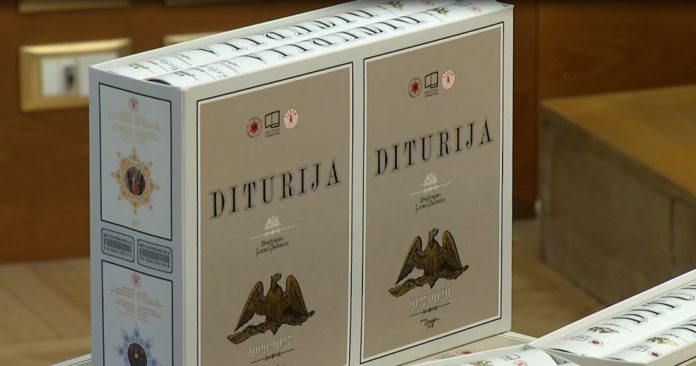
TIRANA, Oct. 18- On Nov. 14 until 22 of 1908 was held in the city of Manastir The conference for the standardization of the Albanian alphabet known as the Congress of Manastir was held on Nov. 14 until 22 of 1908.
Thus, Nov. 22 is the National Alphabet day for Albania and the diaspora.
On Jan. 1, 1909, ‘Diturija’ (knowledge) was published, a temporary magazine for Albanian literature and language. The establisher and publisher was Mid’hat Frasheri alias Lumo Skendo, the chairman of the Congress.
In the framework of the 110th anniversary of the Congress and the publishing of ‘Diturija’, the National Library decided to publish two compressed volumes of Frasheri’s magazine, which remains a heritage of high linguistic, cultural and literary values.
‘’Lumo Skendos’ ‘Diturija’ depicts the rare symbiosis of the notion of knowledge, learning, and the homeland universal one. It connects the individual with the entirety of national entity, through which one turns into ‘a person of the world’, the universal being,’’ said Persida Asllani, the director of the National Library.
The Congress of the Manastir affected the social-cultural situation in Albania in a quite positive way. Since Frasheri was the chairman of the Congress, the first article of the magazine’s first issue was written by him, and it was precisely accurate to be called ‘’History of Albanian writing.’’ the historiography is closely linked to this topic, as Frasheri won the right to keep using the Istanbul alphabet until the current Albanian one came to use. This is pointed out from an article Frasheri wrote for his newspaper ‘Liria’ (freedom), titled ‘’What we won from the Congress of Manastir’’, which was a compromise to use the Istanbul alphabet.
‘’Its information is compact, but the Congress isn’t mentioned, perhaps the article was written prior to the Congress, and with this baggage the author would go to the Congress, on the other hand the magazine was published that year using the Istanbul alphabet,’’ said researcher Xhevat Lloshi on the article ‘’History of Albanian writing.’’
It is noteworthy the background of Mid’hat Frasheri. He comes from the family of the famous Frasheris. His father was academic and statesman Abdyl Frasheri, his uncles were writers and poets Sami and Naim Frasheri. Coming from a family of intellectuals, and his uncles being a close influence towards the literary world, Mid’hat Frasheri was firstly engaged on the magazine ‘Kalendari Kombiar’ (National Calendar). When Sultan Abdul Hamid II declared a constitution in 1908, Skendo published the newspaper ‘Liria’ on July of that year in Ioannina, with various nationalistic articles, and later on started working on ‘Diturija’, which was published first on the same city.
‘’Like everywhere the publishing of the newspaper marks an important event for the economic, political and cultural life. Lumo exploited that entirely for establishing Albanian schools and clubs. This constituted a grand obligation at the time,’’ said historian Luan Malltezi. He also added that the works in ‘Diturija’ has a large composition of research and political articles with a high importance even nowadays.
On the context of the history of Albanian press, Skendo’s ‘Diturija’ is one of the most significant works at the time, which together with other magazines established the Albanian press and left a cultural and historic legacy. Other magazines were ‘Albanesi d’Italia’ from Jeronim De Rada, ‘Albania’ of Faik Konica, ‘Hylli i Drites’ of At Gjergj Fishta, etc. An importance was noted to the literature-press symbiosis, their allegiance and hindrances. Publicistic articles directly communicate with readers, whereas literature uses metaphorical figures. As journalism and literature in many instances have obstructed one-another from full development, they did coexist and influenced one-another, however, and this phenomenon is an attribute of Albanian culture. Researcher Mark Marku says that the literature reader was formed from the journalistic tastes, which also shaped his/her tastes and competence in analysis.
‘’The history of Albania is a sort of ideologized sociology, our studies for Albanian literature and culture have skipped the role of the press in literature’s institutionalization, as the tomb of what is called national spirit. This bypass is harmful, because the press has played an important role in literature’s affirmation and the case of ‘Diturija’ is rather significant,’’ said Mark Marku.
He also added on the diversity of ‘Diturija’ not simply confined on the range of a magazine, but also as a cultural club, academy, Albanologic and geopolitical institution, Museum etc. Researcher Uran Butka added that the publishing of the two volumes will have a significance in learning more on the figure of Lumo Skendo.