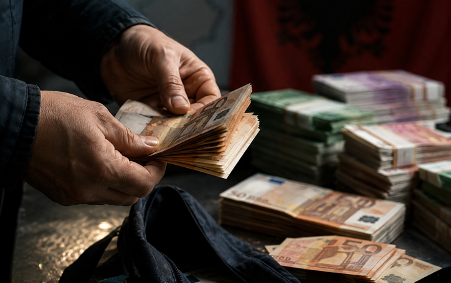
TIRANA, June 26- About 25 million euros are planned to be granted as loans by “Agrocredit” rural and suburban areas over the next three years. “Agrocredit” is a microfinance institution owned by the Albanian government, formerly known as First Financial Society Development FAF, which has changed its name to better understand its mission.
Its general manager Emin Barci, said that through this fund it is intended to help 8-9 thousand new clients in the field of agriculture, livestock, products processing, agro tourism, tourism and fishing. The company underwent a deep reorganization of its structures a year ago, which consisted in aligning the lending procedures with the company structure, as a new product card in line with the needs of agriculture, agrotourism and all funding schemes is being prepared. Barci claims that this reorganization is expected to reduce overdue loans of over 30 days by 10 percent by the end of this year, from over 30 percent at the end of 2018. He adds that all loans disbursed in the last 14 months are standard, with no day lag. The return on equity is expected to reach 17 percent, above the average level of the banking system.
“Our challenge is to disburse 25 million euros without asking the owner for extra money and without having to borrow any extras, for some 8500 clients. The goal is that the average credit be somewhere to 3 thousand euros,” said Barci. Yet, as this is a financial non-banking institution, the loan interest rate ranges from 15 to 30 percent, effective in lek.
In an interview Barci said that “Agrocredit” has two missions, a social and a financial one. The social mission aims to create opportunities for 365 thousand agricultural and livestock farms, and create access to over 50 thousand other operators in rural and suburban areas to the money and capital markets. The financial mission is for the company not to create losses but a reasonable profit. “Only through this we can help as much as possible, aiming for the small enterprises to become medium, and for medium to become large, and having an impact on their well-being and steady growth,” added Barci.
And as agricultural exports amounted to 300 million euros in 2018 and it is the highest contributor to the GDP by about 20 percent, the highest in the region, agriculture is the least paid sector of the Albanian economy. An employee in agriculture is paid on average under 290 euros, almost 30 percent less than the average salary of the country. Nevertheless, according to World Bank data about 40.2 percent of the workforce belonged to the agriculture sector, with a deep margin with the countries in the region. In Bosnia and Herzegovina, labor force in the agricultural sector was about 19.2 percent, while in Serbia 19 percent. In Macedonia, employees in agriculture accounted for about 16.4 percent of the workforce, while Montenegro recorded the lowest percentage with only 7.6 percent of the employed in the agricultural sector. These countries also pay a salary of over 450 euros, where the highest average salary is in Montenegro with 766 euros.
Regardless of the high employees in the sector, they are deemed unproductive, as compared to the regional countries, the added value for every employee in the economy is smaller. Compared to Montenegro, which had the lowest percentage of employees in this sector in the Western Balkans region, the value added in Albania is five times smaller, according to World Bank data. For 2017, the value added in agriculture for every Albanian employee was about 5400 dollars, in Bosnia and Herzegovina, the added value is estimated at 5800 dollars, in Serbia about 6000 dollars, in Macedonia about 8200 dollars. While Montenegro stands at the top with an added value of 25 thousand dollars.
Albanian agriculture still suffers from fragmentation of agricultural land, where the farmer finds it difficult to create economies of scale. At the same time, the agricultural sector has also suffered from a lack of sustainable policies to boost the sector’s development. Farmers continue to sow unorganized and are not oriented to the regional market or beyond.