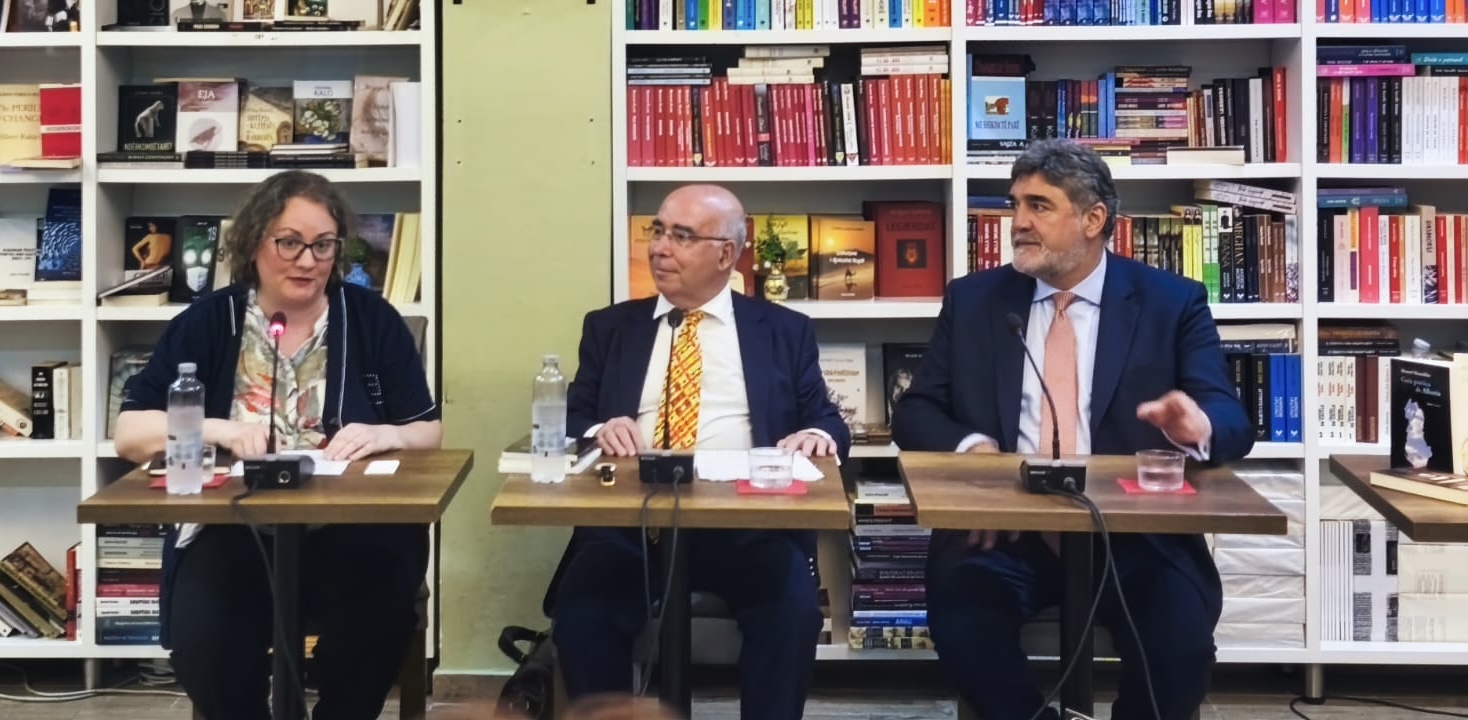
Tirana Times, July 02, 2026. The Albanian Institute for International Studies and Tirana Times book house hosted a special literary evening in Tirana with Ambassador Manuel Montobbio, diplomat, writer, poet and academic, offering a rare encounter between diplomacy, literature and Albania’s own search for memory, identity and soul.
Held at the premises of Tirana Times, the event, titled “Soul of Albania: A Literary Approach,” brought together writers, readers, diplomats, academics, friends of Montobbio and admirers of his work. It marked the return to Tirana of a figure who occupies a special place in Albania and Spain relations: Spain’s first resident ambassador to Albania, serving from July 2006 to January 2011, and one of the most thoughtful foreign literary voices to have reflected on Albania’s contemporary experience.
Montobbio’s return to Tirana came in the context of the 40th anniversary of the reestablishment of diplomatic relations between Albania and Spain, to which he contributed through the academic conference organized by AIIS. But this second gathering turned toward literature, poetry and art, toward Albania not only as a subject of diplomacy, but as a country of symbols, wounds, memories, myths and inner landscapes.
Speaking to Tirana Times, Albert Rakipi, Chairman of AIIS, described Montobbio as “a rare case in which a talented diplomat, a poet and a political scientist come together in one person.”
“It was a pleasure to welcome Manuel Montobbio back to Tirana,” Rakipi said. “He was not only one of the main contributors to the academic conference on the 40th anniversary of the reestablishment of Albania and Spain relations, but also the protagonist of this beautiful event dedicated to literature and art. It seems that he has a special love for Albania and Tirana.”
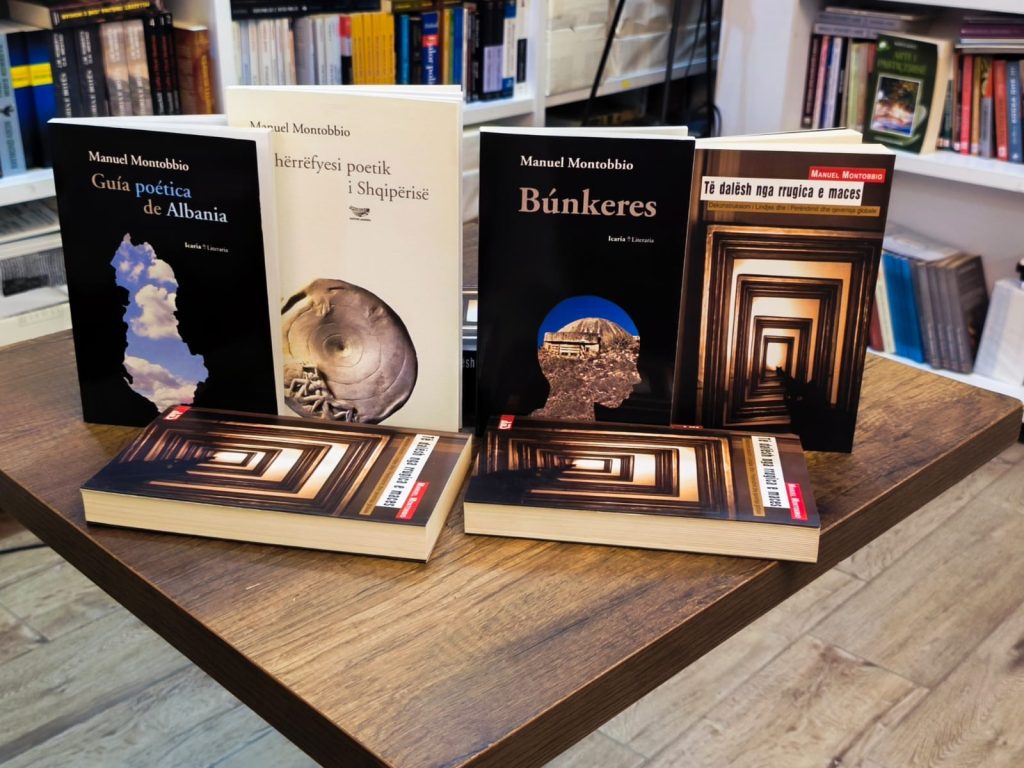
That love has taken literary form. Montobbio’s Albanian experience produced two important works: “Guía poética de Albania,” published in Albanian as “Udhërrëfyesi poetik i Shqipërisë” and in English as “Poetic Guide to Albania,” and “Búnkeres,” in English “Bunkers,” a poetic and reflective exploration of Albania’s totalitarian past, its transition and its deeper collective imagination. AIIS has also published in Albanian his essay “Të dalësh nga rrugica e Maces: Dekonstruksioni i Lindjes dhe i Perëndimit dhe qeverisja globale,” in English “Leaving Cat Alley: The Deconstruction of East and West and Global Governance.”
The evening was introduced by the Ambassador of Spain, H.E. Gabriel Cremades, and AIIS Director Alba Cela. Montobbio then invited the audience into what he described as a journey in search of the soul, universal, collective and personal. He reflected on art and literature as privileged ways of approaching that elusive inner dimension, and on literary creation as a space where lived experience is transformed into meaning.
His presentation moved naturally between life, literature and diplomacy. For Montobbio, diplomacy is not only the representation of one state before another. It is also an encounter with the other, with another society, another history and another imagination. Literature, in this sense, becomes a deeper form of dialogue. It allows the diplomat who has lived in a country to return to it not through official language, but through images, symbols, memories and inner echoes.
From this perspective, Montobbio invited the audience on a journey in search of the soul of Albania through “Poetic Guide to Albania” and “Bunkers.” These two works, born from his years in Tirana, are not conventional books about Albania. They are literary explorations of a country seen through experience, affection, reflection and poetic intuition.
In “Poetic Guide to Albania,” Montobbio presents Albania as both an outer and inner journey. It is a journey to Albania, to life and to oneself, in time and space, moving from the outside to the inside and from the particular to the universal. Through the poetic transformation of lived experience, the book seeks to approach the essence and soul of Albania, its drama, its myths and its symbolic universe.
The work is structured in five stages, or long poems: “Guide to Albania,” “Tirana,” “Bunkers,” “Women Men,” and “Skies of Albania,” the latter composed of moons, winds, clouds and sun. Montobbio described this structure as a kind of symphony in five movements, one that enters the defining experiences of contemporary Albania and its collective touchstones. At the same time, the book opens onto broader human questions: how we travel through life, how we search for our essence, how we become what we can be, and how the return to Ithaca may lie within the journey itself.
In this literary geography, Tirana is more than a capital city. It becomes a place of encounter, a living space where history, everyday life, memory and aspiration coexist. Albania’s skies, winds and moons become part of an inner landscape. The country appears not only through its political history or visible landmarks, but through the atmosphere it leaves in the soul of the person who has lived it deeply.
In “Bunkers,” the symbolic force of Albania’s recent past becomes even more direct. The bunker is, for Montobbio, a word, an image, a poem, a story and an essay. It is also a river that carries the reader on a journey from the bunkers outside to the bunkers within us, from their construction to their deconstruction, from the full development of total power under Enver Hoxha’s regime to its collapse, and from collapse to oblivion, flight, destruction, reconstruction and the foundation of a new society.
But “Bunkers” is not only a meditation on Albania’s communist past. It is also a reflection on power, freedom and the human condition. The bunker becomes a metaphor for fear, isolation, control and survival, but also for the possibility of opening, transformation and liberation. In Montobbio’s literary approach, Albania’s bunkers speak about a regime and a country, but also about the questions that human beings ask in every time and place: about power and its temptations, about freedom and its cost, about memory and forgetting, about the visible and invisible walls that societies and individuals build around themselves.
Montobbio presented “Bunkers” as part of the poetic world of “Poetic Guide to Albania,” but also as a dialogue with it. It is a poem and an essay at the same time, a reflection on Albania’s contemporary history, on the mentality and mechanisms of totalitarian power, and on the epic of Albania’s transformation. Its originality lies precisely in this combination of reason and heart, analysis and emotion, political science and poetry.
One of the most delicate moments of Montobbio’s presentation came when he referred to the idea, inspired by Seferi’s poem, that a soul can fully exist only in the mirror of another soul. In that spirit, he described his Albanian books as the literary processing of the reflection of Albania’s soul in his own soul. They were, he suggested, a return for the besa he received while living in Albania. They are also a mirror in which one may search not only for the soul of Albania, but also for the universal soul and for one’s own.
Toward the end of his presentation, Montobbio placed his Albanian works within the wider architecture of his literary and intellectual life. He described his writing as developing along three main axes: his academic books, his poetry, and the gradual formation of his literary voice and self. Within this broader path, “Poetic Guide to Albania” played a crucial role in the evolution of his poetry and in the creation of a poetic world structured as a poetic geography. “Bunkers,” in turn, became central to his search for a literary voice capable of joining memory, history, reflection and inner experience.
This made the Tirana event not only a presentation of books about Albania, but also a meditation on how Albania shaped the author himself. Montobbio did not speak about the country as an external observer. He spoke as someone whose encounter with Albania became part of his own literary identity.
A particularly moving moment of the evening came when Lorida Demiraqi, one of the Albanian translators of “Poetic Guide to Albania”, recited excerpts from the poems “Tirana” and “Búnkeres” in Albanian. The reading brought Montobbio’s literary Albania back into the language of the country that inspired it, creating a dialogue between the author’s Spanish poetic imagination and the Albanian voice that received and reinterpreted it.
The event concluded with a conversation with the audience, in which literature, diplomacy and personal memory came together in a warm exchange. For many participants, the evening was not only a literary gathering, but a reminder that Albania can be read not only through politics and history, but also through poetry, metaphor and the inner traces it leaves in those who have known it closely.
Born in Barcelona in 1962, Manuel Montobbio is Doctor in Political Science by the Autonomous University of Barcelona and Master in Advanced European Studies from the College of Europe (Bruges, Belgium) and in Law and Economics by the University of Barcelona. A career diplomat since 1987, he has served in San Salvador, Jakarta, Mexico, Guatemala, Tirana, Andorra, Strasbourg to the Council of Europe, Paris to the OECD and currently as Ambassador of Spain in Helsinki. His diplomatic work has focused on peacebuilding, political transitions, development cooperation, European integration and international organizations. In parallel, he has developed a substantial academic and literary career, writing essays and poetry on peace processes, global governance, intercultural relations, diplomacy and the inner geography of human experience.
For Tirana, Montobbio’s return was more than a cultural event. It was a reminder that Albania has inspired not only diplomatic reports and political analyses, but also poetry, and that its history, landscapes and contradictions continue to resonate in the imagination of those who have lived here deeply enough to turn experience into literature.