The provisional closure of three negotiating chapters represents an important milestone for Albania. Yet the Brussels conference also showed that the country’s further progress will depend on difficult reforms concerning the rule of law, environmental protection and the implementation of European standards.
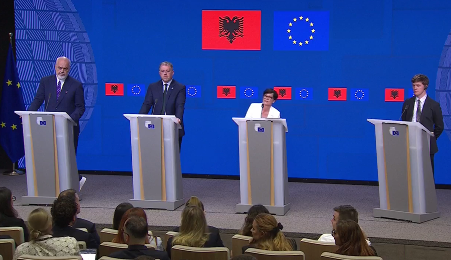
Tirana Times, July 16, 2026 – Albania provisionally closed its first three negotiating chapters with the European Union on July 14, marking the country’s first formal chapter closures since accession negotiations began.
During the ninth Intergovernmental Conference between Albania and the EU, member states agreed to close Chapter 25 on science and research, Chapter 26 on education and culture, and Chapter 30 on external relations.
The decision means that Albania is considered sufficiently aligned with the European Union in these areas. However, the closures remain provisional. Chapters can be reopened if European legislation changes or if Albania fails to maintain the required standards.
The development formed part of what Enlargement Commissioner Marta Kos described as a “Super Tuesday” for enlargement. Four accession conferences involving Albania, Montenegro, Ukraine and Moldova were held on the same day, the highest number in more than two decades.
For Albania, the chapter closures carry considerable political and symbolic importance. After years of delays, bilateral obstacles and doubts among some EU member states, the government can now point to a measurable result in the accession process.
Prime Minister Edi Rama described the decision as another major milestone in Albania’s path towards membership.
“What happened today truly marks another important milestone in Albania’s irreversible journey towards the European Union,” Rama said in Brussels.
“It is a clear recognition that Albania is moving forward, that reforms are producing results and that our country is increasingly prepared to assume the responsibilities of membership.”
Foreign Minister Ferit Hoxha presented the milestone as part of what Ferit Hoxha presented the milestone as part of what he called an “extraordinary journey,” emphasising the rapid progress made during the past two years.
In a post on X, Hoxha recalled that Albania had not opened any negotiating chapters on October 14, 2024. By November 17, 2025, all 33 chapters had been opened.
He also referred to May 26, 2026, when Albania became the first negotiating country to receive the Interim Benchmark Assessment Report under the EU’s revised enlargement methodology. According to Hoxha, the closure of the first three chapters on July 14 marked Albania’s entry into the final phase of negotiations.
“What looks like dates on a timeline are in fact milestones that reflect an extraordinary transformation, the result of hard work, genuine and continued institutional commitment, strong determination and unwavering political will,” Hoxha said.
“When ambition is matched with delivery, progress becomes possible, visible, measurable, real. The enlargement wall is changing again.”
The statements by Rama and Hoxha reflect the government’s broader argument that Albania has moved from a prolonged preparatory period into an accelerated and results oriented phase of accession.
There is substance to this assessment. Closing any chapter requires the agreement of all EU member states. The Brussels decision therefore shows that no member state was prepared to block Albania at this stage.
Nevertheless, the importance of the three closures should not be exaggerated.
Chapters 25 and 26 are traditionally among the less difficult areas of accession negotiations. They contain fewer demanding legislative and institutional obligations than chapters dealing with justice, fundamental rights, competition, public procurement, agriculture or the environment.
Chapter 30 carries greater political importance because it concerns external relations and international commitments. Albania’s high level of alignment with the EU’s foreign and security policy has strengthened its position in Brussels, particularly following Russia’s invasion of Ukraine.
However, geopolitical alignment cannot replace the domestic reforms that will determine whether Albania can close the remaining chapters.
Commissioner Kos congratulated Albania but also called on the government to maintain the momentum of reforms.
“We rely on Albania to continue and to persist with reforms,” she said, adding that she would stand by the country until the end of her mandate.
Thomas Byrne, Ireland’s minister responsible for European affairs, described the conference as part of a “Super Tuesday for enlargement” and encouraged Albania to continue its work on core reforms.
The German Embassy also welcomed the closure of the chapters as a historic moment. At the same time, it stressed the need for concrete and sustainable progress, particularly in the Fundamentals area.
The message from Brussels was therefore supportive but conditional. Albania’s achievement was recognised, but it did not represent a general endorsement of all government policies.
Zvërnec enters the European debate.
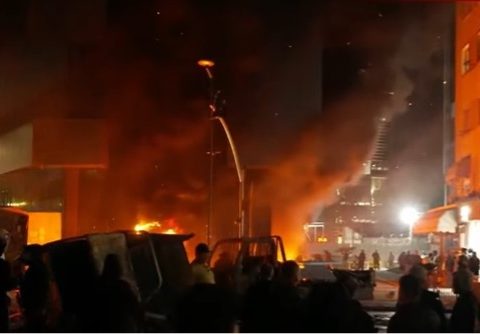
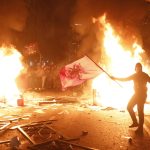
The conference also brought one of Albania’s most controversial domestic issues into the European discussion, the proposed development project in the Zvërnec area and the protests opposing it.
Asked whether the project and the protests could affect Albania’s accession process, Rama said the European Commission was fully informed and that the project had not yet been finalised.
“The Commission is on top of everything and is very well informed, based on facts,” Rama said.
“The project cannot be seen anywhere because it has not been finalised. The environmental impact assessment is under way.”
“For us, the rulebook consists of the membership standards and the standards of the European Commission. There is nothing to worry about. We will deliver a project that will be a source of pride for Albania and Europe. That is my ambition.”
Kos made clear that environmental protection is an integral part of the accession criteria and that Albania must fully align its legislation with EU standards.
“Environmental protection is part of the criteria for EU membership,” Kos said.
“Before the protests started, we had agreed with the Albanian government that the 2024 amendments concerning protected areas and strategic investments should be repealed.”
Kos described Chapter 27, which covers the environment and climate change, as one of the most demanding chapters in the accession process. She said the matter went beyond the immediate controversy surrounding Zvërnec and concerned Albania’s broader obligation to harmonise its legislation.
“We are certain that nothing will happen in this field that is not aligned with European legislation,” she said.
Rama confirmed that the government was preparing to repeal the law on strategic investments, arguing that it had already fulfilled its purpose.
“We need to repeal the law on strategic investments because this law has completed its mission,” Rama said.
On the legislation concerning protected areas, however, the prime minister rejected the idea of repealing the entire law.
“The protected areas law is one of the best laws we have, and we have worked very hard on it,” Rama said.
“We need to address specific parts that must be in full compliance with the European Union, and we are working on this together with the Commission.”
The exchange between Rama and Kos was politically significant. It demonstrated that the accession process is increasingly intersecting with specific domestic legislation, investment projects and public controversies.
It also showed that closing three chapters does not remove the European Commission’s ability to demand changes in other areas.
The hardest chapters remain.
The government aims to close ten chapters during 2026 and complete the closure of all chapters by the end of 2027. This is an ambitious political objective, but achieving it will depend on the agreement of all 27 member states and on Albania’s performance in the most difficult reform areas.
The Fundamentals cluster will remain decisive. It covers the judiciary, fundamental rights, justice, security, public procurement, statistics and financial control. Progress in these areas determines the overall pace of negotiations.
Chapter 27 will also present major challenges. Environmental legislation, biodiversity, waste management, water quality and climate policy require substantial investment and strong enforcement capacity.
The controversy surrounding Zvërnec may therefore become an early test of how Albania balances economic development with its obligations under European environmental standards.
Critics argue that the first three closures were largely procedural and that the most demanding negotiations have only begun. Supporters of the government respond that even comparatively straightforward chapters cannot be closed without unanimous approval from EU member states.
Both assessments contain an element of truth.
July 14 marked a legitimate diplomatic achievement for Albania. It demonstrated that measurable progress in the accession process is possible.
Yet provisional closure is not equivalent to membership. Albania’s progress will ultimately be judged by implementation, institutional independence and the credibility of its reforms.
The first three chapters have been closed. The more difficult negotiations over justice, governance and the environment now lie ahead.