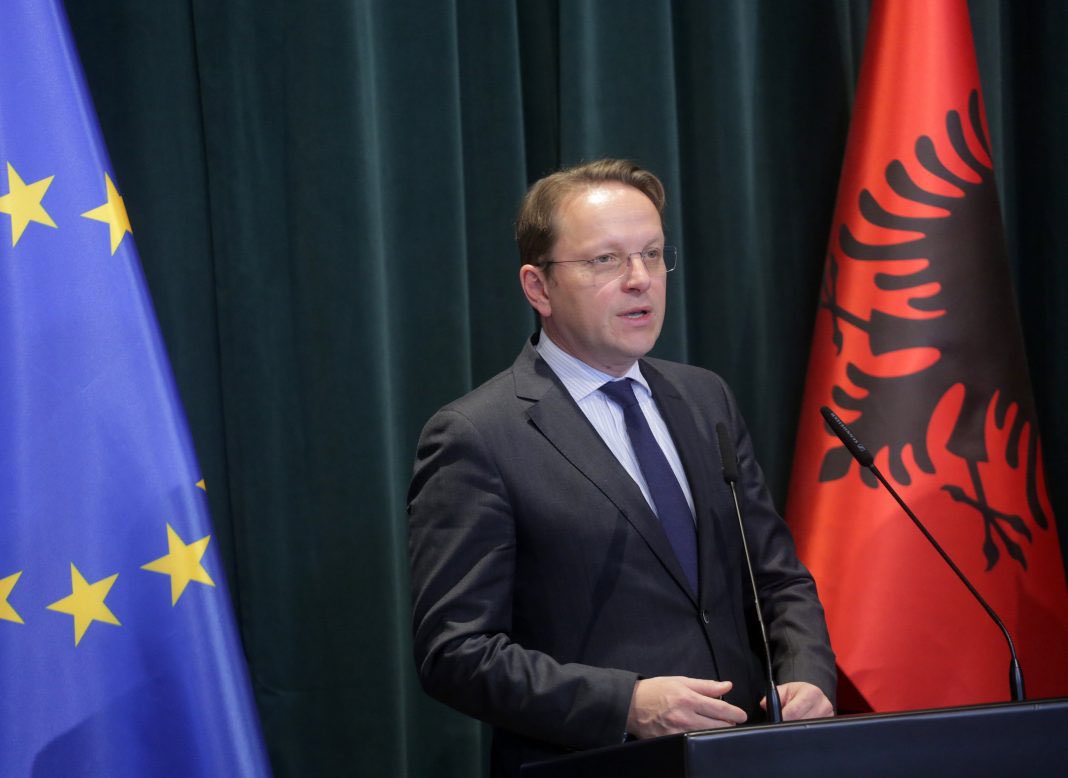
The decoupling of the EU accession process of Albania and North Macedonia, might be an option. This was declared by the European Commissioner for Neighbourhood and Enlargement, Oliver Varhelyi, during an Euronews interview.
The Commissioner said that ‘’If we run into difficulties again with North Macedonia, which means that we are unsuccessful in convincing Bulgaria and North-Macedonia to come to a mutually agreeable solution, then the question will emerge whether we can move forward with Albania only. And we will have to consider that question.’’ Asked by Euronews’ Sándor Zsíros if decoupling could be an option, the Commissioner answered in the affirmative.
This would be a surprising move because the European Commission continuously has maintained its position that the EU Integration Process of Albania and North Macedonia is closely connected and none of the two Western Balkans countries should be left behind. But the recent problems in the Bulgaria – North Macedonia relations seem to have made the European Commission rethink the issue.
Bulgaria has threatened to veto North Macedonia’s start of membership negotiations. Bulgaria wants to scrap from the EU negotiating framework the use of the term ‘Macedonian language’, which despite being recognized by the UN in 1977, Bulgaria still insists is just a dialect of the Bulgarian language. Bulgaria would like to see the use of the formulation, “the language according to the Constitution” of North Macedonia, which has been used since 1999 strictly in bilateral documents between the two countries.
Bulgaria also insists that North Macedonia should accept Sofia’s views on certain parts of the two countries’ shared history, most notably the alleged Bulgarian origin of the Ottoman era revolutionary Goce Delcev, who is celebrated as a national hero in both countries.
Sofia also insists that there is no Macedonian minority in Bulgaria and would like to see Skopje explicitly renounce its existence.
Albania and North Macedonia opened accession talks with the European Union in March 2020 after a much debated refusal by France and the Netherlands in October 2019. Since then, both countries are waiting for the first inter-governmental conference.